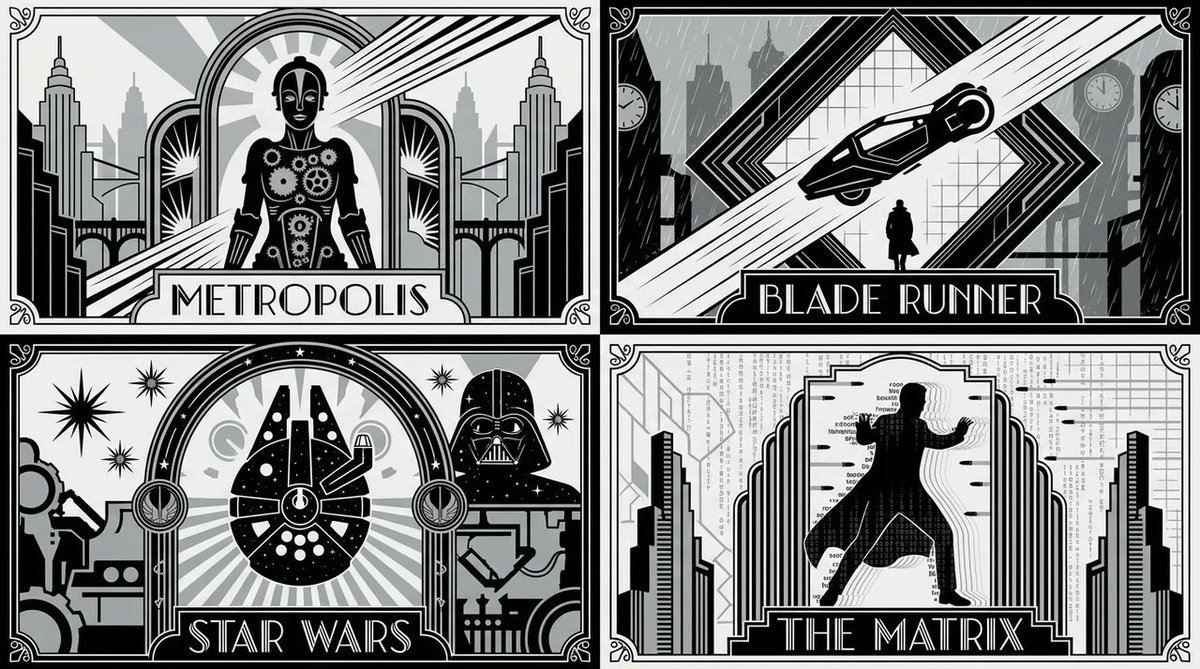
2x2 网格,16:9,为 4 部著名科幻电影执行此操作:{instructions: A = { $ SUBJECT 的轮廓与关键内…
分享链接 · https://openimages.ajiang.me/p/2075790685278543966/
color_palette · monochromecomposition · multi-panelquality_flags · embedded-textsubject_type · architecture-interiorsubject_type · charactersubject_type · graphic-design
提示词(原文,逐字保留)
2x2 grid, 16:9, do this for 4 famous scifi movies: {instructions: A = { silhouette and key internal features of $ SUBJECT, vectorized into black/white forms }
B = { deco ornamentation library: arches, stepped towers, vertical ribs, sunburst panels, circular medallions, chevrons, geometric grids }
C = { background metropolis: tall towers, bridges, arches, clock faces, abstract machinery }
D = { motion graphics: diagonal speed lines, fan rays, stepped echoes, theatrical silhouettes }
POSTER = (A ∩ subject_layer) ∪ (B ∩ ornamental_overlay) ∪ (C ∩ background_field) ∪ (D ∩ dynamic_layer) ∪ (ornamental_border)
Where:
- A is placed centrally, scaled to 70% of canvas.
- B elements are placed along the principal axes of A (symmetry axes, high‑curvature boundaries) by a space‑filling algorithm that respects a semi‑symmetrical grid.
- C fills the remaining canvas, its architectural shapes chosen to echo the angular frequency of A's silhouette (e.g., a curved subject spawns more arches, an angular subject spawns more stepped towers).
- D lines originate from the subject's action focal points, their direction and density derived from the pose vector.
- All elements strictly black, white, or limited 10% grey.}
中文译文
2x2 网格,16:9,为 4 部著名科幻电影执行此操作:{instructions: A = { $ SUBJECT 的轮廓与关键内部特征,矢量化成黑白形态 }
B = { 装饰图案素材库:拱门、阶梯塔、垂直肋条、太阳放射板、圆形徽章、人字纹、几何网格 }
C = { 背景大都市:高塔、桥梁、拱门、钟面、抽象机械 }
D = { 动态图形:对角速度线、扇形放射、阶梯回声、戏剧化剪影 }
POSTER = (A ∩ subject_layer) ∪ (B ∩ ornamental_overlay) ∪ (C ∩ background_field) ∪ (D ∩ dynamic_layer) ∪ (ornamental_border)
其中:
- A 居中放置,缩放为画布的 70%。
- B 元素沿 A 的主轴(对称轴、高曲率边界)放置,通过遵循半对称网格的填充算法布置。
- C 填充画布的剩余空间,其建筑形态的选择旨在呼应 A 轮廓的角度频率(例如,曲线主体衍生更多拱门,棱角主体衍生更多阶梯塔)。
- D 线从主体的动作焦点发出,其方向与密度由姿态向量导出。
- 所有元素严格为黑、白,或限制在 10% 灰度。}
来源与署名
原文由 @Gdgtify 发布在 X:查看原推文。 本页逐字保留原文并提供机器翻译的中文解读;版权归原作者所有。
同工具的更多提示词
- 仅将我的参考图像用于面部身份和面部特征。生成一张超写实的生活方式肖像,呈现同一位女性,保持完全一致的面部结构、表情、发型和自然美感。她站在现代屋顶露台的户外黄…@weiinberg
- 这是你该去计划一次野餐的信号。 Nano Banana 2 on @TapNow_AI prompt 一位美丽的年轻东亚女性仰面躺在一块柔软的浅粉色碎花野餐垫…@Just_sharon7
- 1.. 一位风格化的 3D 动画年轻女性,倚靠在一面由分层开裂漆面面板构成的纹理抽象墙前,墙面色调为温暖的渐变色——黄色、珊瑚色、粉色、红色与柔和的紫色。 她…@iamsofiaijaz
- 无缝融合 Gemini nano 香蕉 🍌 提示词 ⤵️ 超细、半写实、绘画风格插图,以柔软石墨素描为基底,与精致数字绘画无缝融合,特点是瓷器般的亮肤渲染,极…@HustleXR
- 请为阅读和搜索翻译此源提示词。请调用一次translate_prompt。保留URL、JSON键、命令标志、括号、占位符、代码和参数值原内容。不要总结或添加注…@Gdgtify
- 使用 Gemini Nano Banana 2 在 @GeminiApp 上创作 提示词 👇 一位三十出头、相貌英俊的男子,神情严肃而沉思,微微眯着眼,目光强…@pictsbyai