要让一个微小的主体显得宏伟,让排版来承载尺度。
分享链接 · https://openimages.ajiang.me/p/2104140609258672303/
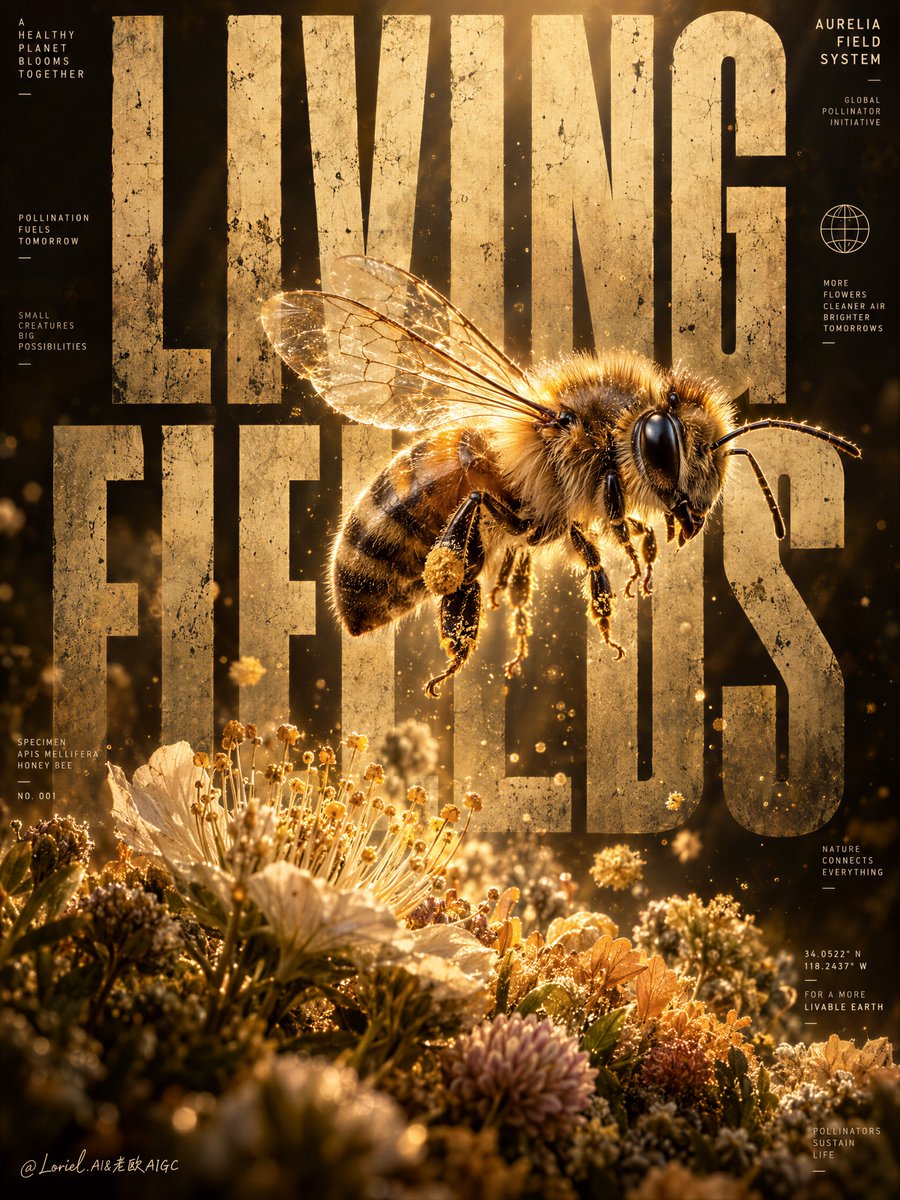
camera_lens · macrocolor_palette · warm-tonescomposition · centeredcomposition · extreme-close-uplighting · golden-hourquality_flags · typography-heavy
提示词(原文,逐字保留)
To make a small subject feel monumental, let typography carry the scale.
🪿 Build one or two oversized, weathered words as a vertical wall behind the bee; treat the letters as physical mass.
Before the text is read, it makes the insect feel like the central force of a much larger world.
🌿 Keep the bee sharply lit in mid-air, compress the flora into one glowing lower field, and leave the upper background dark.
The eye moves from title mass to wings to pollen-rich ground without losing the subject.
GPT- image 2.5 prompt👇
Create the definitive Orbit + Transit + Port final poster for the fictional international ecological design campaign AURELIA FIELD SYSTEM. Preserve the exact editorial architecture of the reference, but refine it into a sharper, rarer, more collectible campaign key visual with stronger bee centrality, stricter typography hierarchy, cleaner scientific micro-system, and more sacred atmospheric depth. Keep the same essential structure: one monumental macro bee suspended mid-flight near the center-right, giant distressed block typography occupying most of the poster height behind and around the insect, a dense glowing flora mass in the lower field, floating pollen and particulate atmosphere throughout, and a restrained system of tiny scientific-editorial markers along the edges. The final result must feel like a museum-grade biodiversity manifesto and a premium environmental campaign where the bee is the unquestioned hero.
The composition must be vertical, severe, and instantly readable from a distance. One massive oversized English word system in tall weathered condensed letters fills almost the entire poster surface, acting as architectural structure rather than simple title. The wording must be entirely newly invented in English only, built from one or two commanding concepts related to pollination, field intelligence, survival, or living systems, without copying the source text. The letters must feel mineral, worn, dusty, and deeply integrated into the atmosphere, with the bee and lower vegetation cutting across them to create strong spatial layering. The typography reads first as mass, second as language.
The absolute hero is one extraordinary honeybee rendered in extreme macro photorealism, suspended in a believable mid-flight state at the center-right of the composition. It must dominate the emotional read through anatomical precision, luminous wing transparency, tactile thorax fur, and exact body structure. Treat the bee as a sacred protagonist, not an insect specimen. Show dense golden-brown body hair, striped abdomen, finely articulated legs, realistic antennae, translucent veined wings catching warm backlight, and a polished dark compound eye with sharp reflection. The flight pose should suggest hovering arrival above the plants, with the legs naturally suspended and the body slightly angled. The bee must feel biologically exact, reverent, and irreplaceable.
The lower third of the frame must become a glowing ecological ground mass: dense pollen-rich blossoms, illuminated seed heads, textured moss-like clusters, wildflower structures, and botanical forms with strong tactile specificity. It should read like a micro-landscape of nourishment and ecological interdependence rather than a decorative meadow. The plants must be lit with warm ember-like light, with select pollen filaments and bloom textures catching glow so the lower field feels alive and precious. This flora mass supports the bee, but the bee remains dominant.
The environment is a dark amber atmospheric stage rather than an open natural scene. Use deep black-brown, umber, and shadowed field darkness as the dominant background, cut by warm shafts of late light and filled with suspended pollen, microscopic dust, drifting particles, and subtle organic haze. The upper half must remain spacious enough for the giant typography wall and the bee silhouette to read clearly. The image should feel half natural history study, half prestige cinematic worship.
Typography beyond the giant title must be extremely restrained and fully re-authored in English only. Add a minimal editorial field system along the edges: one or two micro specimen labels, a tiny numeric marker, one coordinate-style or archive-style notation, and a short conservation-minded line, all subtle and secondary. These details must feel like high-end field-journal design, never clutter. Keep the bee, title mass, and ecological glow as the dominant read.
Lighting is the emotional engine and must be exceptionally controlled. Use powerful golden backlight and warm side-raking light so the bee’s wings glow translucent, thorax fur sparkles with microscopic detail, and the floating pollen ignites in the air. The lower flora mass should receive dense amber highlights while the upper background falls into expensive darkness. The contrast must be sharp but clean: no muddy blacks, no dirty haze, no blown highlights. The whole image should feel radiant, devotional, and mythic while remaining photoreal.
Use a disciplined 60/30/10 palette hierarchy: 60% deep black, umber, and shadowed earth atmosphere, 30% golden amber, honey, and sunlit ochre across the bee and typography, 10% pale cream pollen glow and delicate botanical highlight accents. The palette must feel ecological, luxurious, and immediately iconic.
Material semantics are critical. The bee must feel anatomically real and microscopically tactile. The wings must feel thin, glasslike, and structurally veined. The flora must feel pollen-heavy, living, and textural. The typography must feel printed, worn, and embedded into the poster surface. The atmosphere must feel dusty with living particles. Every element must reinforce that this is a premium environmental campaign about the silent intelligence, fragility, and planetary importance of pollinators.
Orbit priority: maximize first-glance impact through the trinity of giant typography wall, luminous mid-air bee, and glowing particle atmosphere. Transit priority: make the poster clearly expandable into a complete ecological campaign system for butterflies, beetles, seeds, fungi, wildflowers, soil organisms, and micro-habitat chapters while preserving the same title architecture, amber field palette, and scientific editorial language. Port priority: remove all unnecessary landscape information, keep the micro-text minimal, compress the lower flora into one strong glowing mass, and preserve clean dark negative space so the image feels rarer, harder, and more internationally authoritative.
Target feeling: collectible ecological manifesto poster, sacred pollinator iconography, museum-grade environmental design, scientific reverence, cinematic natural intelligence, premium campaign precision.
Quality target and structured exclusions: photoreal macro ecological poster, exact bee anatomy, realistic wing venation, correct leg structure, believable hovering pose, readable invented English typography, no random letters, no deformed insect body, no extra wings, no broken legs, no muddy glow, no cluttered meadow background, no cartoon style, no fantasy insect styling, no visual noise, no style drift, no AI artifacts, no watermark, no real brand names, no real person names.
中文译文
要让一个微小的主体显得宏伟,让排版来承载尺度。
🪿 在蜜蜂后方构筑一面由一到两个超大、风化字体组成的垂直字墙;将这些字母视为实体质量。
在文字被阅读之前,昆虫已然成为更大世界中的核心力量。
🌿 让蜜蜂在空中被锐利地打光,将植物压缩为下方一片发光的区域,并保持上方背景为深暗。
视线从字体的体量到翅膀,再到富含花粉的地面,始终不丢失主体。
GPT- image 2.5 prompt👇
为虚构的国际生态设计活动 AURELIA FIELD SYSTEM 创作决定性的 Orbit + Transit + Port 最终海报。在保留参考图精确编辑结构的同时,将其打磨得更锐利、更稀有、更具收藏价值,成为一张蜜蜂中心感更强、字体层级更严格、迷你科学系统更清晰、氛围更具神圣感的活动主视觉。保持相同的基本结构:一只纪念碑式、微距特写的蜜蜂悬停于中右区域的飞行中、占据海报大部分高度的巨型做旧块状字体分布在昆虫的前后与四周、下方区域密集发光的植物群、漂浮的花粉与颗粒状大气弥漫全场,以及沿边缘布置的克制的微型科学-编辑标记阵列。最终成品必须如同一件博物馆级别的生物多样性宣言,同时是一份高端的环境主题传播战役,使蜜蜂成为无可争议的主角。
构图必须垂直、严苛,并能在远距离一眼读懂。一套巨型超大的英文词组系统,以高瘦、风化、压缩的字母填充几乎整个海报版面,作为建筑式结构而非单纯的标题。文字内容必须完全为全新自创的英文,仅由一到两个与授粉、田野智慧、生存或生命系统相关的强力概念构建,不可抄袭原文本。字母必须呈现矿物感、磨损、蒙尘的质感,并与氛围深度融合,蜜蜂和下方植被横切其上,形成强烈的空间层次。排版首先以体量被读,其次才作为语言被读。
绝对的主角是一只以极致微距照片写实风格呈现的非凡蜜蜂,悬停于画面中右区域的逼真飞行状态中。它必须通过解剖学精度、翅膀的透光发光感、胸部绒毛的触感与精确的身体结构主导情感读取。请将蜜蜂视为神圣的主角,而非昆虫标本。展示浓密的金棕色体毛、条纹腹部、精细分节的腿、真实的触角、捕捉暖色背光的半透明翅脉翅膀,以及具有锐利反光的抛光深色复眼。飞行姿态应暗示其悬停降临于植物之上方,腿自然垂悬,身体微微倾斜。蜜蜂必须具有生物学上的精确性、神圣感与不可替代性。
画面下方三分之一必须成为一片发光的生态地面团块:密集富含花粉的花朵、被照亮的种穗、纹理状的苔藓类簇群、野花结构,以及具有强烈触觉特异性的植物形态。它应被读作一个滋养与生态互依的微缩景观,而非装饰性的草地。植物必须以温暖的余烬般光线打亮,挑选的花粉丝与花朵纹理捕捉辉光,使下方区域充满生命感与珍贵感。这团植物群支撑着蜜蜂,但蜜蜂仍是主体。
环境是深琥珀色的大气舞台,而非开放的天然场景。使用深邃的黑棕、棕土与阴翳的田野暗色作为主导背景,以温暖的光束切入,充盈着悬浮的花粉、微观尘埃、漂浮的颗粒,以及微妙的有机雾气。画面上半部必须保持足够空旷,使巨型字墙与蜜蜂剪影能够清晰读出。图像应呈现一半自然历史研究、一半顶级电影朝圣感的气质。
巨型主标题之外的排版必须极度克制,并完全以英文重新撰写。沿边缘加入极简的编辑性田野系统:一条或两条微型标本标签、一处微型数字标记、一组坐标式或档案式记号,以及一句简短的具有保育意识的句子,全部微妙且处于次要地位。这些细节必须呈现高端田野日志设计的感觉,绝不杂乱。保持蜜蜂、字体的体量与生态辉光作为主导读取。
光线是情感引擎,必须被极为精细地控制。运用有力的金色背光与温暖侧扫光,使蜜蜂的翅膀呈现半透明发光感,胸部绒毛闪烁出微观细节,悬浮的花粉在空气中被点燃。下方植物团块应接收密集的琥珀色高光,而上方背景则沉入昂贵的黑暗。对比必须锐利却干净:没有浑浊的黑,没有污浊的雾气,没有过曝的高光。整张图像应在保持照片写实的同时,呈现出辐射般的、虔敬的、神话般的气质。
使用严谨的 60/30/10 色彩层级:60% 为深邃黑色、棕土与阴翳的大地氛围;30% 为金色琥珀、蜂蜜色与日照赭石,分布于蜜蜂与字体之上;10% 为浅奶油色花粉辉光与精致的植物高光点缀。色彩必须呈现生态感、奢华感,并立即具有标志性。
材质语义至关重要。蜜蜂必须具有解剖学上的真实感与微观可触性。翅膀必须具有轻薄、玻璃感与结构化的翅脉。植物必须呈现花粉浓密、鲜活与富有质感。字体必须具有印刷、磨损并嵌入海报表面的感觉。大气必须蒙尘且充满活的颗粒。每一个元素都必须强化这是一份关于传粉者沉默智慧、脆弱性与星球重要性的高端环境主题活动。
Orbit 优先级:通过巨型字墙、空中发光的蜜蜂与发光颗粒大气三位一体,最大化第一眼冲击力。Transit 优先级:使海报能够清晰地扩展为一套完整的生态活动系统,涵盖蝴蝶、甲虫、种子、真菌、野花、土壤生物与微型生境章节,同时保留相同的标题架构、琥珀田野色彩与科学编辑语言。Port 优先级:去除所有不必要的景观信息,保持极少的微型文字,将下方植物压缩为单一强而有力的发光团块,并保留干净的深色负空间,使图像显得更稀有、更硬朗、更具国际权威感。
目标气质:可收藏的生态宣言海报、神圣的传粉者图像学、博物馆级环境设计、科学敬畏感、电影级的自然智慧、高端活动的精准度。
质量目标与结构化排除项:照片写实的微距生态海报、精确的蜜蜂解剖、真实的翅脉、正确的腿部结构、可信的悬停姿态、可读的全新自创英文排版、无随机字母、无变形的昆虫身体、无多余翅膀、无折断的腿、无浑浊的辉光、无杂乱的草地背景、无卡通风格、无奇幻昆虫造型、无视觉噪点、无风格漂移、无 AI 痕迹、无水印、无真实品牌名、无真实人名。
来源与署名
原文由 @ou_zhen599 发布在 X:查看原推文。 本页逐字保留原文并提供机器翻译的中文解读;版权归原作者所有。
同工具的更多提示词
- 四张海报组成的系列之所以能成为一个系统,是因为威胁保持固定,只有隐喻在变化。 🌑 重复一面粗糙的墙壁、一束硬朗的琥珀色光线、一个站在地面线上的微小人物,以及一…@ou_zhen599
- 超现实图像之所以令人信服,是因为有一个表面遵循真实物理规律。 🧊 将宇航员放置在一片静止的镜面水带上,正下方呈现航天服、花朵与天空的柔和倒影。 倒影将不可能的…@ou_zhen599
- 创作一幅极具创意的极简主义建筑艺术海报,主题为[LANDMARK]。 请勿直接描绘、上色或填充该地标。 而是通过负空间完整地呈现该地标。 [LANDMARK]…@Naiknelofar788
- 这张脸不是主角——那只未被遮挡的眼睛才是。 🪽 让层叠的孔雀颈羽遮住脸颊、嘴部和下颌,只留一只人类的眼睛完全无遮挡地显露。 眼睛成为观者唯一能完全对接的入口…@ou_zhen599
- 创建一张高端编辑风格海报,以上传的照片作为精确参考,采用严格的 3:4 竖向比例,水平分为两个相等的 50/50 区域。上半部分忠实保留原始照片,包括主体、身…@Shorelyn_
- 将上传的照片转换为高级编辑海报,采用严格的3:4竖版格式,水平分为上下两个相等的部分。 上半部分:忠实地保留原始照片——人物、身份、姿势、服装、物体、光线、颜…@miratechtool