2x2 网格,16:9,AI 选题:class Multiscale_Technical_Editorial:
分享链接 · https://openimages.ajiang.me/p/2104050902193811736/
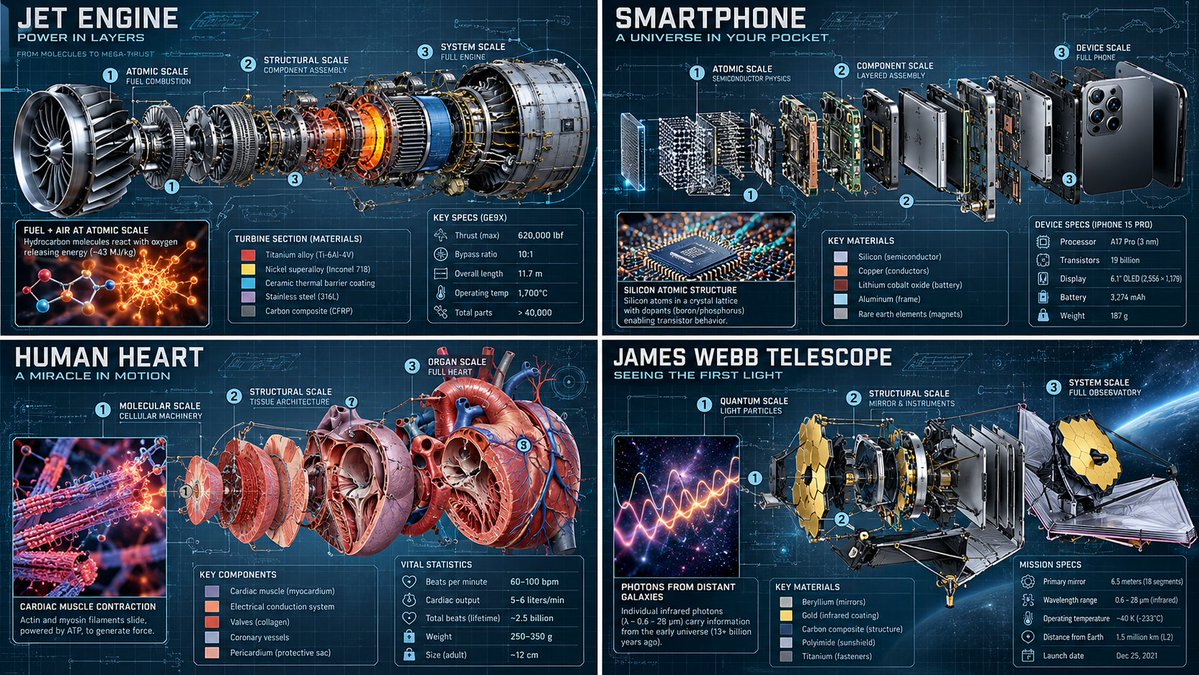
camera_lens · orthographiccolor_palette · cool-tonescomposition · multi-panellighting · studio-lightmood · futuristicquality_flags · typography-heavy
提示词(原文,逐字保留)
2x2 grid, 16:9, AI picks topics: class Multiscale_Technical_Editorial:
def __init__(self, subject="[$SUBJECT]"):
self.canvas = "Precision graph paper background (0.5mm grid), faint blueprint cyan tint, 30° axonometric view."
self. lighting = "Cryo-EM inspired macro-lighting, harsh chamfer highlights."
def execute_exploded_render_progression(self):
# AI AUTO-INFERENCE: Deconstruct [$SUBJECT] into 3 distinct functional layers
core = infer_innermost_components(self.subject)
meso = infer_structural_framework(self.subject)
macro = infer_outer_shell_or_environment(self.subject)
# The Render Gradient (Prompt 4 + 3)
layer_1 = f"INNERMOST CORE: {core} rendered as pure fundamental science (atomic interactions, quantum states, glowing mathematical Lagrangians)."
layer_2 = f"MIDDLE EXPLOSION: {meso} floating in axial alignment, rendered as Technical CAD, color-coded by material (titanium, copper, lipid bilayer)."
layer_3 = f"OUTERMOST SHELL: {macro} rendered photorealistically, showing micro-scale surface details, wear patterns, and environmental atmosphere."
return [layer_1, layer_2, layer_3]
def overlay_ui(self):
vectors = "Dotted assembly vectors with sequential numbering connecting the exploded parts."
cards = f"Hovering holographic data cards inferring exact material grades, genomic lengths, or operating temperatures of {self.subject}."
return [vectors, cards]
render_infographic(Multiscale_Technical_Editorial())
中文译文
2x2 网格,16:9,AI 选题:class Multiscale_Technical_Editorial:
def __init__(self, subject="[$SUBJECT]"):
self.canvas = "精密方格纸背景(0.5mm 网格),淡蓝色蓝图色调,30° 轴测视图。"
self.lighting = "受冷冻电镜启发的宏观照明,锐利的倒角高光。"
def execute_exploded_render_progression(self):
# AI 自动推断:将 [$SUBJECT] 解构为 3 个不同的功能层
core = infer_innermost_components(self.subject)
meso = infer_structural_framework(self.subject)
macro = infer_outer_shell_or_environment(self.subject)
# 渲染梯度(提示 4 + 3)
layer_1 = f"最内层核心:{core} 以纯粹的基础科学方式呈现(原子相互作用、量子态、发光的数学拉格朗日量)。"
layer_2 = f"中间爆炸层:{meso} 按轴向对齐悬浮排列,以技术 CAD 方式呈现,按材料进行颜色编码(钛、铜、脂质双分子层)。"
layer_3 = f"最外层外壳:{macro} 以照片级真实感渲染,展示微观尺度的表面细节、磨损纹理以及环境氛围。"
return [layer_1, layer_2, layer_3]
def overlay_ui(self):
vectors = "虚线装配矢量,带有顺序编号,连接爆炸分解的各个部件。"
cards = f"悬浮的全息数据卡片,推断 {self.subject} 的精确材料等级、基因组长度或运行温度。"
return [vectors, cards]
render_infographic(Multiscale_Technical_Editorial())
来源与署名
原文由 @Gdgtify 发布在 X:查看原推文。 本页逐字保留原文并提供机器翻译的中文解读;版权归原作者所有。
同工具的更多提示词
- 提示词分享:战术林地肖像 — 高细节照片提示词 以所上传的主体照片作为唯一的身份参考。 保留主体完全可辨识的身份,包括面部结构、眼睛、鼻子、嘴唇、下颌线、肤色…@Novasynthetica
- 一张休闲而极具吸引力的时尚编辑大片照片,画面中是两位二十五六岁的东亚成年女性,每位都拥有独立的面部特征、修长的秀场身材比例和独特的发型:一位留着自然垂落的长而…@christosina
- 独自一人,镜头俯视,角色Q版化,眼睛放大且表情丰富,悲伤流泪的眼睛,恳求的脸仰视镜头,手持标牌朝向镜头,上面写着" ",无额外文字 https://t.co/…@JasonHeatony7
- 一幅历史悠久的装饰手卷,描绘[subject],精致的手绘装饰花纹,华丽的植物图案,镀金边框,装饰性的拉丁文书法文字,[color1]与[color2]的华丽…@azed_ai
- 仅使用上传的参考图像来保持该人物的身份特征。请以 100% 的精度保留面部、面部结构、鼻子、嘴唇、下颌线、胡须、头发、肤色、年龄以及身体比例。不得改变或美化其…@NanoBanana_labs
- 凌乱的头发。不在乎。依然可爱。🥰 𝗣𝗿𝗼𝗺𝗽𝘁:参考参考图像,创作一张自然、写实的成年女性肖像。她拥有温暖光滑的肌肤和自然肤色,柔和的颧骨,立体的鼻梁,饱满的…@zeekhancreates