我喜欢这个,不过不一定喜欢 GPT 的输出。给 GPT Image 2.5 的可食用寿司立体模型提示词。
分享链接 · https://openimages.ajiang.me/p/2102679361992167686/
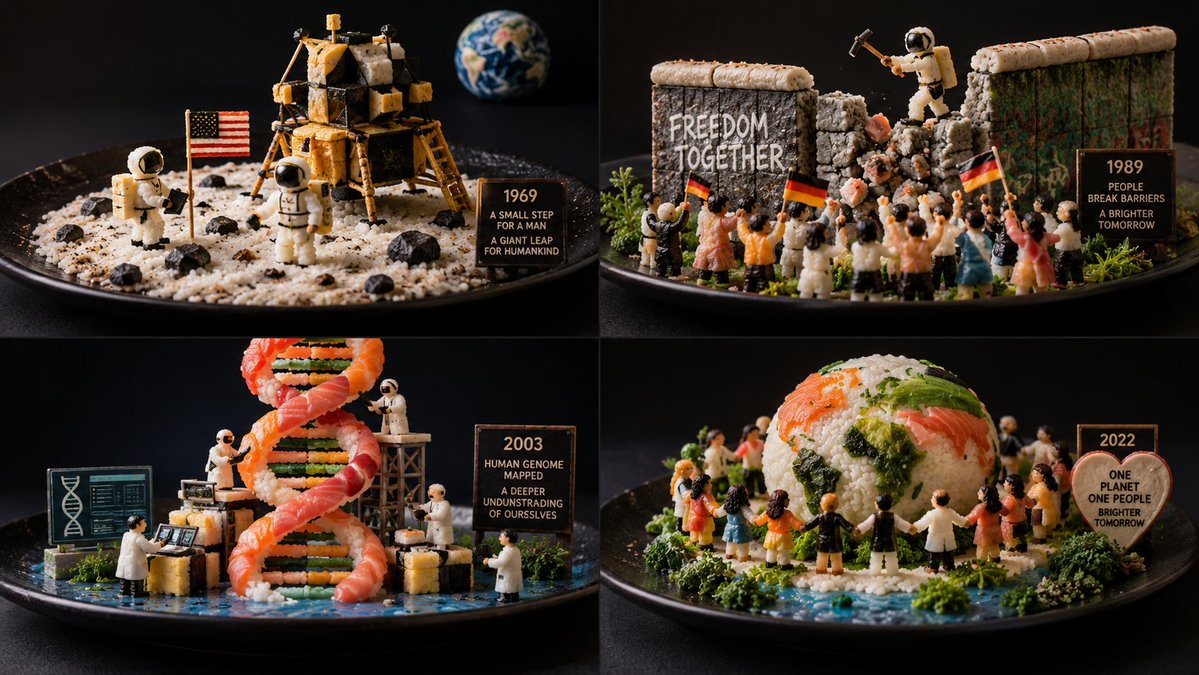
camera_lens · macrocamera_lens · shallow-depth-of-fieldcolor_palette · dark-moodycomposition · close-upcomposition · multi-panellighting · low-key
提示词(原文,逐字保留)
I like this one though not necessarily GPT's output. edible sushi diorama prompt for GPT Image 2.5.
2x2 grid, 16:9, do this for 4 days that made humans proud: -- INPUT: $ SUBJECT CREATE TEMP VIEW subject_analysis AS SELECT INFER_MAIN_SILHOUETTE(:SUBJECT) AS silhouette, INFER_INTERNAL_ZONES(:SUBJECT) AS zones, INFER_TINY_ACTORS(:SUBJECT) AS actors, INFER_SYMBOLIC_PROPS(:SUBJECT) AS props, INFER_MOVEMENT_PATHS(:SUBJECT) AS routes; CREATE TEMP VIEW plate_base AS SELECT BUILD_SERVING_STAGE( plate = 'matte black ceramic plate', ground = 'sushi rice terrain with sesame scatter', lighting = 'premium food photography, dark background, soft overhead highlights' ) AS plate FROM subject_analysis; CREATE TEMP VIEW edible_structure AS SELECT CONVERT_TO_SUSHI_ARCHITECTURE( silhouette, material_map = ARRAY[ 'pressed rice blocks for walls and mass', 'salmon and tuna sashimi for smooth surfaces', 'tamago for roofs, panels, platforms', 'nori strips for beams, supports, outlines, flags', 'cucumber for rails, wheels, columns, arcs', 'roe and sesame for small lights, stones, crowds, particles' ], construction = 'precise knife-cut edible miniature' ) AS sushi_subject FROM subject_analysis; CREATE TEMP VIEW cutaway_world AS SELECT BUILD_EDIBLE_ROOMS( zones, style = 'tiny isometric dollhouse spaces made of food', actors = 'small rice-and-nori figures', props = 'food-based mini props inferred from subject' ) AS rooms, ADD_ROUTE_SYSTEM( routes, material = 'thin cucumber paths, nori rails, sauce lines, sashimi roads' ) AS paths FROM subject_analysis; RENDER plate_base.plate, edible_structure.sushi_subject ON plate_base.plate, cutaway_world.rooms INSIDE edible_structure.sushi_subject, cutaway_world.paths AROUND edible_structure.sushi_subject WITH CAMERA = 'macro food photography, three-quarter view', PALETTE = 'black plate, white rice, salmon orange, tuna red, nori black, cucumber green, roe orange', DETAIL = 'tiny edible craftsmanship, clean plating, playful narrative clarity'; -- OUTPUT RULES: -- 1. $ SUBJECT becomes an edible sushi diorama. -- 2. Keep the subject readable through silhouette and major structural features. -- 3. Convert interior logic into tiny food-built rooms, decks, paths, and platforms. -- 4. Add tiny food characters performing inferred actions. -- 5. Use elegant plating and premium culinary lighting. -- 6. Avoid messy food piles, random ingredients, full-scale realism, and flat cartoon rendering
中文译文
我喜欢这个,不过不一定喜欢 GPT 的输出。给 GPT Image 2.5 的可食用寿司立体模型提示词。
2x2 网格,16:9,为让人类感到自豪的 4 天做这件事:-- INPUT: $ SUBJECT CREATE TEMP VIEW subject_analysis AS SELECT INFER_MAIN_SILHOUETTE(:SUBJECT) AS silhouette, INFER_INTERNAL_ZONES(:SUBJECT) AS zones, INFER_TINY_ACTORS(:SUBJECT) AS actors, INFER_SYMBOLIC_PROPS(:SUBJECT) AS props, INFER_MOVEMENT_PATHS(:SUBJECT) AS routes; CREATE TEMP VIEW plate_base AS SELECT BUILD_SERVING_STAGE( plate = 'matte black ceramic plate', ground = 'sushi rice terrain with sesame scatter', lighting = 'premium food photography, dark background, soft overhead highlights' ) AS plate FROM subject_analysis; CREATE TEMP VIEW edible_structure AS SELECT CONVERT_TO_SUSHI_ARCHITECTURE( silhouette, material_map = ARRAY[ 'pressed rice blocks for walls and mass', 'salmon and tuna sashimi for smooth surfaces', 'tamago for roofs, panels, platforms', 'nori strips for beams, supports, outlines, flags', 'cucumber for rails, wheels, columns, arcs', 'roe and sesame for small lights, stones, crowds, particles' ], construction = 'precise knife-cut edible miniature' ) AS sushi_subject FROM subject_analysis; CREATE TEMP VIEW cutaway_world AS SELECT BUILD_EDIBLE_ROOMS( zones, style = 'tiny isometric dollhouse spaces made of food', actors = 'small rice-and-nori figures', props = 'food-based mini props inferred from subject' ) AS rooms, ADD_ROUTE_SYSTEM( routes, material = 'thin cucumber paths, nori rails, sauce lines, sashimi roads' ) AS paths FROM subject_analysis; RENDER plate_base.plate, edible_structure.sushi_subject ON plate_base.plate, cutaway_world.rooms INSIDE edible_structure.sushi_subject, cutaway_world.paths AROUND edible_structure.sushi_subject WITH CAMERA = 'macro food photography, three-quarter view', PALETTE = 'black plate, white rice, salmon orange, tuna red, nori black, cucumber green, roe orange', DETAIL = 'tiny edible craftsmanship, clean plating, playful narrative clarity'; -- OUTPUT RULES: -- 1. $ SUBJECT 变成一个可食用的寿司立体模型。 -- 2. 通过剪影和主要结构特征保持主体的可读性。 -- 3. 将内部逻辑转化为用食物搭建的微小房间、甲板、路径和平台。 -- 4. 添加正在执行推断动作的微小食物角色。 -- 5. 使用优雅的摆盘和高级美食级打光。 -- 6. 避免凌乱的食物堆、随机食材、全尺寸写实和扁平的卡通渲染。
来源与署名
原文由 @Gdgtify 发布在 X:查看原推文。 本页逐字保留原文并提供机器翻译的中文解读;版权归原作者所有。
同工具的更多提示词
- 为 [LOCATION](地点)创作一张高级感电影冒险片海报,设计为可收藏的院线电影海报。 构图:竖版 4:5 比例。上三分之一位置由巨大的立体“[LOCAT…@Goodmanprotocol
- 当单一强烈的色彩首先属于服装本身——其次才属于图形系统时,它会呈现出一种编辑风格的视觉张力。 🍋 将裙装的青柠色廓形作为主导的色彩体量构建,再在其背后镜像呼应…@ou_zhen599
- 当巨型物体留下它如何进入画面的痕迹时,尺度才会显得可信。 🧴 将放大的口红倾斜到刚好让膏体触及地面,然后向前延伸出一道浓密的缎面痕迹。产品应读作"正在使用中"…@ou_zhen599
- { "prompt_type": "photorealistic_reference_reconstruction", "objective": "尽可能忠实…@noneugc
- 笔触之所以显得昂贵,是因为它身兼两职:先是引导肖像构图,继而化作衣物的表面肌理。 🖤 在肩部与头部后方构建一道巨大的、未完成的水墨弧线。它为画面注入动感,同时…@ou_zhen599
- GPT image 2.5 on chatgpt Prompt 为每张上传的照片创建一张独立的高端编辑海报。不要将多张照片合并为拼贴。每张照片必须作为单独的海…@saniaspeaks_