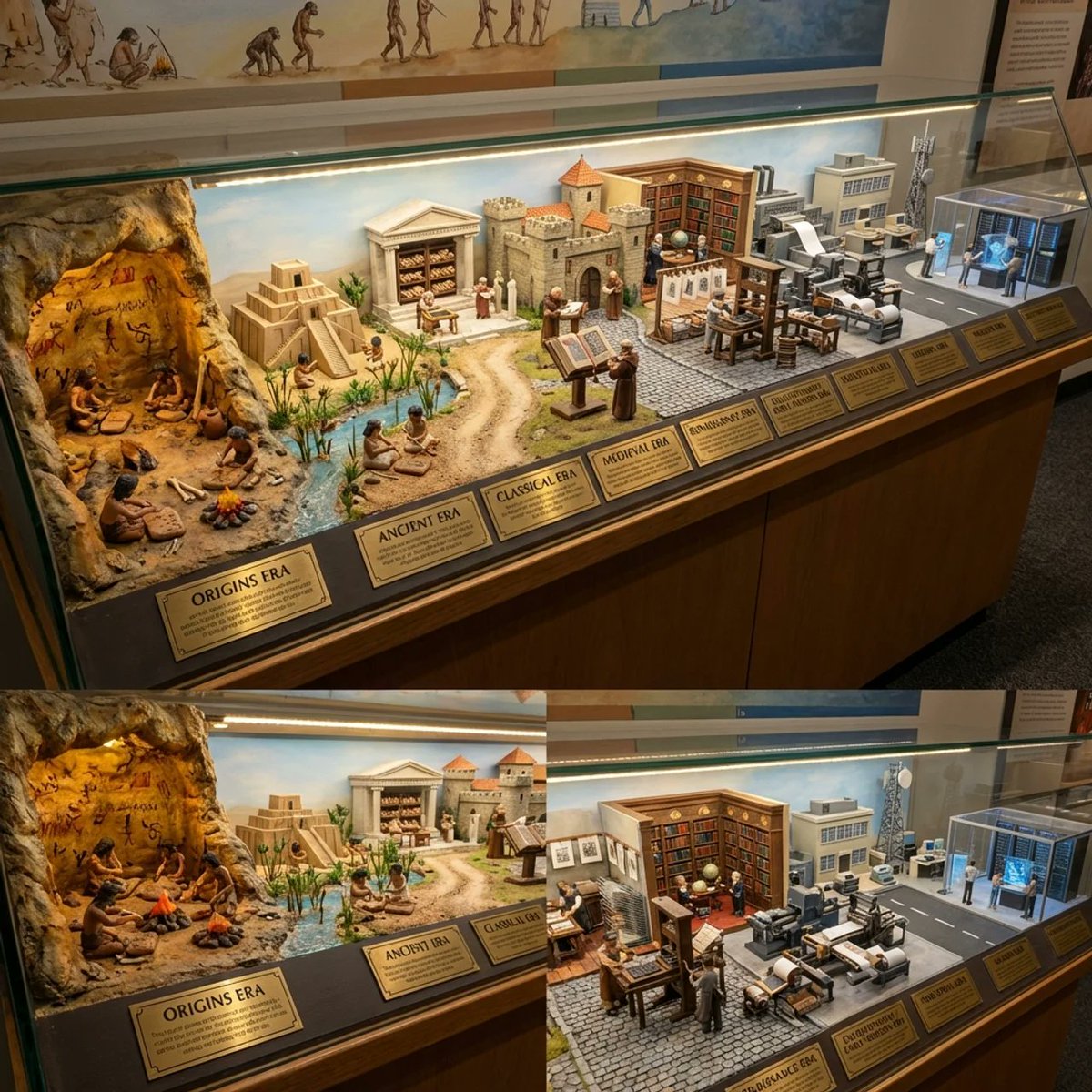
创建一个高度细致、物理上合理的博物馆级立体模型,展现某一选定主题跨越多个时代的完整历史演变过程。不要硬编码特定的文化或美学风格;而应根…
分享链接 · https://openimages.ajiang.me/p/2032619721179402525/
camera_lens · deep-focuscolor_palette · earthycomposition · dynamic-diagonalcomposition · high-anglecomposition · wide-shotlighting · studio-light
提示词(原文,逐字保留)
Create a highly detailed, physically plausible museum‑grade diorama that depicts the full historical evolution
of a chosen subject across multiple eras. Do not hard‑code specific cultures or aesthetics; instead infer the
most contextually appropriate details based on the subject itself.
STRUCTURE
Divide the landscape into the following chronological eras, each with a brass-style plaque:
1. ORIGINS ERA — earliest known or hypothesized beginnings of the subject.
2. ANCIENT ERA — early civilizations, foundational systems, first formal uses.
3. CLASSICAL ERA — structured development, codification, and refinement.
4. MEDIEVAL ERA — transitional forms, regional diversification, early institutions.
5. RENAISSANCE ERA — rediscovery, innovation, and expansion of formal techniques.
6. ENLIGHTENMENT / EARLY MODERN ERA — systematization, theory, and global exchange.
7. INDUSTRIAL ERA — mechanization, mass production, and technological acceleration.
8. MODERN ERA — 20th‑century innovation, global culture, and rapid evolution.
9. CONTEMPORARY ERA — present‑day complexity, digital systems, and hybrid forms.
For each era:
- Infer architecture, tools, environments, and cultural markers appropriate to the subject’s natural progression.
- Use environmental storytelling to show how the subject functioned in that era.
- Include human, architectural, or technological elements only when logically relevant.
- Maintain realistic scale relationships and avoid stereotypes.
CONTINUITY
Include a single unifying environmental feature (e.g., a river, road, beam of light, root system, trade route,
energy conduit, or symbolic thread) that flows through all eras, representing continuity and transformation.
TRANSITIONS
- Smoothly blend each era into the next using natural gradients in terrain, lighting, materials, and density.
- Avoid abrupt borders; transitions should feel like time unfolding across a single continuous landscape.
CAMERA & RENDERING
- Present the entire diorama from a slightly elevated three‑quarter angle.
- Use crisp depth of field, realistic materials, and subtle atmospheric lighting.
- Maintain a miniature, museum‑display aesthetic with handcrafted textures.
- Ensure all eras are visible simultaneously and readable at a glance.
OUTPUT
- Produce one coherent diorama showing all eras in chronological order.
- Ensure the viewer can infer the full historical timeline through visual logic alone.
中文译文
创建一个高度细致、物理上合理的博物馆级立体模型,展现某一选定主题跨越多个时代的完整历史演变过程。不要硬编码特定的文化或美学风格;而应根据主题本身推断出最符合上下文的细节。
结构
将景观划分为以下按时间顺序排列的时代,每个时代配有一块黄铜风格的铭牌:
1. 起源时代(ORIGINS ERA) — 该主题已知或假定的最早开端。
2. 古代时代(ANCIENT ERA) — 早期文明、基础系统、首次正式使用。
3. 古典时代(CLASSICAL ERA) — 系统化发展、规范化与精细化。
4. 中世纪时代(MEDIEVAL ERA) — 过渡形态、地区多样化、早期机构。
5. 文艺复兴时代(RENAISSANCE ERA) — 重新发现、创新与正式技法的拓展。
6. 启蒙 / 早期现代时代(ENLIGHTENMENT / EARLY MODERN ERA) — 体系化、理论化与全球交流。
7. 工业时代(INDUSTRIAL ERA) — 机械化、大规模生产与技术加速。
8. 现代时代(MODERN ERA) — 20 世纪的创新、全球文化与快速演变。
9. 当代时代(CONTEMPORARY ERA) — 当下的复杂性、数字系统与混合形态。
对于每个时代:
- 推断与该主题自然发展过程相适应的建筑、工具、环境和文化标志。
- 通过环境叙事展现该主题在该时代是如何运作的。
- 仅在逻辑相关时加入人物、建筑或技术元素。
- 保持真实的比例关系,避免刻板印象。
连续性
加入一个统一的贯穿性环境特征(例如河流、道路、光束、根系、贸易路线、能源管道或象征性线索),贯穿所有时代,代表连续性与转化。
过渡
- 使用地形、光线、材质和密度的自然渐变,将每个时代平滑地融合到下一个时代。
- 避免突兀的边界;过渡应感觉像时间在单一连续景观中展开。
镜头与渲染
- 以略微抬高的四分之三视角呈现整个立体模型。
- 使用清晰的景深、真实的材质和细腻的氛围光。
- 保持微缩模型、博物馆展示的美学风格,配以手工制作的纹理。
- 确保所有时代同时可见,并能一目了然地清晰辨认。
输出
- 制作一个统一的立体模型,按时间顺序展现所有时代。
- 确保观众能够仅通过视觉逻辑推断出完整的历史时间线。
来源与署名
原文由 @Gdgtify 发布在 X:查看原推文。 本页逐字保留原文并提供机器翻译的中文解读;版权归原作者所有。
同工具的更多提示词
- { "image_generation_parameters": { "version": "1.0", "render_engine": "Octane R…@youngcatwoman
- 以上传的图片作为唯一参考,且不改变面部,创作一幅时尚编辑风格的人像:一位女性自信地坐在一张毛绒质感的超大粉色人造毛皮扶手椅上,背景为柔和的粉彩色粉色;她身穿蓬…@Naiknelofar788
- 电影感肖像照:一位英俊男子留着精心打理的短发和修剪整齐的胡须,站在墙壁旁,身穿一件微微解开扣子的白色衬衫,戴着一条低调的链式项链,温暖的金色阳光透过窗户洒入…@Taaruk_
- 将这张老照片修复成专业级 DSLR 品质的人像肖像,恢复出色的色彩与细节,使用可媲美佳能 EOS R6 II 拍摄效果的先进升频算法。确保修复后的图像看起来自…@doctorwasif
- 创建一个高端极简主义时尚广告海报。 背景:浅灰色褶皱纸张海报纹理,搭配编辑杂志版式布局。 在顶部中央位置放置一个小型品牌标签“A&H”,其上方是极简圆点风格的…@auqibhabib
- { "scene": "电影感色彩工作室人像", "reference": { "identity_match": "精确匹配上传的参考面部", "facia…@mehvishs25