漂浮进另一个世界
分享链接 · https://openimages.ajiang.me/p/2109331302248034655/
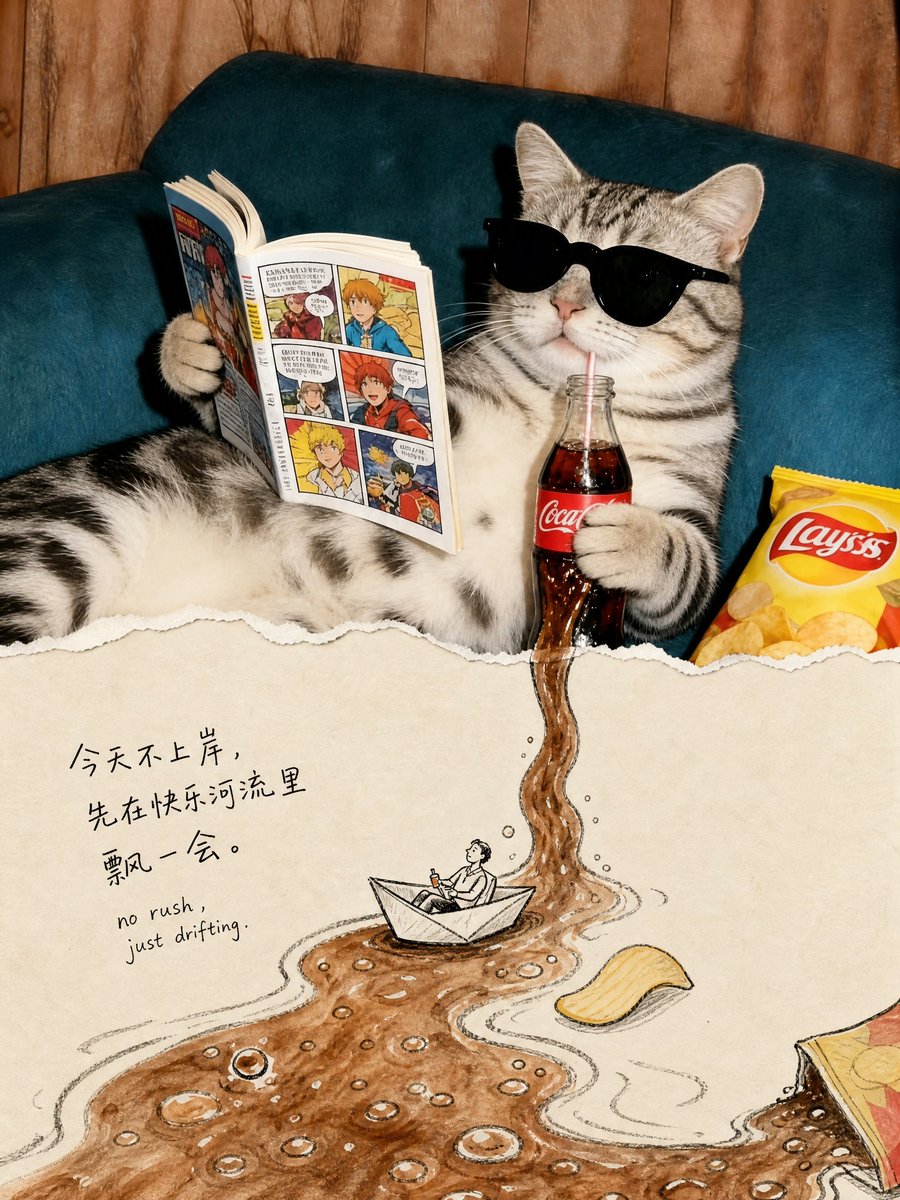
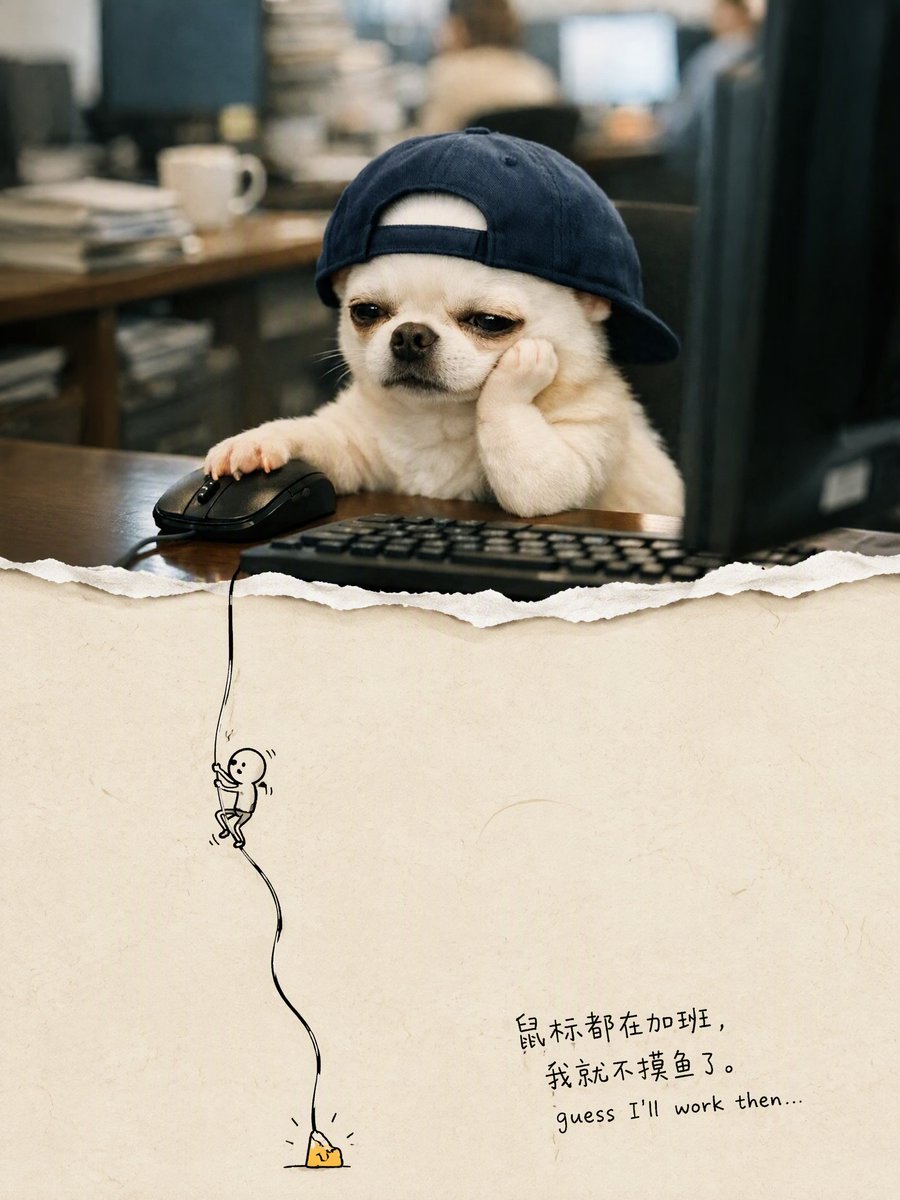
composition · close-upcomposition · multi-panelmood · playfulquality_flags · multi-panel-layoutscene · indoor-homesubject_type · animal
提示词(原文,逐字保留)
Floating into the other world
GPT Image 2 on @TapNow_AI
Prompt
Generate independently for each photo. { "name": "Second World", "version": "1.2", "task": "Using each uploaded photo as an independent source, generate one complete poster per photo. Do not merge multiple photos onto the same canvas.", "output": { "aspect_ratio": "3:4", "orientation": "vertical", "one_poster_per_photo": true, "layout": "Canvas horizontally divided at exactly 50% height, with upper and lower sections each occupying 50%, same width", "no_mockup": true }, "core_principle": "The Second World is already hidden in the photo. Let the same scene pass through the midline and continue downward, changing only the physical rules in the lower half. Continuity of the cross-boundary structure is the highest visual priority.", "upper_half": { "source": "The current uploaded photo", "preserve": [ "Subject identity and appearance", "Character poses, expressions, and actions", "Spatial relationships, proportions, and perspective", "Original color atmosphere", "Natural lighting and shadows", "Environment and important details" ], "allowed_change": "Only necessary proportional cropping to fit the upper half, avoiding cutting off key subjects or connection structures", "forbidden": [ "Redesigning the photo", "Redrawing or replacing the subject", "Rearranging characters and objects", "Changing the photo's colors", "Fictional lighting or background" ], "fidelity_rule": "Prioritize directly reusing the original photo; do not claim generative redrawing as lossless preservation of the original. If the tool cannot meet original preservation and precise layout, state the limitations—do not lower requirements and claim full compliance." }, "continuity": { "choose_one_source_structure": "Identify a structure from the original photo that can naturally extend to the midline, such as a road, shoreline, water surface, reflection, tree branch, light beam, architectural line, clothing flow, or body movement", "requirements": [ "The structure must continue into the lower half at the exact midline meeting point", "Maintain believable continuity in direction, position, scale, and occlusion relationships", "Establish a visible connection first, then develop the lower half's imagination", "Both halves must read as the same scene, not like two independent images stacked vertically" ], "transition_edge": { "optional": "Allow irregular torn paper edges", "rule": "Tearing must follow the original image's structure, not just as decoration, and avoid using the same tearing shape for every image", "interaction": "Source elements can touch, cling to, pass through, or cross over the torn edge" } }, "lower_half": { "background": "Warm ivory paper texture, with subtle visible fibers, rich negative space", "media": [ "Restrained photo fragments", "Simple cut-paper shapes", "Minimal black hand-drawn lines" ], "construction": "Extend downward from where the upper half's source structure meets the midline, then gradually reinterpret it as the Second World", "prohibited": "Do not turn it into an isolated entrance, window, stage, platform, or floating vignette, unless the form clearly grows continuously from the original photo", "density": "Bright, airy, restrained—avoid dense drawing or collage buildup" }, "second_world_logic": { "question": "If the structure in the photo could be touched, used, entered, folded, stretched, or changed, what would it naturally become?", "interaction_count": 1, "instruction": "Establish only one specific, clear, and interesting interaction per image, prioritizing possibilities discovered from the original image's shapes and actions, not reverse-engineering from fixed props or templates.", "examples_for_logic_only": [ "Water surface remains connected to the lake while being rolled up or stretched", "Road extends onto the paper, becoming a path that can be continued by drawing", "An existing light beam extends downward, becoming something gently graspable" ], "variation": "Judge each work individually—do not mechanically repeat actions, connection structures, compositions, or jokes. Examples are not required content." }, "tiny_figures": { "count": "0–3", "appearance": "Minimalist, tiny black line figures", "add_only_if": "Figures can engage in necessary and explicit physical interaction with the extending structure", "omit_if": "Source photo already contains strong human actions", "forbidden": "Using little figures as irrelevant decorations or adding crowds just for liveliness" }, "copy": { "language": "Primarily Chinese, paired with a short English accent", "main_text": "A short, witty, cute, humorous Chinese marginal note, or one with a slight surprising insight", "english": "Shorter, lighter English supplement; can complement the Chinese without word-for-word translation", "intent": "Make viewers smile knowingly after seeing the image and then the small text, or suddenly understand one more layer", "requirements": [ "Recreate based on this photo's specific interaction with the Second World", "Don't just name the action or mechanically describe the image", "Can include anthropomorphism, slight contrasts, deadpan little jokes, or gentle self-deprecation", "Can have a wake-up-call vibe, but no grand life lessons", "Don't force self-love, motivational, or emotional comfort templates", "Humor targets the situation, without belittling characters' appearance, identity, or circumstances" ], "avoid": [ "Vague inspirational fluff", "Grand maxims", "Preachiness", "Ad slogans", "Irrelevant internet memes", "Fixed 'same..., different...' sentence structures", "Reusing the same copy for every image" ], "examples_for_tone_only": [ { "context": "Taking away the sunset", "chinese": "这个不算超重吧", "english": "just a little sunset" }, { "context": "Rolling the lake surface into a paper ribbon", "chinese": "不用袋子,我卷着走", "english": "no bag, thanks" }, { "context": "Shadow rolled into a bed corner", "chinese": "影子先躺了,我再走会儿", "english": "five more minutes" } ], "example_rule": "Borrow only the humor mechanism—do not fix example sentences into new works." }, "handwriting": { "scale": "Small marginal notes, English even smaller—no huge titles stealing the scene", "placement": "In natural white space, not obscuring subjects, cross-boundary connection points, or key interactions", "chinese": "Truly natural, slightly messy handwriting, not neat computer-generated script", "english": "Similarly like casually scribbled, relaxed and irregular", "details": [ "Slight variations in character size", "Baseline with minor undulations", "Tilt angles not perfectly consistent", "Natural variations in spacing", "Strokes with pressure and pauses", "Minimal overlapping or incomplete ink traces" ], "corrections": { "allowed": true, "frequency": "Occasional only—not required for every image", "method": "Can gently strike through a mistaken or revised word, adding the correct version nearby or above", "limit": "Usually at most 1–2 instances—don't turn the whole page into a repeatedly scribbled draft", "legibility": "Final meaning must be clear—no simulating handwriting with gibberish or meaningless errors" } }, "overall_style": { "mood": [ "Indie magazine vibe", "Bright and airy", "Warm paper texture", "Restrained", "Lightly humorous", "Subtle handmade traces" ], "hierarchy": [ "Original photo and cross-boundary structure", "Clear interaction in the lower half", "Small bilingual handwritten marginal notes" ], "finish": "Like gently unveiling a hidden world in the photo, not pasting an extra illustration below it" }, "negative_prompt": [ "Detached lower-half illustrations", "Broken cross-boundary continuity", "Generic torn-paper templates", "Isolated entrances or windows", "Irrelevant vignettes", "Dense illustrations", "Random decorations", "Decorative crowds", "Altering original photo colors", "Redesigning the upper photo", "Glossy 3D", "Scrapbook clutter", "Huge titles", "Neat printed-style handwriting", "Nonsensical text", "Motivational fluff", "Watermarks", "Logos", "UI elements", "Merging multiple photos", "Grid layouts" ], "final_check": [ "Does each original image correspond to one independent 3:4 poster?", "Do upper and lower sections strictly each occupy 50%?", "Is the upper half's original photo faithfully preserved, with only necessary cropping?", "Is there one authentic source structure accurately continuing at the midline?", "Does the lower half belong to the same scene as the original image, not an isolated illustration?", "Is there only one clear, natural, and non-repetitive templated interaction?", "Is the Chinese interesting and lingering, not just a simple action label or preachiness?", "Are the Chinese and English in small, natural, messy, and readable handwriting?", "Is sufficient negative space preserved?" ] } Note: The above are target requirements; generated results still need checking for original image preservation, seams, and text—do not treat generative redrawing as lossless original preservation.
中文译文
漂浮进另一个世界
GPT Image 2 @TapNow_AI
提示词
为每张照片独立生成。 { "name": "第二世界", "version": "1.2", "task": "将每张上传的照片作为一个独立来源,每张照片生成一张完整的海报。不要将多张照片合并到同一画布上。", "output": { "aspect_ratio": "3:4", "orientation": "vertical", "one_poster_per_photo": true, "layout": "画布在正好 50% 高度处水平分割,上下两部分各占 50%,宽度相同", "no_mockup": true }, "core_principle": "第二世界已经隐藏在照片里。让同一个场景穿过中线向下延续,只在下半部分改变物理规则。跨界结构的连贯性是最高的视觉优先项。", "upper_half": { "source": "当前上传的照片", "preserve": [ "主体的身份与外观", "角色的姿态、表情与动作", "空间关系、比例与透视", "原始色彩氛围", "自然的光照与阴影", "环境与重要细节" ], "allowed_change": "仅在必要时进行比例裁剪以适配上半部分,避免截掉关键主体或连接结构", "forbidden": [ "重新设计照片", "重绘或替换主体", "重新安排人物与物品", "改变照片的色彩", "虚构的光照或背景" ], "fidelity_rule": "优先直接复用原图;不要把生成式重绘声称为对原图的无损保留。如果工具无法满足原图保留与精确排版,应说明其局限——不要降低要求并声称完全合规。" }, "continuity": { "choose_one_source_structure": "从原图中识别一个可以自然延伸到中线的结构,例如道路、岸线、水面、倒影、树枝、光束、建筑线条、衣料流动或身体动作", "requirements": [ "该结构必须在正好中线的衔接点处延续进入下半部分", "在方向、位置、比例与遮挡关系上保持可信的连续性", "先建立可见的连接,再展开下半部分的想象", "上下两部分必须读作同一个场景,而不是两张独立图像上下堆叠" ], "transition_edge": { "optional": "允许不规则的撕纸边缘", "rule": "撕痕必须顺着原图的结构,而不是仅作为装饰,并避免每张图都使用同一种撕纸形状", "interaction": "原图元素可以接触、附着、穿过或跨越撕边" } }, "lower_half": { "background": "暖色调象牙白纸张纹理,带隐约可见的纤维,留有丰富的负空间", "media": [ "克制的照片碎片", "简洁的剪纸形状", "极少的黑色手绘线条" ], "construction": "从上半部分来源结构抵达中线处开始向下延伸,再逐步被重新诠释为第二世界", "prohibited": "不要把它变成孤立的入口、窗户、舞台、平台或飘浮的特写画面,除非其形态明显从原图连续生长出来", "density": "明亮、通透、克制——避免密集的绘画或拼贴堆叠" }, "second_world_logic": { "question": "如果照片中的结构可以被触摸、使用、进入、折叠、拉伸或改变,它自然会变成什么?", "interaction_count": 1, "instruction": "每张图只建立一个具体、清晰且有趣的交互,优先从原图的形态与动作中发现可能性,而不是从固定的道具或模板反推。", "examples_for_logic_only": [ "水面仍与湖水相连,同时被卷起或拉伸", "道路延伸到纸上,成为可以继续画下去的路径", "既有的光束向下延伸,成为可以轻轻握住的东西" ], "variation": "逐张作品独立判断——不要机械重复动作、连接结构、构图或笑点。示例并非必选内容。" }, "tiny_figures": { "count": "0–3", "appearance": "极简的细小黑色线条小人", "add_only_if": "小人能够与延伸结构发生必要且明确的物理交互", "omit_if": "原图本身已包含强烈的人物动作", "forbidden": "把小人当作无关装饰,或仅为增添热闹而加入人群" }, "copy": { "language": "以中文为主,搭配简短的英文点缀", "main_text": "一句简短、机智、可爱、幽默的中文旁白,或带一点小小惊喜的感悟", "english": "更短、更轻的英文补充,可以与中文互补,不必逐字对译", "intent": "让观者先看到图再看小字后心领神会一笑,或突然再多懂一层", "requirements": [ "围绕这张照片与第二世界的具体交互重新创作", "不要只是命名动作或机械描述画面", "可以包含拟人、轻微反差、面瘫小幽默或温和自嘲", "可以有一点清醒提醒的氛围,但不要宏大人生哲理", "不要强行套用自爱、励志或情感慰藉模板", "幽默针对情境,不贬低角色的外貌、身份或处境" ], "avoid": [ "模糊的励志空话", "宏大的格言", "说教腔", "广告语", "无关的网络梗", "固定的“同一个……,不同的……”句式", "每张图重复使用同一句文案" ], "examples_for_tone_only": [ { "context": "把晚霞带走", "chinese": "这个不算超重吧", "english": "just a little sunset" }, { "context": "把湖面卷成纸带", "chinese": "不用袋子,我卷着走", "english": "no bag, thanks" }, { "context": "影子被卷到床角", "chinese": "影子先躺了,我再走会儿", "english": "five more minutes" } ], "example_rule": "只借用幽默机制——不要把示例句固定搬到新作品里。" }, "handwriting": { "scale": "小幅旁注,英文更小——不要用巨大的标题抢戏", "placement": "放在自然的留白里,不遮挡主体、跨界衔接点或关键交互", "chinese": "真正自然的、略带凌乱的手写字,不是整齐的电脑体", "english": "类似随手涂写的感觉,放松且不规则", "details": [ "字的大小略有变化", "基线有细微起伏", "倾斜角度不完全一致", "字间距自然变化", "笔画有压笔与停顿", "极少量叠笔或未完全干透的墨迹" ], "corrections": { "allowed": true, "frequency": "仅偶尔出现——并非每张图都必须", "method": "可以用细线轻轻划掉写错或修改的字,并在附近或上方补上正确版本", "limit": "通常最多 1–2 处——不要把整页变成反复涂改的草稿", "legibility": "最终含义必须清晰——不要用乱码或无意义涂写来模拟手写字" } }, "overall_style": { "mood": [ "独立杂志感", "明亮通透", "温暖的纸张质感", "克制", "轻微幽默", "微妙的手工痕迹" ], "hierarchy": [ "原图与跨界结构", "下半部分清晰的交互", "小幅中英文手写旁注" ], "finish": "像轻轻掀开照片里藏着的世界,而不是在下方再贴一张插画" }, "negative_prompt": [ "脱离的下半部分插画", "断裂的跨界连续性", "通用的撕纸模板", "孤立的入口或窗户", "无关的特写画面", "密集的插画", "随意的装饰", "装饰性的人群", "改变原图色彩", "重新设计上半部分照片", "光面 3D", "剪贴簿式杂乱", "巨大的标题", "整齐印刷体手写", "无意义的文字", "励志空话", "水印", "标志", "界面元素", "合并多张照片", "网格布局" ], "final_check": [ "每张原图是否对应一张独立的 3:4 海报?", "上下两部分是否严格各占 50%?", "上半部分的原图是否被忠实保留,仅作必要裁剪?", "在中线处是否有一个真实的来源结构被准确延续?", "下半部分是否与原图属于同一场景,而非孤立插画?", "是否只有一处清晰、自然且不重复模板化的交互?", "中文是否有趣且耐看,不是简单的动作标签或说教?", "中英文是否为小巧、自然、略带凌乱且可读的手写字?", "是否保留了足够的负空间?" ] } 注:以上为目标要求,生成结果仍需检查原图保留、接缝与文字——不要把生成式重绘当作无损的原图保留。
来源与署名
原文由 @Just_sharon7 发布在 X:查看原推文。 本页逐字保留原文并提供机器翻译的中文解读;版权归原作者所有。
同工具的更多提示词
- ChatGPT Image 2 vs Grok Imagine vs Gemini Nano Banana 2 🖤🖤🖤 1️⃣ ChatGPT Image 2…@punkhuri1
- 1. 打开 Gemini / Grok / GPT Image 2.0 2. 上传你的照片 3. 复制提示词 4. 生成 5. 提示词 ⤵️ "微微一笑,一个…@ShamshadMa75100
- 1. 打开 Gemini / Grok / GPT Image 2.0 2. 上传你的照片 3. 复制提示词 4. 生成 5. 提示词 ⤵️ "一个男孩,微微…@mzahid1125524
- A stunning ultra-realistic 8K luxury fashion editorial portrait of an elegant a…@TaliaAariz
- GPT image 2 on ChatGPT Prompt Create a vertical minimalist mosaic art poster in…@Taaruk_
- 以上传的图片作为主要的视觉参考。创作一幅高端极简风格的编辑类艺术海报,将照片写实风格的自然摄影与精致的手绘墨水插画相结合。 构图:严格采用 2:3 竖版格式…@Sairah_0