城市之所以真实,是因为纸张必须先失败。
分享链接 · https://openimages.ajiang.me/p/2107083029143265399/
camera_lens · deep-focuscolor_palette · warm-tonescomposition · centeredcomposition · full-bodylighting · golden-hourmood · nostalgic
提示词(原文,逐字保留)
The city feels real because the paper has to fail first.
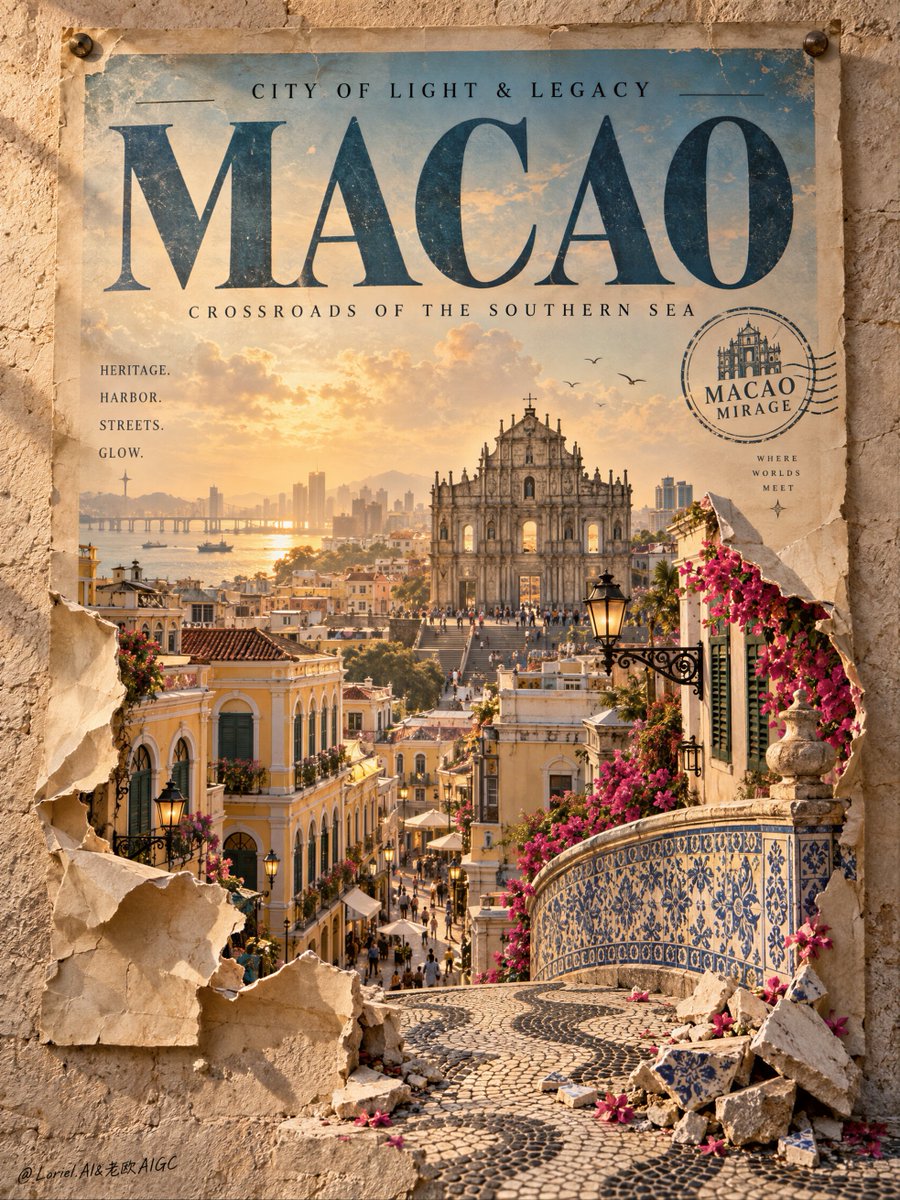
🪽 “a torn lower poster edge curling outward into a real three-dimensional city reveal”
This makes the poster act like a physical threshold, not a flat image with scenery pasted onto it.
🧊 “match the paper’s torn edge to the city’s foreground: ceramic parapet, mosaic pavement, dust, and small debris”
The transition becomes believable because the printed world and the physical objects share one break line.
GPT- image 2.5 prompt👇
Create a Cannes-level premium travel poster ad for fictional destination campaign brand MACAO MIRAGE, unifying vintage paper-poster aesthetics, architectural depth, and sculptural physical illusion into one collectible hero image. The core concept is a city breaking through memory: a refined travel poster pinned to an aged plaster wall tears open along its lower portion, and Macao emerges physically from the paper as if history is pushing outward into the real world. The poster object must remain the absolute visual leader.
Use a vertical full-bleed composition with a front-facing wall-mounted view, subtle natural perspective, and disciplined rule-of-thirds balance. Preserve the exact structure: one large vintage travel poster dominates the frame, pinned to a textured plaster wall with aged metal tacks, its upper half mostly graphic and typographic while the lower section tears, curls, fractures, and becomes three-dimensional. The poster sits centered and monumental against the wall, with clean negative space around it. The bottom edge is broken open and partially collapsed outward, creating a believable transition from printed artifact to spatial city reveal. The composition should feel iconic, collectible, and instantly legible.
Inside the torn lower portion, build a highly realistic miniature Macao cityscape emerging from the paper surface. The Ruins of Saint Paul’s act as the distant architectural anchor, framed by layered heritage rooftops, colonial facades, and compressed urban terraces. In the immediate foreground, integrate Senado Square-inspired Portuguese mosaic pavement and a curved azulejo-like tiled parapet physically protruding from the torn poster edge. Scatter a few broken plaster chunks, ceramic fragments, and dust at the base where wall, paper, and city illusion split apart. The effect must feel tactile, elegant, and structurally believable, never chaotic or fantasy-heavy.
The surrounding wall is warm stone-beige plaster with subtle age, stucco grain, minor cracks, and soft sun-cast shadow from the pinned poster. Within the poster portal, the Macao scene glows in late-afternoon golden light with layered architectural density and atmospheric depth. Foreground details include tiled surfaces, limited magenta bougainvillea-like blossoms along one edge, and a few tiny pedestrians deep below to establish scale. Midground includes Macanese facades, stair-like street layering, and terrace edges. Background holds the Ruins of Saint Paul’s and a luminous skyline haze. Depth must transition smoothly from printed surface to real spatial volume.
Lighting and color merge into one precise palette: 60% warm limestone beige, parchment ivory, dusted cream, and sun-faded paper; 30% terracotta, muted teal-blue tile, amber city glow, and warm stone shadow; 10% magenta floral accents, weathered bronze, and slightly deepened dusk-blue atmospheric notes. Use warm golden-hour light from the upper left to create gentle relief on curled paper edges, realistic wall shadow, and luminous separation inside the city aperture. Preserve softness and richness without muddy browns, dead shadow pits, or oversaturated postcard color. The mood is historic, luminous, poetic, tactile, and premium.
Materials must feel extremely real: poster paper with subtle creases, curled corners, faint print wear, fiber grain, slight age staining, and layered thickness at torn edges; wall plaster with fine stucco texture and believable wear; tiled parapet and pavement with glazed ceramic reflectance, tiny chips, hand-laid irregularity, and artisanal craft; and architecture that feels sun-worn, dense, and tactile. The whole image should feel like a museum-worthy travel poster brought physically to life, with print-ready clarity and restrained luxury polish.
All in-image text must be English only, styled as a refined vintage travel-poster system. At the top, place a small header line reading “CITY OF LIGHT & LEGACY”. The main title is “MACAO” in large elegant serif capitals dominating the upper third. Beneath it, place a smaller line reading “CROSSROADS OF THE SOUTHERN SEA”. Along the left side, add a short vertical stack such as “HERITAGE. HARBOR. STREETS. GLOW.” On the right, integrate a circular stamped emblem reading “MACAO MIRAGE” with a small icon inspired by the Ruins of Saint Paul’s facade. Typography must feel printed into the poster, slightly aged, perfectly aligned, and harmonized with the dimensional architecture below. No Chinese text and no copied wording from existing tourism posters.
Output: a premium travel-poster ad with the poster object as hero, full-bleed composition, no white border, no extra frames, no modern billboard styling, no random contemporary clutter, no floating fantasy buildings, no unreadable text, no warped architecture, no broken perspective, no muddy colours, no dead black areas, no low-quality AI texture, no excessive debris, no postcard-cliche overload, and no style drift. The final image must feel like a world-class collectible Macao destination poster where memory, material, and city become one object.
中文译文
城市之所以真实,是因为纸张必须先失败。
🪽 “撕裂的下半部分海报边缘向外卷曲,露出真实的三维城市”
这让海报像一道物理门槛,而不是一张贴有风景的平面图像。
🧊 “将纸张的撕裂边缘与城市前景对齐:陶瓷矮墙、马赛克铺地、尘埃与细碎残片”
转换之所以可信,是因为印刷世界与实物物件共享同一条断裂线。
GPT- image 2.5 prompt👇
为虚构目的地推广品牌 MACAO MIRAGE 创作一幅戛纳级别的高端旅行海报广告,将复古纸质海报美学、建筑纵深与雕塑般的物理错觉统一于一张值得收藏的主形象中。核心概念是一座城市突破记忆:一张精致的旅行海报钉在陈旧灰泥墙面上,下半部分撕裂开来,澳门从纸张中真实地浮现出来,如同历史向外推入真实世界。海报本身必须是绝对的视觉主角。
采用纵向满版构图,正面墙面悬挂视角,微妙自然透视,严谨三分法构图。保留精确结构:一张大型复古旅行海报占据画面主体,钉在带有肌理的灰泥墙面上,使用老旧的金属图钉,上半部分以图形与排版为主,下半部分撕裂、卷曲、碎裂,变为三维形态。海报居中、宏伟地矗立墙面,四周留出干净的负空间。底部边缘被打破并部分向外塌陷,形成从印刷物到空间城市揭露的可信过渡。构图应具有标志性、收藏感且一目了然。
在撕裂的下半部分内部,构建一座高度真实的微型澳门城市景观,从纸张表面浮现。大三巴牌坊作为远处的建筑锚点,被层叠的遗产屋顶、殖民立面和压缩的城市露台环绕。在紧贴前景处,融入受议事亭前地启发的葡萄牙马赛克铺地,以及从撕裂的海报边缘实体突出的一道弯曲的瓷砖蓝绿色瓷砖(azulejo)矮墙。在墙面、纸张与城市幻象分开的底部,散落少量碎灰泥块、陶瓷碎片与尘埃。效果必须感受:可触、优雅、结构可信,绝不混乱或过度奇幻。
周围墙面为温暖的米黄石质灰泥,带有微妙的岁月痕迹、灰泥颗粒、细微裂纹,以及钉住海报投射的柔和日光阴影。在海报窗口内,澳门场景沐浴在午后金色光线中,具有层次建筑纵深与空气感深度。前景细节包括瓷砖表面、沿一侧少量洋红色九重葛 (bougainvillea-like) 花朵,以及深处少量微小行人以建立尺度感。中景包括澳门立面、阶梯式街道分层与露台边缘。背景保留大三巴牌坊与发光的天际线雾气。深度必须从印刷表面平滑过渡到真实的空间体积。
光线与色彩融合为统一的精确调色板:60% 温暖石灰石米色、羊皮纸象牙白、蒙尘奶油色与日晒褪色纸色;30% 陶土色、柔和蓝绿瓦色、米色暖光与暖石阴影;10% 洋红花朵亮泽、做旧青铜与略深的暮色蓝空气感点缀。使用来自左上方暖色调的黄金时段光线,在卷曲纸张边沿上形成温和浮雕、逼真的墙面阴影,并在城市开口内形成发光的层次。避免软弱,土灰或浑浊棕色、死黑阴影坑或过饱和明信片色彩。氛围是历史的、发光的、诗意的、可触的与高级的。
材质必须极度真实:海报纸张带有微妙折痕、卷曲边角、轻微印刷磨损、纤维颗粒、轻微岁月污迹,以及撕裂边缘的层叠厚度;墙面灰泥带有细密灰泥肌理与可信磨损;瓷砖矮墙与铺地带有釉面陶瓷反光、细小缺口、手工铺设的不规则感与匠人手作;建筑应感受日晒风化、密集且可触。整张图像应感受如一张博物馆级旅行海报被物理地赋予生命,具有印刷级清晰度与克制奢华的润色。
所有图内文字必须仅使用英文,呈现为精致的复古旅行海报字体系统。顶部放置一行小标题“CITY OF LIGHT & LEGACY”。主标题为“MACAO”,使用大号优雅衬线大写字母,占据上三分之一。其下放置一行较小的文字“CROSSROADS OF THE SOUTHERN SEA”。沿左侧添加一个短竖排堆叠,例如“HERITAGE. HARBOR. STREETS. GLOW.”。右侧整合一枚圆形盖章徽章“MACAO MIRAGE”,配以受德累斯圣保罗立面启发的小图标。字体必须感受印刷于海报之上、略带岁月痕迹、对齐完美,并与下方立体建筑和谐。无中文文字,无抄袭现有旅游海报的措辞。
输出:一幅以海报为主角的高端旅行海报广告,满版构图,无白边、无额外画框、无现代广告牌样式、无随机当代杂物、无漂浮奇幻建筑、无不可读文字、无扭曲建筑、无破坏透视、无浑浊色彩、无死黑区域、无低质量 AI 纹理、无过多残骸、无明信片俗套堆砌与无风格漂移。最终图像必须感受如一幅世界级可收藏的澳门目的地海报,其中记忆、材质与城市合而为一。
来源与署名
原文由 @ou_zhen599 发布在 X:查看原推文。 本页逐字保留原文并提供机器翻译的中文解读;版权归原作者所有。
同工具的更多提示词
- 平板电脑之所以让人觉得快,是因为道路并没有停在玻璃上。 🏎️ 赛车跑道、动态模糊以及带有方向感的落叶,从屏幕内毫无缝隙地延续到满版的山间环境之中 这让屏幕感觉…@ou_zhen599
- 创作一幅极其精美、细节丰富的电影感室内艺术作品,标题为“如果[COUNTRY]拥有一间卧室”。 想象[COUNTRY]的整体个性、文化、建筑、风景、色彩、传统…@Naiknelofar788
- 保留参考图中女孩的外貌。真实的夜间自拍,使用 iPhone 17 Pro 的前置摄像头拍摄,画面中不出现手机。近景,自然视角。 女孩放松地倚靠坐着,头微微后仰…@mehvishs25
- 蓝图叠加是不够的。线框必须继承真实机械的载荷路径。 🪿 “一台起重机,沿其中心结构轴精确分割;两侧的吊臂、小车、钢索和集装箱几何形状完全一致” 这能让渲染侧与…@ou_zhen599
- 创作一幅高级感的 4:5 竖版旅行写生作品,以[国家 / 城市 / 地点 / 地标]为主题,画在一本小巧的水彩写生本上。 仅限文生图(TXT2IMG)—— 完…@Goodmanprotocol
- 【人物】 × 凹版照相早期摄影印刷 × 连续柔和灰阶 × 银灰、暖灰、米白,低反差细腻颗粒纸感 https://t.co/hO95rFaLGo@DeepBlueX0