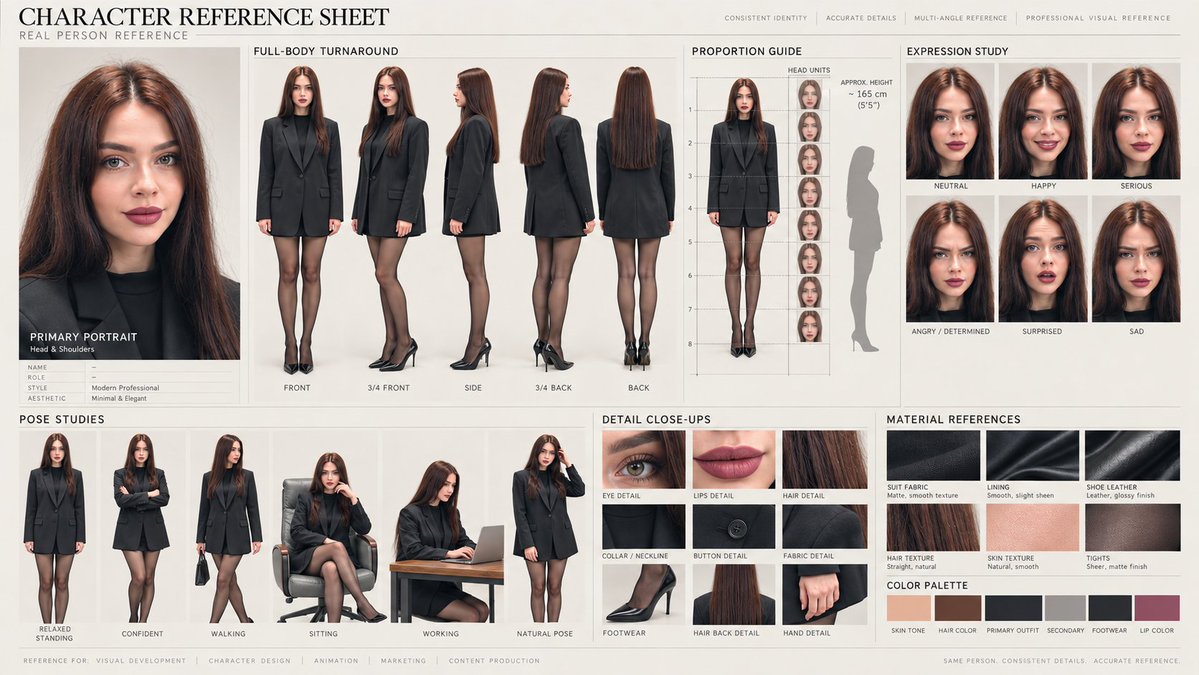
使用上传的图片作为该角色的唯一视觉权威,创建一个高级、可投入生产的角色参考表。
分享链接 · https://openimages.ajiang.me/p/2102455966369280388/
camera_lens · orthographiccomposition · multi-panelhuman_attributes · long-hairhuman_attributes · makeuplighting · soft-lightlighting · studio-light
提示词(原文,逐字保留)
Create a premium production-ready character reference sheet using the uploaded image as the sole visual authority for the character.
## CORE PRIORITY — CHARACTER CONSISTENCY
The uploaded reference defines the character. Do not redesign or reinterpret the person.
Preserve the character's recognizable identity exactly, including:
* facial structure and proportions
* eyes, eye color and eye spacing
* eyebrows
* nose and lips
* jawline and face shape
* skin tone and age appearance
* hairstyle, hairline and hair volume
* body type and physical proportions
* height and overall silhouette
* clothing construction, fit and layering
* colors, patterns and graphics
* footwear
* jewelry and accessories
* distinctive marks or identifying details
The objective is one character shown from multiple angles, not multiple interpretations of the same character.
Before generating the board, establish a consistent internal model of the character's face, anatomy, silhouette, wardrobe, materials and proportions. Maintain those decisions across every panel.
## PRESENTATION
Create a single landscape 16:9 professional character-development board.
Style: high-end animation / game / visual-development production sheet.
Use:
* clean warm-neutral or off-white studio background
* sophisticated editorial grid
* precise alignment
* generous negative space
* subtle technical construction lines
* restrained labels
* consistent panel sizing
* polished professional rendering
The result should look like an actual production document used by a professional art or character-development team, not a collage of unrelated AI generations.
Avoid decorative elements that do not contribute to character documentation.
## 01 — PRIMARY IDENTITY PORTRAIT
Give the character one prominent portrait that establishes the canonical appearance.
Use a head-and-shoulders or three-quarter composition.
Show:
* accurate facial structure
* canonical hairstyle
* correct skin tone
* natural neutral expression
* correct clothing and visible accessories
This portrait should function as the visual reference point for the entire sheet.
## 02 — FIVE-VIEW TURNAROUND
Create a clean full-body turnaround of the exact same character.
Include:
Front
3/4 Front
Side Profile
3/4 Back
Back
Use the same neutral standing posture and consistent scale.
Maintain alignment of:
* top of head
* eyes
* shoulders
* chest
* waist
* hips
* knees
* ankles and feet
Every view must preserve the same anatomy, clothing construction, hairstyle, accessories, patterns and silhouette.
Do not introduce details that are not supported by the reference.
## 03 — FACIAL EXPRESSION SHEET
Create a compact expression study with approximately six expressions:
* neutral
* subtle happiness
* serious
* determined / angry
* surprised
* sad / emotional
The expressions may change naturally, but the underlying person must remain unmistakably identical.
Keep the same:
* facial proportions
* eye structure
* nose
* mouth shape
* jawline
* hairstyle
* head proportions
Favor believable facial acting over exaggerated cartoon deformation.
## 04 — CHARACTER POSE STUDIES
Show 4–6 full-body poses that reveal the character's natural personality and physical behavior.
Possible poses include:
* relaxed standing
* confident stance
* walking
* sitting
* interacting with an object
* distinctive dynamic pose
Keep the anatomy, clothing, accessories and silhouette consistent across every pose.
Do not allow pose variation to become character redesign.
## 05 — DESIGN DETAIL CALLOUTS
Add focused close-up panels for the most important design elements.
Prioritize details actually visible or clearly established in the reference, such as:
* hair and hairstyle
* facial details
* collar / neckline
* garment construction
* sleeves and seams
* footwear
* jewelry
* accessories
* logos, emblems or patterns
* important props
* distinctive textures
Present these as production callouts, not as decorative fashion photography.
## 06 — MATERIAL & SURFACE REFERENCES
Document the major materials present in the character design.
Include only relevant materials, such as:
* fabric
* leather
* denim
* metal
* silk
* knit
* plastic
* glass
* hair
* skin
Show their characteristic surface behavior, texture, reflectivity and construction.
Keep the material studies directly connected to the actual costume and character design.
## 07 — CHARACTER COLOR PALETTE
Add a compact professional palette extracted faithfully from the reference.
Organize it by role:
Skin
Hair
Primary clothing
Secondary clothing
Accent color
Accessories / materials
Do not introduce new colors simply to make the palette more visually interesting.
## 08 — PROPORTION & SILHOUETTE GUIDE
Add a subtle technical anatomy section beside the turnaround.
Include:
* overall character height
* head-to-body relationship
* shoulder and torso proportions
* major body alignment guides
* simplified silhouette
* key proportional landmarks
Keep this technical and understated.
The purpose is to help another artist reproduce the same character consistently.
## 09 — CANONICAL DESIGN LOCK
Treat the entire board as one unified source of truth.
Every panel must represent the same character.
Lock:
Identity — same face and recognizable features
Anatomy — same body structure and proportions
Hair — same hairstyle and hairline
Wardrobe — same garments and construction
Accessories — same placement and quantity
Colors — same palette
Silhouette — same recognizable shape
Details — same left/right elements and patterns
No unexplained variations between panels.
## VISUAL QUALITY
Aim for sophisticated professional visual-development quality:
* refined character rendering
* accurate anatomy
* realistic skin and hair
* believable material response
* crisp construction details
* controlled neutral studio lighting
* clean edges
* polished presentation
* strong visual hierarchy
* consistent rendering style
Lighting should be **soft, neutral and diagnostic**, allowing the character design and materials to be inspected clearly. Avoid dramatic cinematic lighting.
Use a restrained neutral studio environment rather than scenery.
## CAMERA & VIEW CONSISTENCY
Turnaround views should feel close to orthographic production references, with minimal perspective distortion.
Expression studies should maintain consistent head framing and camera distance.
Pose studies may use natural perspective, but the character's anatomy must remain accurate.
Avoid extreme lenses, fisheye distortion or dramatic camera angles that make proportions difficult to compare.
## LAYOUT RULES
Build the board as a coherent information system.
Prioritize:
1. identity portrait
2. turnaround
3. expressions
4. poses
5. design details
6. materials
7. color palette
8. proportion guide
Use consistent margins, spacing and alignment.
Do not overlap characters or panels.
Do not crop important anatomy.
Do not create unnecessary environmental backgrounds.
Every visual element should have a clear production purpose.
## FINAL FIDELITY CHECK
Before finalizing, verify that all panels depict the **same exact character**.
Check for:
* facial identity consistency
* matching eye shape and placement
* matching hairstyle and hairline
* consistent body proportions
* consistent height and silhouette
* identical clothing
* identical accessories
* correct left/right details
* consistent colors and patterns
* anatomically correct hands and limbs
* no unexplained additions or omissions
The final result should feel like a **single professionally designed character documented from multiple viewpoints**, with no visible identity drift.
## AVOID
Character redesign, beautification, identity changes, age changes, hairstyle changes, wardrobe changes, accessory changes, proportion drift, facial drift, inconsistent left/right details, duplicate accessories, missing clothing elements, extra fingers, malformed hands, extra limbs, distorted anatomy, random props, unrelated scenery, cinematic backgrounds, excessive visual effects, decorative clutter, watermarks, logos or cropped reference views.
Overall goal: create a highly polished, production-grade character model sheet that allows an artist, animator, game designer or creative team to reproduce the character accurately and consistently from any required angle.
中文译文
使用上传的图片作为该角色的唯一视觉权威,创建一个高级、可投入生产的角色参考表。
## 核心优先级 — 角色一致性
上传的参考图即为角色的定义。不要重新设计或重新诠释该人物。
精确保留角色可辨识的身份,包括:
* 面部结构与比例
* 眼睛、眼色与眼距
* 眉毛
* 鼻子与嘴唇
* 下颌线与脸型
* 肤色与年龄观感
* 发型、发际线与发量
* 体型与身体比例
* 身高与整体轮廓
* 服装的剪裁、合体度与层叠
* 色彩、图案与图形
* 鞋履
* 珠宝与配饰
* 显著特征或识别细节
目标是同一角色从多个角度展示,而不是对同一角色的多种诠释。
在生成此表之前,建立角色面部、解剖、轮廓、服饰、材质与比例的一致内部模型,并在所有面板中维持这些决策。
## 呈现方式
创建一张 16:9 横版的专业角色开发表。
风格:高端动画 / 游戏 / 视觉开发制作表。
使用:
* 干净的暖中性色或米白色影棚背景
* 精致的编辑式网格
* 精确的对齐
* 充足的留白
* 微妙的技术性构造线
* 克制的标注
* 一致的面板尺寸
* 精致的专业渲染
成果应看起来像是专业美术或角色开发团队实际使用的制作文档,而不是互不相关 AI 生成图的拼贴。
避免使用对角色记录无贡献的装饰性元素。
## 01 — 主身份肖像
为角色绘制一幅突出的肖像,建立其规范外观。
采用头部与肩部或四分之三构图。
展示:
* 准确的面部结构
* 规范的发型
* 正确的肤色
* 自然中性的表情
* 正确的服装与可见配饰
该肖像应作为整张表的视觉参考基准。
## 02 — 五视图转身图
绘制同一角色的清晰全身转身图。
包含:
正面
3/4 正面
侧脸
3/4 背面
背面
使用相同的中性站姿与一致的比例。
保持以下对齐:
* 头顶
* 眼睛
* 肩膀
* 胸部
* 腰部
* 髋部
* 膝盖
* 脚踝与脚部
每个视图必须保持相同的解剖、服装剪裁、发型、配饰、图案与轮廓。
不要引入参考图中没有的细节。
## 03 — 面部表情表
创建一个紧凑的表情研究,包含大约六种表情:
* 中性
* 轻微开心
* 严肃
* 坚定 / 愤怒
* 惊讶
* 悲伤 / 动情
表情可以自然变化,但底层人物必须保持无可置疑的一致。
保持相同的:
* 面部比例
* 眼部结构
* 鼻子
* 嘴型
* 下颌线
* 发型
* 头部比例
优先选择可信的面部表演,而非夸张的卡通变形。
## 04 — 角色姿态研究
展示 4–6 个全身姿态,揭示角色自然的个性与身体行为。
可能的姿态包括:
* 放松站立
* 自信站姿
* 行走
* 坐姿
* 与物件互动
* 独特的动态姿势
在每个姿态中保持解剖、服装、配饰与轮廓的一致。
不要让姿态变化演变为角色再设计。
## 05 — 设计细节标注
为最重要的设计元素添加聚焦的特写面板。
优先选择参考图中实际可见或清晰确立的细节,例如:
* 头发与发型
* 面部细节
* 衣领 / 领口
* 服装剪裁
* 袖部与接缝
* 鞋履
* 珠宝
* 配饰
* 标志、徽记或图案
* 重要道具
* 显著纹理
以制作标注的方式呈现,而非装饰性时尚摄影。
## 06 — 材质与表面参考
记录角色设计中出现的主要材质。
仅包含相关材质,例如:
* 织物
* 皮革
* 牛仔布
* 金属
* 丝绸
* 针织
* 塑料
* 玻璃
* 头发
* 皮肤
展示其特征的表面行为、纹理、反光与构造。
保持材质研究直接关联实际的服装与角色设计。
## 07 — 角色配色
添加从参考图忠实提取的紧凑专业色板。
按用途分类组织:
肤色
发色
主服装
次服装
点缀色
配饰 / 材质
不要为了让色板更视觉化而引入新颜色。
## 08 — 比例与轮廓指南
在转身图旁添加低调的技术性解剖板块。
包含:
* 角色整体身高
* 头身比关系
* 肩部与躯干比例
* 主要身体对齐指引
* 简化轮廓
* 关键比例标点
保持其技术性且低调。
目的是帮助另一位艺术家一致地复刻同一角色。
## 09 — 规范设计锁定
将整张表视为统一的真理来源。
每个面板必须呈现同一角色。
锁定:
身份 — 同一张脸与可辨识的特征
解剖 — 相同的身体结构与比例
头发 — 相同的发型与发际线
服装 — 相同的服饰与剪裁
配饰 — 相同的位置与数量
色彩 — 相同的色板
轮廓 — 相同的可辨识形状
细节 — 相同的左右元素与图案
面板之间不得出现无解释的变化。
## 视觉质量
追求精致的专业视觉开发质量:
* 精致的角色渲染
* 准确的解剖
* 真实的皮肤与头发
* 可信的材质表现
* 清晰的构造细节
* 受控的中性影棚光照
* 干净的边缘
* 精致的呈现
* 强烈的视觉层级
* 一致的渲染风格
光照应 **柔和、中性、可诊断**,以便清晰检视角色设计与材质。避免戏剧化的电影级光照。
使用克制的、中性的影棚环境,而非场景。
## 相机与视角一致性
转身图应接近正交制作参考,透视畸变极小。
表情研究应保持一致的头部取景与相机距离。
姿态研究可使用自然透视,但角色的解剖必须保持准确。
避免极端镜头、鱼眼畸变或戏剧化相机角度,这些会使比例难以比较。
## 布局规则
将整张表构建为一个连贯的信息系统。
优先级:
1. 身份肖像
2. 转身图
3. 表情
4. 姿态
5. 设计细节
6. 材质
7. 配色
8. 比例指南
使用一致的边距、间距与对齐。
不要让角色或面板相互重叠。
不要裁切重要的解剖部分。
不要创建不必要的环境背景。
每个视觉元素都应有明确的制作目的。
## 最终保真度检查
在定稿前,验证所有面板都描绘 **完全相同的角色**。
检查:
* 面部身份一致性
* 眼形与眼位匹配
* 发型与发际线匹配
* 身体比例一致
* 身高与轮廓一致
* 服装完全相同
* 配饰完全相同
* 左右细节正确
* 色彩与图案一致
* 解剖正确的手部与四肢
* 没有无解释的增加或遗漏
最终结果应感觉是 **一份以多视角记录的专业设计的单一角色**,没有可见的身份漂移。
## 避免
角色再设计、美化、身份变更、年龄变更、发型变更、服饰变更、配饰变更、比例漂移、面部漂移、左右细节不一致、配饰重复、服装元素缺失、多指、手部畸形、多余肢体、解剖扭曲、随机道具、不相关场景、电影级背景、过度的视觉效果、装饰性杂乱、水印、标志或裁切的参考视图。
总体目标:创建一份高度精致、可投入生产的角色模型表,使艺术家、动画师、游戏设计师或创意团队能够从任何所需角度准确、一致地复刻该角色。
来源与署名
原文由 @HeyZoyaKhan 发布在 X:查看原推文。 本页逐字保留原文并提供机器翻译的中文解读;版权归原作者所有。
同工具的更多提示词
- 创作一位身着深酒红色单色造型的女性,包含皮夹克、黑色紧身裤、长大围巾及黑色高筒靴。她倚靠在同色系的酒红色门前摆姿势。 她拥有黑色长直发配刘海,眉形分明,棕色眼…@DigitalManSteve
- { "prompt_type": "photorealistic_reference_reconstruction_with_safe_celebrity_s…@roninsignal
- 以参考图像作为绝对的视觉与解剖学参考。保持与参考图像完全一致的角色身份、精确的面部特征、头型、发型、肤色、身体比例、高宽比、肌肉量、肩宽、长四肢、腰围以及整体…@MayorKingAI
- 使用 GPT image 2.5 旭日形 图像 @Hailuo_AI Prompt 👇 超现实电影级特写肖像照,一位年轻男士,以图像作为面部参考。他身穿深黑色…@iamsofiaijaz
- { "prompt_type": "photorealistic_reference_variation", "objective": "以提供的参考照片为指…@rewind02
- 一张动漫风格的肖像摄影,参考图中一位迷人的年轻女性,留着齐肩深色波波头和柔和的刘海,对着镜头温柔地微笑。她身穿米色长袖衬衫,衬衫带有小巧的蝴蝶结领,外搭一件栗…@mehvishs25