最强的眼镜视觉板不会重复同一张图像——而是通过四种不同条件重复同一副镜片。
分享链接 · https://openimages.ajiang.me/p/2102423728558911610/
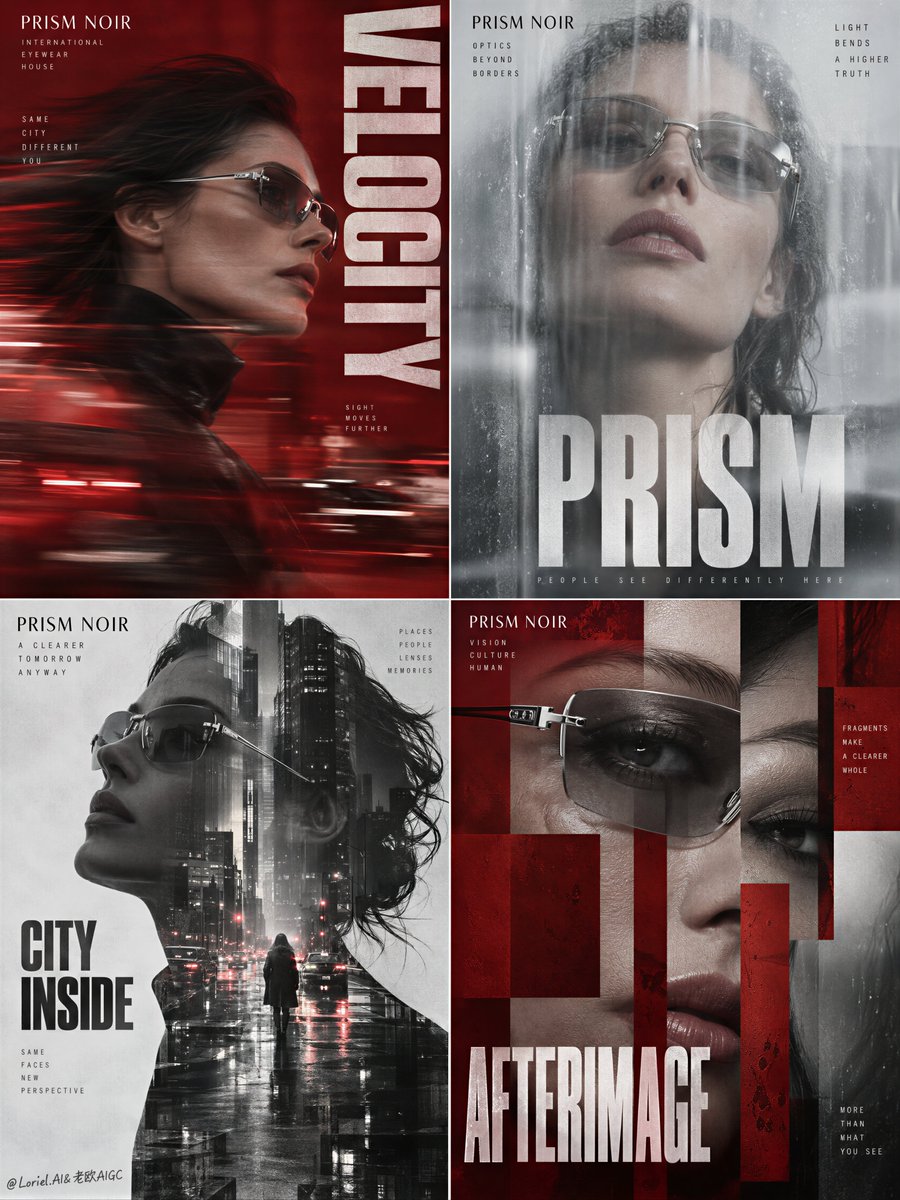
color_palette · high-contrastcomposition · close-upcomposition · multi-panelhuman_attributes · glasseslighting · studio-lightsubject_type · fashion-person
提示词(原文,逐字保留)
The strongest eyewear boards don’t repeat one image—they repeat one lens through four different conditions.
🪞 Use one recognizable eyewear silhouette across speed, rain-filtered glass, city reflection, and tight facial crops. The campaign gains range without losing product recall.
🟥 Let red blocks interrupt the close-up only where they frame the lens, eye, or type. Fragmentation then feels like a visual point of view—not decoration.
GPT- image 2.5 prompt👇
Create a premium four-panel editorial fashion poster for a fictional international luxury eyewear house named PRISM NOIR, designed as a single square 2x2 grid composition with razor-clean panel divisions and a strict gallery-magazine layout. The campaign must feel like a Cannes-level fashion key visual, a collectible art-zine cover system, and a product-led optical advertisement at the same time. Preserve the reference logic as pure visual structure only, but compress it into four stronger, more distilled panels: alternating crimson and pale-grey tonal worlds, blurred and sharp portrait contrasts, frosted-glass overlays, face fragment crops, urban double exposure, giant typography, and cold editorial spacing.
The true product hero is one consistent eyewear family repeated across all four panels: sculptural luxury optical pieces with translucent smoke lenses, pale silver titanium temples, refined frameless or semi-rimless geometry, subtle mirror glare, precise hinge engineering, and expensive fashion-tech presence. The eyewear must appear across every panel as the recurring identity anchor, sometimes fully visible, sometimes partially obscured by blur, crop, reflection, or masking, but always clearly the defining object of the campaign. The eyewear should feel like a prestige design artifact, not generic sunglasses.
Top-left panel: a deep lacquer-red motion portrait with a mature female model in side profile moving through soft horizontal blur, the eyewear catching a thin silver highlight while the face remains elegant and partially smeared by speed. The panel should communicate urban velocity and psychological distance. Integrate one giant vertical or stacked word such as "VELOCITY" or "STATIC" in bold condensed uppercase, but keep it sparse and architectural.
Top-right panel: a cool pale-grey portrait behind a frosted-glass plane, the model facing slightly upward or toward camera, wearing the hero eyewear with refined lens reflection and softened facial edges. The glass haze, reflection bands, and optical distortion should make the face feel half-visible, as if seen through a veil of light. Place one large typographic word such as "PRISM" or "GLAZE" across the lower or central area, with only minimal supporting microtype if absolutely needed.
Bottom-left panel: a monochrome-to-grey urban double-exposure silhouette where the outline of a woman wearing the eyewear contains city streets, windows, architectural voids, and distant traffic glow. The body becomes a vessel for metropolitan memory and emotional isolation. Keep the eyewear readable within the silhouette logic. Add one short editorial headline such as "LOST IN THE STATIC" or "CITY INSIDE" in a controlled, sparse typographic system.
Bottom-right panel: a red-and-grey fragmented face composition where the portrait is divided into geometric mask blocks or vertical strips, revealing different parts of the face, lens, eye, mouth, and skin texture. This is the most graphic and curatorially sharpened panel, combining close-up beauty realism with rigid editorial construction. The eyewear should sit at the center of the visual disruption, becoming the line between identity and abstraction. Use one bold short word such as "HER", "AFTERIMAGE", or "STATE" as the typographic anchor.
Across all four panels, the models are real mature women with correct anatomy, refined fashion-editorial features, believable skin texture, natural lips, accurate eyes, elegant neck-shoulder proportion, and no plastic smoothing. Hair can vary subtly between panels but must stay within one coherent cold-fashion world: sleek bob, controlled wet strands, or soft studio flyaways. If hands appear, they must be anatomically correct with five fingers and elegant gesture logic. Emotion across the board is controlled alienation, optical seduction, urban intimacy, and self-possession.
Color hierarchy: 40% saturated crimson, lacquer red, and deep vermilion; 35% pale paper-grey, stone-beige, and cold silver haze; 15% black, charcoal, and urban shadow; 10% white typography and chrome-silver eyewear highlights. Lighting must shift between soft editorial daylight, neon-reflected blur, frosted studio glow, and low urban contrast, but stay unified through cool luxury grading. Typography must behave as graphic architecture, not ad copy: giant condensed uppercase, sparse microtext, vertical index-like labels, and a few short editorial fragments only. All visible text must be newly invented in English only, crisp and beautiful, integrated into the composition flow, and never crudely pasted over the eyes or the core eyewear silhouette.
Material semantics must be explicit and high-end: glass haze, mirrored lens glare, titanium temple sheen, skin pores, paper grain, print dust, urban window reflections, mask edges, and soft analogue blur. The overall result must feel like a world-class fashion-optics campaign where the product is not isolated from the image world but becomes the visual language of memory, city, identity, and refraction.
Quality control and exclusion constraints: photoreal fashion-editorial realism only, no cartoon styling, no warped eyewear geometry, no floating temples, no broken hinge logic, no distorted face, no asymmetrical eyes, no duplicated facial features, no plastic skin, no unreadable typography, no random letters, no cheap glitch effects, no muddy red, no cluttered layout, no style drift, no AI slop, no real person names, no brand plagiarism, no hand deformity, no extra fingers, no missing fingers, no fused fingers.
中文译文
最强的眼镜视觉板不会重复同一张图像——而是通过四种不同条件重复同一副镜片。
🪞 在速度、雨水过滤的玻璃、城市反射和紧密的面部裁切这四种条件下,使用同一可识别的眼镜轮廓。系列在不损失产品记忆点的前提下获得广度。
🟥 仅在红色块能框住镜片、眼睛或文字的位置,让红色块打断特写。如此一来,碎片化便成为一种视觉观点——而非装饰。
GPT- image 2.5 prompt👇
为一家名为 PRISM NOIR 的虚构国际奢侈眼镜品牌,创作一张高级的四格编辑时尚海报,采用 2x2 单正方形网格构图,分格边缘如刀裁般利落,遵循严苛的画廊-杂志版式。该系列须同时具备戛纳级别的时尚主视觉、可收藏的艺术独立志封面体系,以及产品主导的光学广告气质。仅将参考逻辑作为纯粹视觉结构保留,但将其压缩为四个更强烈、更精炼的面板:绯红与淡灰的双调世界交替、模糊与锐利的人像对比、磨砂玻璃叠加、面部碎片裁切、城市双重曝光、巨型字体以及冷静的编辑式留白。
真正的产品主角是一组贯穿四个面板的同一眼镜系列:雕塑感的高端光学作品,配半透明烟熏镜片、淡银色钛金属镜腿、精致的无框或半框几何造型、含蓄的镜面反光、精密的铰链工程,以及昂贵的前沿时尚科技存在感。眼镜必须作为反复出现的身份锚点出现在每个面板中——有时完整可见,有时被模糊、裁切、反射或遮罩部分遮挡——但始终是系列中清晰可辨的标志性物件。眼镜应呈现为声望卓著的设计工艺品,而非普通的太阳镜。
左上格:深漆红色调的运动人像,成熟的女性模特以侧脸姿态穿越柔和的水平动态模糊,眼镜捕捉一道细窄的银色高光,面部保持优雅并被速度轻微晕染。该面板应传达都市速度感与心理距离感。整合一个巨型纵向或堆叠排版的英文单词,如 "VELOCITY" 或 "STATIC",采用粗体压缩大写字母,但保持稀疏与建筑感。
右上格:冷调的淡灰色人像,位于一面磨砂玻璃平面之后,模特微微仰头或面向镜头,佩戴主角眼镜,呈现精致的镜片反光与柔化的面部边缘。玻璃的雾感、反射光带与光学失真应让面孔呈现若隐若现的状态,仿佛透过一层光的薄纱。在下方或中央位置放置一个巨大的英文排印单词,如 "PRISM" 或 "GLAZE",仅在绝对必要时附以极简辅助微文字。
左下格:单色至灰色的都市双重曝光剪影,其中佩戴眼镜的女性轮廓内包裹着城市街道、窗户、建筑空隙以及远处的车灯辉光。身体成为都市记忆与情感孤独的容器。在剪影逻辑中保持眼镜的可读性。增加一条简短的编辑标题,如 "LOST IN THE STATIC" 或 "CITY INSIDE",采用克制、稀疏的排印体系。
右下格:红灰相间的碎片化面孔构图,人像被分割为几何面具块面或垂直条带,揭示面部、镜片、眼睛、嘴唇与皮肤纹理的不同部分。这是图形感最强、策展感最锐利的一格,将特写美妆写实与严谨的编辑式构成结合。眼镜应坐落于视觉断裂的中心,成为身份与抽象之间的界线。使用一个醒目的简短英文单词,如 "HER"、"AFTERIMAGE" 或 "STATE" 作为排印锚点。
贯穿四个面板,模特均为成熟的真实女性,解剖结构正确,具备精炼的时尚编辑特征,皮肤质感真实,双唇自然,眼神精准,颈肩比例优雅,杜绝塑胶磨皮感。发型在不同面板间可细微变化,但必须统一在同一冷酷时尚语境中:利落的波波头、受控的湿发缕或柔软的摄影棚飞发。若手部出现,须解剖正确,五指齐全,手势优雅。全局情绪为克制的疏离感、光学的诱惑、都市的亲密与自我笃定。
色彩层级:40% 饱和绯红、漆红与深朱红;35% 淡纸灰、石灰米色与冷银雾;15% 黑色、炭灰与都市阴影;10% 白色排版与镀铬银色眼镜高光。光线须在柔和的编辑日光、霓虹反射模糊、磨砂摄影棚辉光与低对比都市光之间切换,但通过冷调奢华调性保持统一。排印须表现为图形建筑而非广告文案:巨型压缩大写、稀疏微文字、纵向索引式标签,以及仅几条简短的编辑碎片。所有可见文字必须为全新英文自创词组,清晰优美,融入构图流动,绝不粗暴地贴覆于眼睛或核心眼镜轮廓之上。
材质语义必须显化且高端:玻璃雾感、镜面镜片反光、钛金属镜腿光泽、皮肤毛孔、纸纹、印刷尘点、都市窗反、面具边缘以及柔和的模拟模糊。整体须呈现为一场世界级的时尚-光学系列:产品并不脱离图像世界孤立存在,而是成为记忆、城市、身份与折射的视觉语言。
质量控制与排除约束:仅限摄影写实的时尚编辑现实主义,无卡通风格、无扭曲的眼镜几何、无漂浮镜腿、无断裂的铰链逻辑、无变形面孔、无不对称眼睛、无重复面部特征、无塑胶皮肤、无不可读的排版、无随机字母、无廉价故障效果、无浑浊红色、无杂乱版式、无风格漂移、无 AI 废片、无真实人名、无品牌抄袭、无手部畸形、无多余手指、无缺失手指、无粘连手指。
来源与署名
原文由 @ou_zhen599 发布在 X:查看原推文。 本页逐字保留原文并提供机器翻译的中文解读;版权归原作者所有。
同工具的更多提示词
- 标准短提示词在常用的模型上效果不错,但对 GPT Image 2 或 2.5 不行。对于这两个模型,去掉"S-curve"和"bikini"这两个词。 改用…@tealdog2
- { "prompt_type": "photorealistic_reference_variation", "objective": "以提供的参考照片为指…@rewind02
- 一次双重曝光需要第二个场景来承担任务。 🪽 将门框、垂直窗棂和柔和反光与肖像的额头、脸颊、脖颈与肩部平面相对齐 让建筑结构嵌入面部之中,而非像拼贴一样浮于其上…@ou_zhen599
- 以参考图像作为绝对的视觉与解剖学参考。保持与参考图像完全一致的角色身份、精确的面部特征、头型、发型、肤色、身体比例、高宽比、肌肉量、肩宽、长四肢、腰围以及整体…@MayorKingAI
- 在科技海报中,字体应强化轮廓,而非遮蔽产品。 🪽 将巨型压缩字块置于头部与耳机之后;仅允许一道细轮廓笔画横越人物 字体承载海报级冲击力,同时耳罩与头梁仍须保持…@ou_zhen599
- 创作一位身着深酒红色单色造型的女性,包含皮夹克、黑色紧身裤、长大围巾及黑色高筒靴。她倚靠在同色系的酒红色门前摆姿势。 她拥有黑色长直发配刘海,眉形分明,棕色眼…@DigitalManSteve