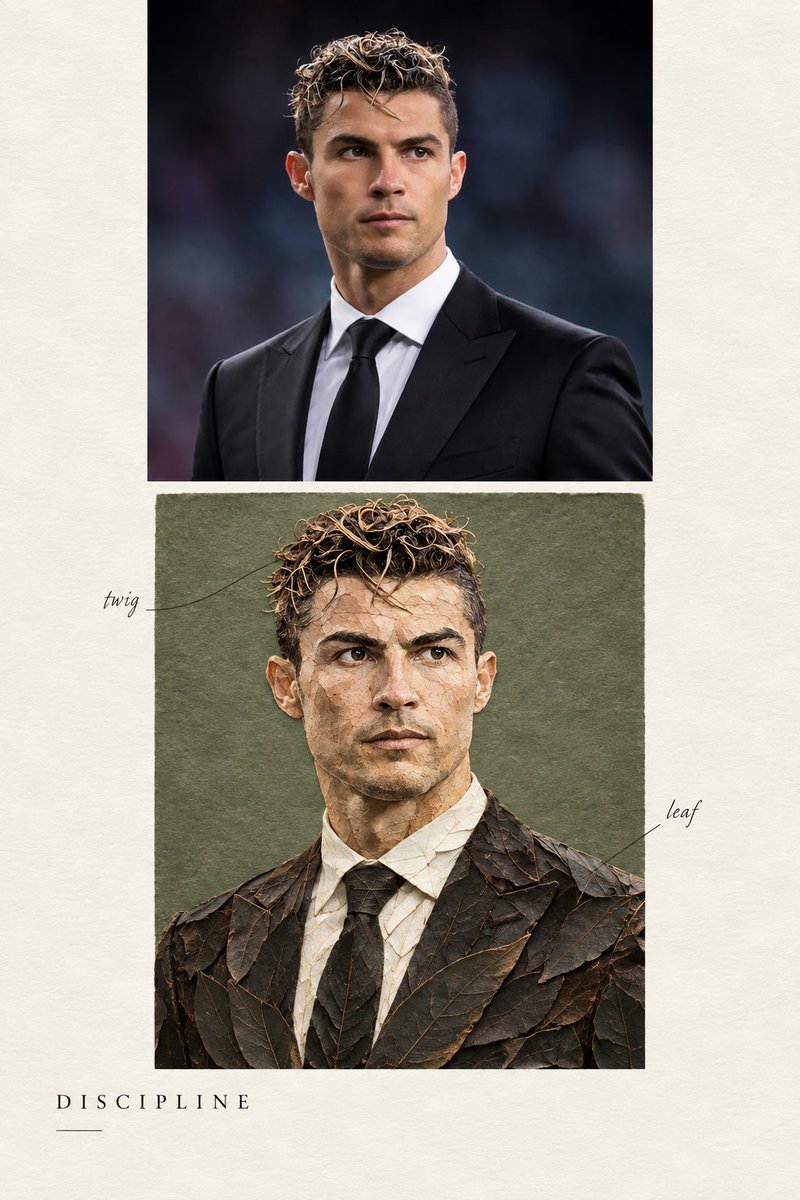
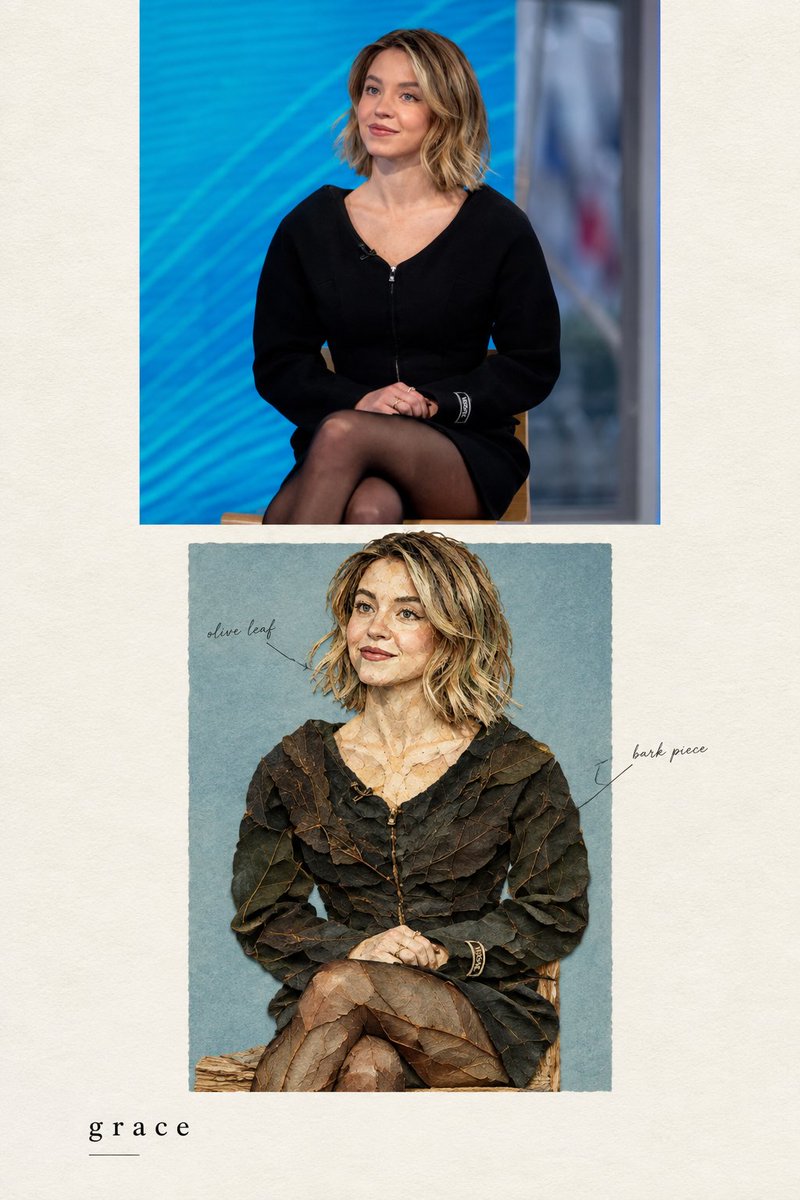
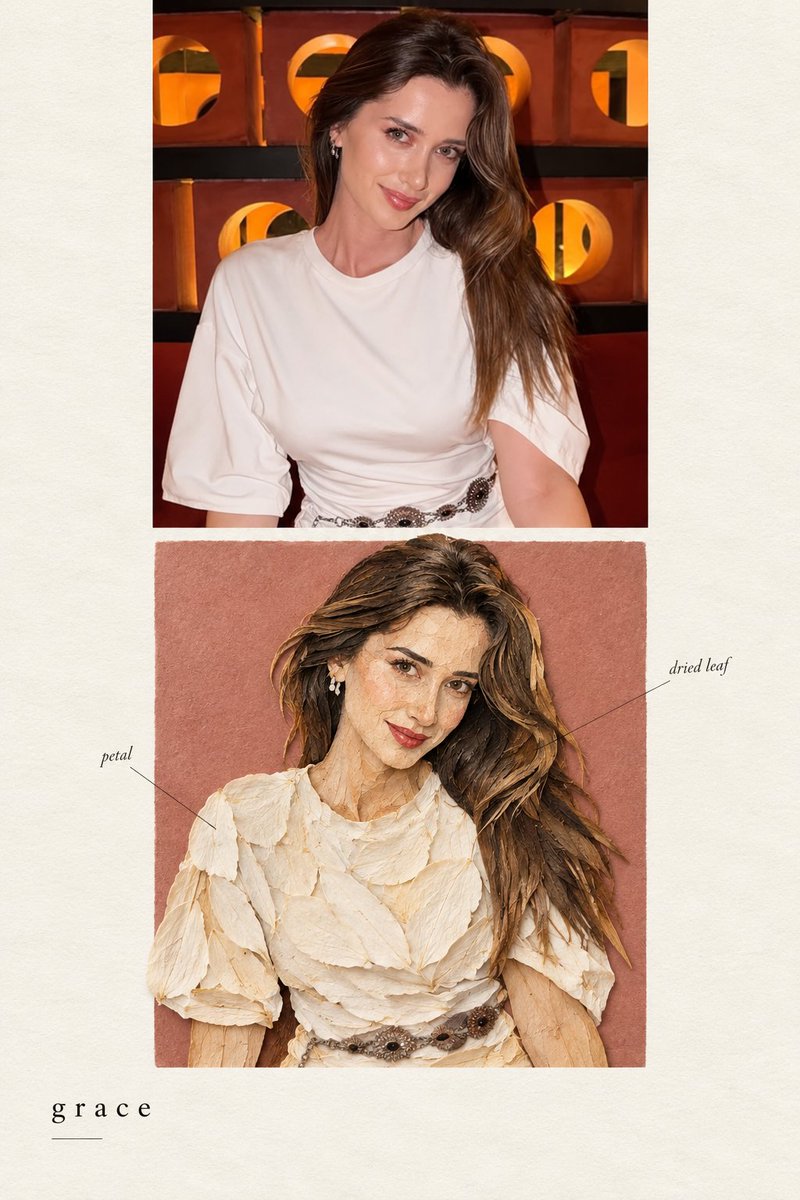
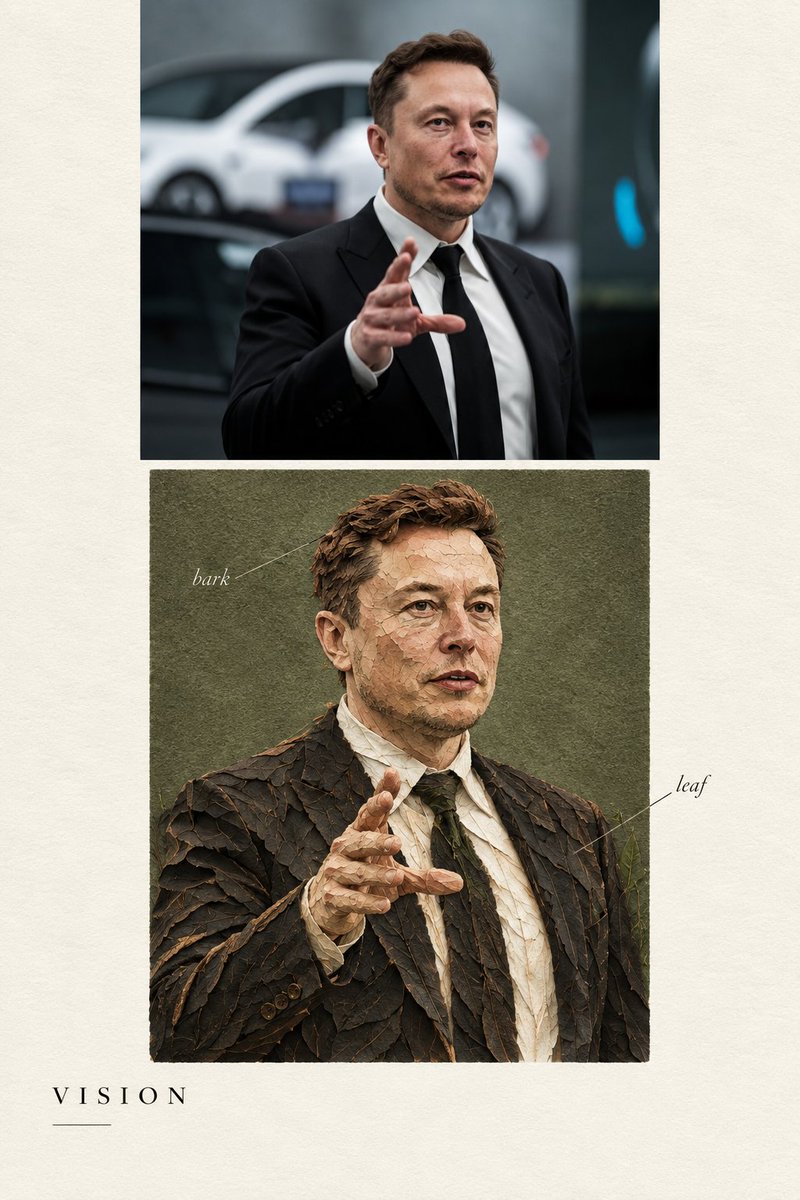
以所上传的照片作为准确的视觉参考,创作一幅竖向双面板的编辑风格艺术作品。
分享链接 · https://openimages.ajiang.me/p/2101542040588726592/
color_palette · earthycomposition · multi-panelmood · elegantquality_flags · multi-panel-layoutsubject_type · fashion-personsubject_type · portrait
提示词(原文,逐字保留)
Create a vertical two-panel editorial artwork using the uploaded photograph as the exact visual reference.
TOP HALF — ORIGINAL PHOTO
Keep the top half as the real, unaltered photograph. Preserve the subject's identity, face, hair, clothing, pose, proportions and gesture. For animals, preserve coat colour, markings, ears, body shape, tail and action. If there is a person-and-animal pair, preserve their exact relationship and positioning.
Architecture and complex background details remain photographic only and must not be recreated in the lower half.
BOTTOM HALF — NATURAL-MATERIAL RECREATION
Rebuild the same subject, pose and silhouette as a sophisticated editorial illustration made entirely from real leaves, petals, twigs, grass stems, fruits, seeds, bark and dried leaves.
The natural materials must form the actual structure of the subject—not simply decorate a drawn figure.
Use their natural shapes intelligently:
- Hair from layered or curling leaves and grass.
- Clothing from overlapping leaves and petals.
- Arms and legs from twigs, grass stems or narrow leaves.
- Ears from naturally pointed leaves.
- Tails from curved twigs or slender plant material.
- Face and body from the natural contours, textures and edges of the materials.
Do not draw the subject's outline first and fill it with plants. Do not cut plants into geometric shapes or create a children's leaf-craft appearance. The same person, animal or pair from the photograph must remain immediately recognisable.
COMPOSITION & COLOUR
Place the natural-material subject within one simple rectangular colour field on a pale paper background. The rectangle must have a perfectly straight bottom and right edge, with no notches, steps or inner panels.
Allow only a few naturally directional elements—such as a hand, ear, tail, twig or grass stem—to extend beyond the field organically.
Keep generous white space, an elegant centre of gravity and slightly imperfect symmetry.
Match the photograph's strongest colours using the natural colours of the materials themselves. Preserve real variations in leaf, petal, fruit, bark and dried-plant colours. Never make all materials artificially uniform.
Use black linework only as a minimal supporting detail for eyes, mouth, tiny motion marks or small handwritten accents. Never create a complete black outline around the subject.
TEXT & TYPOGRAPHY
Include exactly three pieces of text:
1. One short English title.
2. One tiny annotation naming a real plant, material or object.
3. One different tiny annotation naming another real plant, material or object.
All text must use Latin letters only, be correctly spelled, and contain no copied signage, logos or text from the original photograph. No word may be repeated between the three text elements.
Keep typography subtle and editorial, never like a conventional poster headline.
EMPTY BOTTOM AREA
The bottom sixth of the entire image must remain completely empty paper, except the title if needed. No plants, colour field, twig, annotation or drawn line may enter this area.
The right third of this bottom strip must be completely empty, including the title.
FINAL LOOK
High-end contemporary editorial art direction: real photograph × real natural materials × delicate hand-drawn trace × clean geometric colour field × restrained typography.
The result should feel poetic, intelligent, handmade and intentionally art-directed—as if an artist physically selected natural materials and reconstructed the photographed subject from their own organic forms.
Do not invent subjects, duplicate limbs/objects, alter the identity, use complete outlines, create cartoon aesthetics, or turn the architecture into the natural-material collage.
中文译文
以所上传的照片作为准确的视觉参考,创作一幅竖向双面板的编辑风格艺术作品。
上半部分——原始照片
将上半部分保留为真实且未经修改的照片。保持主体的身份、面容、发型、服装、姿态、比例和动作。若是动物,则保留其毛色、花纹、耳朵、体型、尾巴和动作。若是人与动物的组合,则保留两者之间的确切关系和位置关系。
建筑和复杂的背景细节仅保留为照片,不得在下半部分中重绘。
下半部分——自然材料再造
将相同的主体、姿态和轮廓重新构建为一幅精致的编辑风格插画,完全由真实的叶子、花瓣、细枝、草茎、果实、种子、树皮和干叶构成。
自然材料必须构成主体的真实结构——而不仅仅是装饰一个绘制好的人物。
巧妙地利用它们的天然形态:
- 头发由层叠或卷曲的叶子与草构成。
- 服装由相互重叠的叶子和花瓣构成。
- 手臂与腿部由细枝、草茎或窄叶构成。
- 耳朵由天然尖形的叶片构成。
- 尾巴由弯曲的细枝或纤细的植物材料构成。
- 面部和身体由材料的自然轮廓、纹理和边缘构成。
不得先勾出主体轮廓再在内部填入植物。不得将植物切割成几何形状,也不得出现儿童手工叶贴画的观感。照片中的同一个人物、动物或组合必须能够被立刻认出。
构图与色彩
将自然材料构成的主体放置在浅色纸面背景上的一个简洁矩形色块之中。矩形必须具有完全平直的底边和右边,不得出现缺口、阶梯或内嵌分块。
仅允许少量具有自然方向感的元素——例如手、耳朵、尾巴、细枝或草茎——有机地延伸出色块之外。
保留充裕的留白、优雅的重心以及略带不完美的对称感。
用材料本身的天然颜色匹配照片中最强烈的色彩。保留叶子、花瓣、果实、树皮和干植物颜色中的真实差异。绝不使所有材料人为地统一化。
黑色线条仅作为细微的辅助细节,用于刻画眼睛、嘴部、微小的动作痕迹或小巧的手写点缀。绝不在主体周围绘制完整的黑色轮廓。
文字与排版
仅包含恰好三段文字:
1. 一个简短的英文标题。
2. 一处极小的注释,标注一种真实的植物、材料或物件。
3. 另一处不同的极小注释,标注另一种真实的植物、材料或物件。
所有文字只能使用拉丁字母,拼写必须正确,且不得包含原照片中的标识、徽标或文字。三段文字之间不得重复任何单词。
排版应保持细微、编辑感,绝不像常规海报标题那样。
底部空白区域
整个图像的底部六分之一必须保持完全空白的纸面,标题如需放置则除外。任何植物、色块、细枝、注释或绘制线条都不得进入此区域。
该底部长条右侧的三分之一必须完全留空,包括标题在内。
最终效果
高端当代编辑艺术指导:真实照片 × 真实自然材料 × 细腻的手绘痕迹 × 简洁的几何色块 × 克制的排版。
最终效果应具有诗意、聪慧、手工感与刻意的艺术指导感——仿佛一位艺术家亲手挑选自然材料,以其自身的有机形态重建了照片中的主体。
不得凭空发明主体,不得复制肢体或物件,不得改变身份,不得使用完整轮廓,不得制造卡通观感,也不得将建筑变为自然材料拼贴。
来源与署名
原文由 @Goodmanprotocol 发布在 X:查看原推文。 本页逐字保留原文并提供机器翻译的中文解读;版权归原作者所有。
同工具的更多提示词
- GPT Image 2.5 Prompt 创建一个超现实的顶级赛车运动编辑海报,画面中是一辆白色 GT 赛车,采用戏剧性的高角度俯视视角拍摄。 格式: 垂直…@harboriis
- 维兹拉(Vyzira),帝国角精灵圣物君主。身高10头身,拉长的尖耳,苍白瓷器般的肌肤,锋利的颧骨,深色唇部,发光的琥珀色双眼,乌鸦般的黑发。巨大、向后上方弧…@itsPixieVerse
- 创作一张超写实的编辑时尚海报,灵感来自日本实验性杂志封面,具有大胆的当代视觉设计和电影级摄影风格。 格式: 竖版人像海报,4:5 长宽比,高分辨率,清晰专业的…@Shorelyn_
- 一幅酒店三联画需要在中间安放一个仪式场景。 🍊 左侧放置目的地建筑,右侧放置一个亲密的人性瞬间,二者都笼罩在同一种余烬琥珀色夜光之中 外侧两幅画框确立你所处的…@ou_zhen599
- 一幅精致的极简生活方式艺术海报,以 [PERSON / SUBJECT / MOMENT](人物 / 主体 / 瞬间)作为核心焦点,从一张真实生活的照片转化为…@Naiknelofar788
- 当每个面板只承担一个职责时,奢华版面会更安静。 🪽 顶部严格三栏:一处有烟火气的咖啡馆肖像,一组产品与材质静物,一个完整的定制剪影 每一张图都在传递不同的卖点…@ou_zhen599