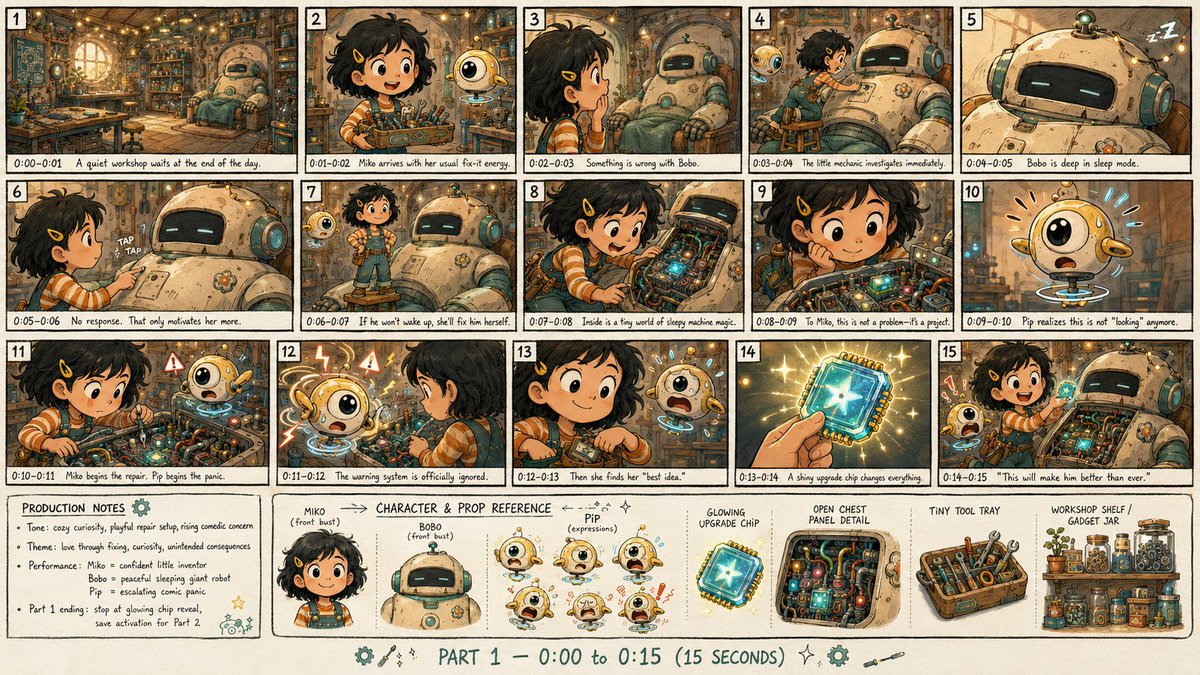
为一部名为《小机械师与沉睡的机器人》的原创2D动画短片的第一部分(PART 1)创建一张高细节的专业故事板(分镜)单页图像。该页应呈现…
分享链接 · https://openimages.ajiang.me/p/2085702931026956369/
color_palette · mutedcolor_palette · warm-tonescomposition · multi-panelmood · cozymood · playfulquality_flags · multi-panel-layout
提示词(原文,逐字保留)
Create a single high-detail professional storyboard sheet image for PART 1 of an original 2D animated short titled “The Little Mechanic and the Sleeping Robot”. The sheet should present a complete 15-second storyboard for Part 1 only, with a cozy, playful, family-friendly retro-futuristic sci-fi comedy tone. Make it feel like a polished animation pre-production board in a soft painterly 2D cartoon style, with expressive acting, rounded appealing character shapes, warm workshop lighting, whimsical gadget details, and strong emotional readability. The story must be fully original and copyright-safe. Do not use copyrighted robot designs, franchise characters, logos, or recognizable brand references. Keep everything safe, gentle, funny, and heartwarming. No violence, no dangerous repair actions, no scary robot imagery, and no disturbing transformations. All tools and tech should feel harmless, stylized, and child-friendly.
The image should look like a professional storyboard page with a clean off-white paper background, subtle paper texture, neat hand-drawn panel borders, readable handwritten captions, and a charming studio development presentation. Use subtle selective color throughout the whole board, with warm oranges, teal-blue tech glows, cream metal tones, cozy yellow workshop light, and soft pink or mint accent details. Use light pencil-and-ink linework with soft painted fills and a visually organized, dense but readable layout. At the bottom center, include the label: “PART 1 – 0:00 to 0:15 (15 SECONDS)” with tiny doodled gear icons, spark shapes, or little tool motifs. Arrange the storyboard as 15 panels in a 3-row by 5-column grid. Every panel must have a number, timestamp, and short caption beneath it. The page should feel cinematic, cute, polished, and easy to follow.
Story concept for Part 1: In a cozy retro-future workshop, little inventor Miko discovers that her beloved old house robot Bobo is asleep in power-down mode. She immediately decides to fix him herself. While Miko cheerfully inspects his chest panel and prepares an upgrade, the tiny floating helper bot Pip slowly realizes she is about to perform a completely unauthorized “repair.” The part ends on a cliffhanger when Miko confidently reveals a glowing upgrade chip and declares that Bobo will be better than ever.
Main character designs:
Miko: little girl around 7–8 years old, short fluffy black hair, one yellow hairclip, big curious eyes, cheerful expressive face, teal mechanic overalls, orange striped shirt, small tool belt with harmless gadgets, confident inventive energy, small but energetic body language.
Bobo: big old friendly house robot, rounded soft design, cream-metal body with teal accents, large gentle arms, slightly worn but lovable surface details, simple digital eyes that are currently powered off or sleepy slits, broad calm body shape, non-threatening and cozy.
Pip: tiny floating helper bot, round yellow-white body, one large expressive eye, small hover ring or propeller, comic panic personality, cute and dramatic reaction character.
Props / environment: cozy workshop bench, jars of screws and bolts, glowing string lights, hanging tools, tiny harmless wrenches, gears, gadget drawers, stool, dust cloth, chest panel, colorful wires, glowing components, small tray of tools, shiny upgrade chip, shelves filled with inventions. Everything should feel imaginative, cute, and warm.
Use a retro-futuristic workshop setting that feels handmade and lived-in, with warm ambient light, teal glows from old tech, and lots of cozy mechanical clutter. The tone should be curious and playful, with a slight comedic sense of “oh no, what is she about to do?”
Include exactly these 15 storyboard panels with clear visual storytelling:
1. (0:00–0:01)
Wide establishing shot of the cozy retro-future workshop. Shelves of gadgets, hanging tools, glowing string lights, and worktables fill the room. In the background, Bobo sits powered down in a corner chair or charging nook. Caption: “A quiet workshop waits at the end of the day.”
2. (0:01–0:02)
Miko enters carrying a small tray or toolbox, full of playful confidence. Pip floats nearby in a calm ordinary mood. Caption: “Miko arrives with her usual fix-it energy.”
3. (0:02–0:03)
Miko notices Bobo in the corner and stops suddenly. Her expression shifts to surprise and concern when she sees his chest light is off. Caption: “Something is wrong with Bobo.”
4. (0:03–0:04)
Medium shot. Miko rushes toward Bobo, kneeling or climbing onto a small stool to inspect him closely. Pip hovers behind, curious. Caption: “The little mechanic investigates immediately.”
5. (0:04–0:05)
Close-up on Bobo’s face and upper body. His digital eyes are dark or half-sleeping, his body still and peaceful, with a tiny bit of dust or a dangling string light. Caption: “Bobo is deep in sleep mode.”
6. (0:05–0:06)
Miko gently taps Bobo’s arm or chest panel, trying to wake him. No response. She becomes more determined. Caption: “No response. That only motivates her more.”
7. (0:06–0:07)
Miko pulls a tiny stool into place and climbs up in front of Bobo’s chest. She plants her hands on her hips like a professional inventor. Caption: “If he won’t wake up, she’ll fix him herself.”
8. (0:07–0:08)
Miko opens Bobo’s small chest panel. Inside are colorful wires, glowing little lights, friendly gadget components, and neat retro-future mechanical details. Caption: “Inside is a tiny world of sleepy machine magic.”
9. (0:08–0:09)
Close-up of Miko leaning in with delight, studying the harmless wires and components like a puzzle. Caption: “To Miko, this is not a problem—it’s a project.”
10. (0:09–0:10)
Pip notices what Miko is doing and suddenly widens its eye in alarm. Its hover posture stiffens in comic concern. Caption: “Pip realizes this is not ‘looking’ anymore.”
11. (0:10–0:11)
Miko starts lightly inspecting parts with a tiny harmless tool or gloved finger, while Pip hovers closer, trying to warn her with nervous gestures or warning icons. Caption: “Miko begins the repair. Pip begins the panic.”
12. (0:11–0:12)
Pip becomes more dramatic—spinning, flashing warning symbols, or waving tiny caution signs. Miko barely notices because she is too focused. Caption: “The warning system is officially ignored.”
13. (0:12–0:13)
Miko reaches into her tool tray or belt and pulls out something special. Keep the reveal partially hidden for suspense. Pip looks horrified. Caption: “Then she finds her ‘best idea.’”
14. (0:13–0:14)
Close-up reveal of the shiny glowing upgrade chip in Miko’s hand. It should look bright, fun, and mysterious, not dangerous. Caption: “A shiny upgrade chip changes everything.”
15. (0:14–0:15)
Cliffhanger ending panel. Miko smiles proudly while holding the glowing chip near Bobo’s open chest panel. Pip is in full panic mode beside her. Bobo remains peacefully asleep. Caption: “‘This will make him better than ever.’”
Under the storyboard grid, include a small note section with handwritten production notes such as:
Tone: cozy curiosity, playful repair setup, rising comedic concern
Theme: love through fixing, curiosity, unintended consequences
Performance: Miko = confident little inventor, Bobo = peaceful sleeping giant robot, Pip = escalating comic panic
Part 1 ending: stop at glowing chip reveal, save activation for Part 2
Also include a small right-side or lower-side character / prop reference area if space allows, with quick design callouts for:
Miko front bust
Bobo front bust
Pip expression study
glowing upgrade chip
open chest panel detail
tiny tool tray
workshop shelf / gadget jar sketch
Keep the whole sheet visually polished, readable, charming, original, and emotionally clear. Make sure the suspense gently builds from discovery to inspection to the glowing-chip cliffhanger, while keeping the visual style warm, whimsical, and consistent with a high-quality 2D animated short film development board.
中文译文
为一部名为《小机械师与沉睡的机器人》的原创2D动画短片的第一部分(PART 1)创建一张高细节的专业故事板(分镜)单页图像。该页应呈现完整的15秒故事板内容(仅限第一部分),整体基调为温馨、俏皮、适合全家观看的复古未来科幻喜剧风格。画面需呈现出精致的动画前期制作板效果,采用柔和的绘画式2D卡通风格,表演富有表现力,角色造型圆润讨喜,工坊灯光温暖,道具细节充满奇趣,且情感表达清晰可读。故事必须完全原创且版权安全。不得使用受版权保护的机器人设计、已有系列角色、标志或可识别的品牌引用。所有内容应保持安全、温和、有趣且温暖。不得出现暴力、危险的修理动作、恐怖的机器人形象或令人不安的变形。所有工具与科技都应显得无害、风格化且对儿童友好。
图像应看起来像专业故事板页面:干净的米白纸张背景,细腻的纸张纹理,工整的手绘画格边框,可读的旁白手写字体,以及迷人的工作室开发演示效果。在整块板上使用细腻的局部上色,色彩包括温暖的橙色、青蓝色的科技光晕、奶油色金属调、温馨的黄色工坊灯光,以及柔和的粉色或薄荷色点缀。线稿采用淡雅的铅笔与墨水线条,配合柔和的上色填充,布局视觉上整齐有序、密集但清晰可读。在底部中央加入标签:“PART 1 – 0:00 to 0:15 (15 SECONDS)”,并配以小巧的齿轮涂鸦、闪光形状或迷你工具图案。故事板按3行5列网格排列,共15个画格。每个画格下方都必须有编号、时间戳和简短旁白。整页应具有电影感、可爱精致且易于阅读。
第一部分的故事概念:在温馨的复古未来工坊中,小小发明家米可(Miko)发现她心爱的老旧家务机器人波波(Bobo)正处于关机休眠状态。她立刻决定自己来修理他。当米可愉快地检查他的胸前面板并准备升级时,漂浮的小助手机器人小皮(Pip)渐渐意识到她即将进行一场完全未经授权的"修理"。这一部分在悬念中结束:米可自信地展示出一枚发光的升级芯片,并宣布波波将会变得比以往更好。
主要角色设计:
米可(Miko):7–8岁的小女孩,短而蓬松的黑发,一枚黄色发夹,大而好奇的眼睛,表情开朗富有表现力,青绿色机械工装裤,橙色条纹衬衫,腰间小工具带挂着无害的小工具,自信充满发明家气质,身形小巧但动作充满活力。
波波(Bobo):高大友好的老式家务机器人,造型圆润柔和,奶油色金属身体配青绿色装饰,手臂粗大温和,表面略有磨损但讨喜可爱,数字眼睛目前处于关闭状态或呈睡眠细缝状,身形宽厚沉稳,给人无害而安心的感觉。
小皮(Pip):微型漂浮助手机器人,圆形黄白色身体,一只大大的富有表情的眼睛,小型悬浮环或螺旋桨,喜剧式的慌乱个性,可爱且反应夸张。
道具/环境:温馨的工作台,装满螺丝和螺栓的罐子,发光的串灯,悬挂的工具,无害的小扳手,齿轮,工具抽屉,凳子,抹布,胸前面板,五颜六色的电线,发光元件,小型工具托盘,闪闪发亮的升级芯片,摆满发明的架子。一切都应显得充满想象力、可爱且温暖。
采用复古未来工坊设定,呈现手工打造且有人生活气息的氛围,温暖的环境光,旧科技散发的青绿色光晕,以及大量舒适的机械杂物。整体基调应好奇而俏皮,带有一点"哦不,她到底要干什么?"的喜剧感。
请严格按照以下15个故事板画格进行清晰视觉叙事:
1. (0:00–0:01)
温馨复古未来工坊的远景建立镜头。架子上摆满小工具,挂着的工具,发光的串灯和工作台填满房间。背景中,波波坐在角落的椅子或充电凹槽中处于关机状态。旁白:"A quiet workshop waits at the end of the day."(一天结束时,安静的车间静静等待。)
2. (0:01–0:02)
米可入场,手持小托盘或工具箱,充满俏皮的自信。小皮在旁边漂浮,情绪平静平常。旁白:"Miko arrives with her usual fix-it energy."(米可以她一贯的修理活力到来。)
3. (0:02–0:03)
米可注意到角落的波波,突然停下脚步。看到他胸前的灯熄灭,她的表情转为惊讶和担心。旁白:"Something is wrong with Bobo."(波波有些不对劲。)
4. (0:03–0:04)
中景。米可冲向波波,跪下或爬上小凳子近距离检查他。小皮在身后悬浮,好奇地观望。旁白:"The little mechanic investigates immediately."(小机械师立刻开始调查。)
5. (0:04–0:05)
波波面部和上半身的特写。他的电子眼睛暗淡或半闭,身体静止安详,沾着一点点灰尘或挂着一盏串灯。旁白:"Bobo is deep in sleep mode."(波波处于深度休眠模式。)
6. (0:05–0:06)
米可轻轻拍打波波的手臂或胸前面板,试图唤醒他。没有反应。她变得更加坚定。旁白:"No response. That only motivates her more."(没有反应。这只会让她更有干劲。)
7. (0:06–0:07)
米可把小凳子拉到合适位置,爬到波波胸口前方。她双手叉腰,像一个专业的发明家。旁白:"If he won’t wake up, she’ll fix him herself."(如果他不肯醒来,她就自己把他修好。)
8. (0:07–0:08)
米可打开波波的小胸前面板。内部是五颜六色的电线、闪闪发光的小灯、友好的元件,以及整齐的复古未来机械细节。旁白:"Inside is a tiny world of sleepy machine magic."(里面是一个沉睡机器魔法的小小世界。)
9. (0:08–0:09)
米可凑近仔细观察的特写,她愉快地研究无害的电线和元件,像在解谜。旁白:"To Miko, this is not a problem—it’s a project."(对米可来说,这不是问题——这是一个项目。)
10. (0:09–0:10)
小皮注意到米可的行为,突然睁大眼睛露出惊慌。它的悬浮姿态僵硬起来,带着喜剧式的担忧。旁白:"Pip realizes this is not ‘looking’ anymore."(小皮意识到这已经不再是"看看"了。)
11. (0:10–0:11)
米可开始用无害的小工具或戴着手套的手指轻轻检查部件,小皮则靠近悬浮,试图用紧张的肢体动作或警告图标提醒她。旁白:"Miko begins the repair. Pip begins the panic."(米可开始修理,小皮开始慌张。)
12. (0:11–0:12)
小皮变得更加夸张——旋转、闪出警告符号,或挥舞小小的警示牌。米可因为太专注而几乎没有注意到。旁白:"The warning system is officially ignored."(警报系统被正式无视。)
13. (0:12–0:13)
米可伸手从工具托盘或腰带上取出一件特别的东西。为保持悬念,揭示部分要部分遮挡。小皮看起来惊恐万分。旁白:"Then she finds her ‘best idea.’"(然后她找到了自己的"绝妙主意"。)
14. (0:13–0:14)
米可手中闪闪发光升级芯片的特写揭示。它应该看起来明亮、有趣且神秘,但不危险。旁白:"A shiny upgrade chip changes everything."(一枚闪闪发亮的升级芯片改变了一切。)
15. (0:14–0:15)
悬念结尾画格。米可自豪地微笑着,把发光的芯片举到波波打开的胸前面板附近。小皮在一旁处于完全惊慌状态。波波依然安详沉睡。旁白:"‘This will make him better than ever.’"("这会让他比以前更好。")
在故事板网格下方,加入一个小型笔记区,包含手写制作备注,例如:
Tone(基调):温馨的好奇、俏皮的修理铺垫、逐渐上升的喜剧担忧
Theme(主题):通过修理表达爱、好奇、无意中的后果
Performance(表演):米可 = 自信的小小发明家,波波 = 安详沉睡的巨型机器人,小皮 = 不断升级的喜剧式惊慌
Part 1 ending(第一部分结尾):停在发光芯片揭示处,激活场面留到第二部分
如空间允许,可在右侧或下方加入一个小型的角色/道具参考区,包含以下快速设计注释:
Miko front bust(米可正面半身像)
Bobo front bust(波波正面半身像)
Pip expression study(小皮表情研究)
glowing upgrade chip(发光升级芯片)
open chest panel detail(打开的胸前面板细节)
tiny tool tray(小型工具托盘)
workshop shelf / gadget jar sketch(工坊架子/零件罐草图)
整张图稿应保持视觉精致、可读、迷人、原创且情感清晰。悬念应从发现、检视轻柔地推进到发光芯片的悬念结尾,同时保持温暖、奇趣的视觉风格,并与高质量2D动画短片开发板保持一致。
来源与署名
原文由 @ManuAGI01 发布在 X:查看原推文。 本页逐字保留原文并提供机器翻译的中文解读;版权归原作者所有。
同工具的更多提示词
- 使用上传的产品或食物图片作为精确的主角参考。 创建一张超高端极简风格的 4:5 广告海报,将真实、超写实的上传物体与一幅优雅的黑白手绘涂鸦插画相结合。 创意构…@saurabh_uix
- 为一部原创2D动画短片《The Little Mechanic and the Sleeping Robot(小机械师与沉睡的机器人)》的第2部分(PART…@ManuAGI01
- 👇 主体内容: 两位20岁的东亚年轻女性并肩而立,左边的女孩浅栗棕色短发,佩戴白色发簪花饰;右边的女孩黑色拧花辫发型,配以红色花朵与流苏发饰;精致的鹅蛋脸,明…@qoobee2036
- 为一部名为《小机械师与沉睡的机器人》的原创2D动画短片绘制一张单一、高细节、专业级分镜表图片,仅对应第3部分。该表应呈现完整的15秒第3部分分镜,并在角色造型…@ManuAGI01
- 创建一个完整的高细节专业动画分镜表,采用精确的 16:9 宽屏横向格式,用于: “西奥与奈拉——那座等待某人的钟” 分镜章节: “第 4 部分 / 共 4 部…@ManuAGI01
- 为原创2D动画短片《小机械师与沉睡的机器人》的第4部分,绘制一张高细节的专业动画分镜表。这是1分钟故事中最后的15秒章节,必须与第1、2、3部分直接衔接,角色…@ManuAGI01