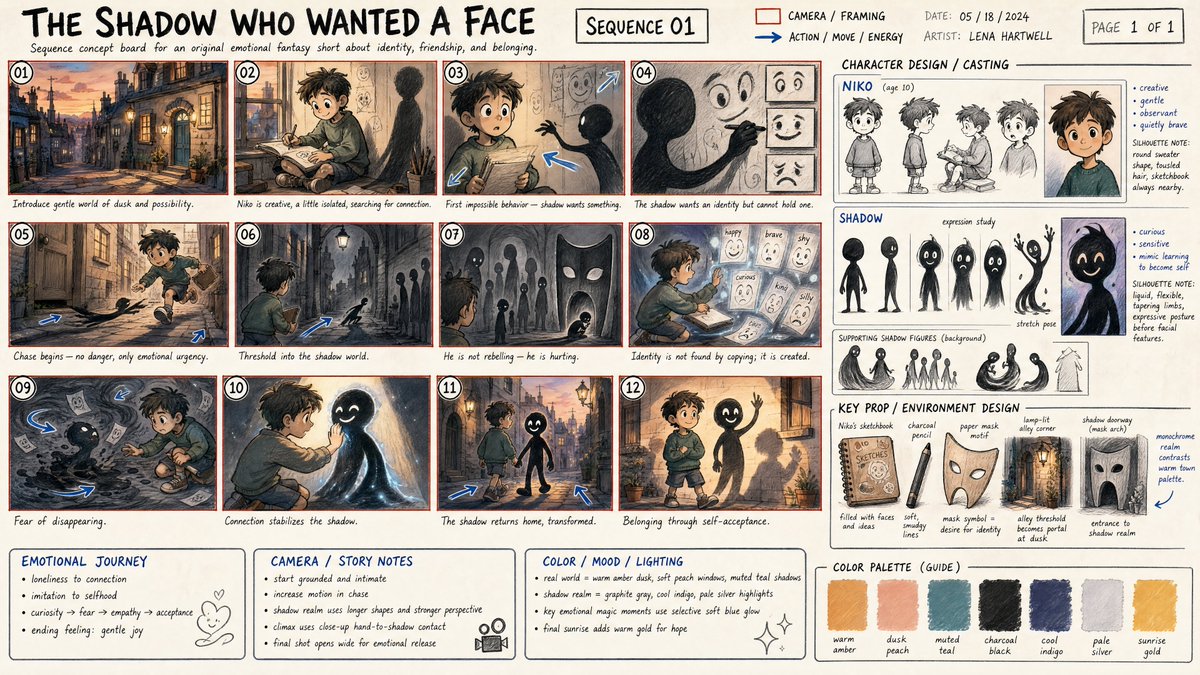
创建一个干净的16:9宽屏横向格式的单一高细节专业动画分镜表,用于原创2D卡通故事,标题为:“The Shadow Who Wante…
分享链接 · https://openimages.ajiang.me/p/2084832200772776386/
composition · multi-panelmood · dreamyquality_flags · embedded-textquality_flags · multi-panel-layoutquality_flags · typography-heavysubject_type · character
提示词(原文,逐字保留)
Create a single high-detail professional animation storyboard sheet in a clean 16:9 widescreen landscape format for an original 2D cartoon story titled: “The Shadow Who Wanted a Face.” Make the concept fully original, family-friendly, copyright-safe, and violence-free, with no copyrighted characters, no franchise designs, no logos, no gore, no horror, and no realistic weapons. Present it as a polished studio pre-production board on a clean off-white paper background with a hand-drawn graphite and pencil storyboard look, light shading, red framing boxes around each storyboard panel, blue arrows indicating camera movement and action flow, circled shot numbers, handwritten production notes, and a clean animation-studio development layout that is visually dense yet organized. Use subtle color only in selected reference boxes, the character color portraits, the prop reference area, and a few key emotional or magical moments. All text must be highly readable and feel like a professional storyboard presentation. At the top place a large bold title: “THE SHADOW WHO WANTED A FACE,” under it a smaller subtitle: “Sequence concept board for an original emotional fantasy short about identity, friendship, and belonging.” Add a small boxed label reading “SEQUENCE 01.” In the top-right corner include a small legend with a red box icon labeled “CAMERA / FRAMING,” a blue arrow icon labeled “ACTION / MOVE / ENERGY,” a small handwritten date, a small handwritten artist credit, and a small “PAGE 1 OF 1” label. The main storyboard grid must contain exactly 12 panels arranged in 3 rows of 4, reading left to right, top to bottom. The story world is a cozy old town at dusk with warm windows, narrow alleys, lamp-lit walls, and a hidden monochrome shadow realm beneath doorways and street corners. The main character is an original young boy named Niko, around 10 years old, slim, curious, kind, wearing a simple oversized sweater, rolled shorts, and sneakers, with expressive hair and big eyes. The second major character is his living shadow, an elastic ink-like silhouette that has no face at first and communicates through shape, gesture, and drawn expressions. The symbolic key prop is a small sketchbook and charcoal pencil used to draw faces, plus a paper cut-out theater mask motif that appears in design notes. The tone should be magical, heartfelt, slightly mysterious, hopeful, and visually poetic, with soft emotional progression and expressive body language. Panel 1, Shot 01: Establishing wide shot of a quiet sunset street and Niko’s small apartment building, long evening shadows stretching across the pavement, camera wide and slightly high angle, mood calm and wistful, caption note: “Introduce gentle world of dusk and possibility.” Panel 2, Shot 02: Medium character intro of Niko sitting by a window drawing silly cartoon faces in his sketchbook while his shadow stretches along the wall beside him, camera medium side angle, mood lonely but imaginative, production note: “Niko is creative, a little isolated, searching for connection.” Panel 3, Shot 03: Story trigger, Niko notices his shadow is no longer copying him and instead reaches toward the sketchbook, camera push-in with blue arrow toward the shadow hand, mood surprise and wonder, caption note: “First impossible behavior—shadow wants something.” Panel 4, Shot 04: Early emotional beat, the shadow draws crude face shapes on the wall using Niko’s charcoal, trying eyes, smiles, and frowns that smear and disappear, camera close-up with small inserts of failed faces, mood tender and sad, note: “The shadow wants an identity but cannot hold one.” Panel 5, Shot 05: Escalation, the frustrated shadow slips under the bedroom door and races into the alley, Niko grabs the sketchbook and chases after it, camera dynamic low tracking shot with blue arrows showing movement, mood urgent but playful and safe, note: “Chase begins—no danger, only emotional urgency.” Panel 6, Shot 06: Development, Niko follows the shadow through twisting alleys where walls become abstract and darker, and enters a hidden monochrome shadow corridor under a street lamp, camera wide perspective tunnel shot, mood mysterious and cinematic, caption: “Threshold into the shadow world.” Panel 7, Shot 07: Deeper turn, inside the shadow world Niko sees dozens of faceless shadows mimicking emotions without features, and his own shadow stands apart, ashamed and hiding behind a giant mask-shaped doorway, camera medium-wide with dramatic negative space, mood melancholy and revealing, note: “He is not rebelling—he is hurting.” Panel 8, Shot 08: Midpoint reveal and strategy, Niko kneels and gently sketches many different simple faces into the air and on floating paper scraps—happy, brave, shy, curious—showing the shadow that it can choose who it wants to be, camera over-the-shoulder with insert sketches and soft magical glow, mood hopeful, caption: “Identity is not found by copying; it is created.” Panel 9, Shot 09: Climax setup, a gust of swirling shadow wind scatters the drawn faces and the shadow begins to dissolve into the dark floor, afraid it will never become real, camera dramatic diagonal composition with blue spiral arrows, mood emotional tension, note: “Fear of disappearing.” Panel 10, Shot 10: Main climax, Niko steps into a beam of light and presses his hand to the shadow, then draws one simple glowing face directly onto it—a face made from kindness, not perfection—camera close dramatic hero angle, mood uplifting and cathartic, note: “Connection stabilizes the shadow.” Panel 11, Shot 11: Resolution, the shadow now holds a soft, simple expressive face of its own and stands beside Niko as an equal, both walking back through the alley into the warm color world, camera medium back three-quarter shot, mood peaceful and relieved, caption: “The shadow returns home, transformed.” Panel 12, Shot 12: Final emotional payoff hero shot, Niko and the shadow are shown in a warm sunrise reflection on the wall, the shadow making its own joyful expression while Niko smiles proudly, camera wide hero composition with gentle upward tilt, mood triumphant, healing, and heartwarming, note: “Belonging through self-acceptance.” On the right side create a “CHARACTER DESIGN / CASTING” section. Include for Niko: front turnaround sketch, side turnaround sketch, a seated pose study with sketchbook, a surprised expression study, and a small soft-color reference portrait with handwritten notes: “creative,” “gentle,” “observant,” “quietly brave,” plus silhouette note: “round sweater shape, tousled hair, sketchbook always nearby.” Include for the Shadow: front silhouette study, side silhouette study, expression study showing how a face appears within the dark form, playful stretch pose, and a small color-accent reference portrait using charcoal black with a faint blue-violet edge glow; handwritten notes: “curious,” “sensitive,” “mimic learning to become self,” silhouette note: “liquid, flexible, tapering limbs, expressive posture before facial features.” Add 2–3 mini support sketches labeled “supporting shadow figures” showing other faceless background shadows in the shadow realm. Include an optional “KEY PROP / ENVIRONMENT DESIGN” section with small design drawings of Niko’s sketchbook, charcoal pencil, paper mask motif, lamp-lit alley corner, and the shadow doorway shaped like a theater mask. Add tiny handwritten notes such as “mask symbol = desire for identity,” “alley threshold becomes portal at dusk,” and “monochrome realm contrasts warm town palette.” Along the bottom place 3 neat note boxes. Box 1 heading: “EMOTIONAL JOURNEY” with short bullet points: “loneliness to connection,” “imitation to selfhood,” “curiosity -> fear -> empathy -> acceptance,” “ending feeling: gentle joy.” Box 2 heading: “CAMERA / STORY NOTES” with bullets: “start grounded and intimate,” “increase motion in chase,” “shadow realm uses longer shapes and stronger perspective,” “climax uses close-up hand-to-shadow contact,” “final shot opens wide for emotional release.” Box 3 heading: “COLOR / MOOD / LIGHTING” with bullets: “real world = warm amber dusk, soft peach windows, muted teal shadows,” “shadow realm = graphite gray, cool indigo, pale silver highlights,” “key emotional magic moments use selective soft blue glow,” “final sunrise adds warm gold for hope.” In the lower right include a small color palette strip with swatches labeled warm amber, dusk peach, muted teal, charcoal black, cool indigo, pale silver, and sunrise gold. Ensure the whole sheet feels like a premium professional 2D animation development board: hand-drawn, cinematic, expressive, readable, story-rich, emotionally clear, original, safe, and suitable for a high-quality short film storyboard presentation.
中文译文
创建一个干净的16:9宽屏横向格式的单一高细节专业动画分镜表,用于原创2D卡通故事,标题为:“The Shadow Who Wanted a Face.” 使概念完全原创、适合家庭、版权安全且无暴力,没有版权角色、没有特许经营设计、没有标志、没有血腥、没有恐怖、没有真实武器。将其呈现为抛光的工作室前期制作板,在干净的米白色纸张背景上,具有手绘石墨和铅笔分镜外观、浅阴影、每个分镜面板周围的红色框架框、指示摄像机运动和动作流的蓝色箭头、圈出的镜头编号、手写制作笔记,以及视觉密集但有组织的干净动画工作室开发布局。仅在选定的参考框、角色彩色肖像、道具参考区域和一些关键情感或魔法时刻使用微妙的颜色。所有文本必须高度可读,并感觉像专业分镜演示。在顶部放置一个大粗体标题:“THE SHADOW WHO WANTED A FACE,” 其下是较小的副标题:“Sequence concept board for an original emotional fantasy short about identity, friendship, and belonging.” 添加一个小框标签,写着“SEQUENCE 01。” 在右上角包括一个小图例,带有红色框图标标记为“CAMERA / FRAMING,” 蓝色箭头图标标记为“ACTION / MOVE / ENERGY,” 一个小手写日期、一个小手写艺术家署名,以及一个小“PAGE 1 OF 1”标签。主分镜网格必须包含正好12个面板,排列成3行4列,从左到右、从上到下阅读。故事世界是一个黄昏时分的舒适老城镇,有温暖的窗户、狭窄的小巷、灯火照亮的墙壁,以及门道和街角下隐藏的单色阴影领域。主角是一个原创的年轻男孩,名叫Niko,大约10岁,瘦削、好奇、善良,穿着简单的超大毛衣、卷起的短裤和运动鞋,有富有表现力的头发和大眼睛。第二个主要角色是他的活阴影,一个弹性墨水般的轮廓,起初没有脸,通过形状、手势和绘制的表情进行交流。象征性的关键道具是一个小速写本和木炭铅笔,用于画脸,加上出现在设计笔记中的纸剪影剧院面具图案。基调应该是魔法的、衷心的、略带神秘的、充满希望的、视觉诗意的,具有柔和的情感进展和富有表现力的肢体语言。面板1,镜头01:安静日落街道和Niko小公寓楼的建立宽镜头,长长的傍晚阴影伸展在人行道上,摄像机宽且略高角度,情绪平静而怀旧,字幕笔记:“Introduce gentle world of dusk and possibility.” 面板2,镜头02:Niko坐在窗边在他的速写本上画傻卡通脸的中等角色介绍,而他的阴影沿着旁边的墙壁伸展,摄像机中等侧角度,情绪孤独但富有想象力,制作笔记:“Niko is creative, a little isolated, searching for connection.” 面板3,镜头03:故事触发,Niko注意到他的阴影不再复制他,而是伸向速写本,摄像机推近带蓝色箭头指向阴影手,情绪惊讶和惊奇,字幕笔记:“First impossible behavior—shadow wants something.” 面板4,镜头04:早期情感节拍,阴影使用Niko的木炭在墙上画粗糙的脸形状,尝试眼睛、微笑和皱眉,它们涂抹并消失,摄像机特写带失败脸的小插入,情绪温柔而悲伤,笔记:“The shadow wants an identity but cannot hold one.” 面板5,镜头05:升级,沮丧的阴影滑过卧室门并冲进小巷,Niko抓起速写本追赶它,摄像机动态低跟踪镜头带蓝色箭头显示运动,情绪紧急但好玩且安全,笔记:“Chase begins—no danger, only emotional urgency.” 面板6,镜头06:发展,Niko跟随阴影穿过扭曲的小巷,墙壁变得抽象和更暗,并进入街灯下隐藏的单色阴影走廊,摄像机宽透视隧道镜头,情绪神秘和电影感,字幕:“Threshold into the shadow world.” 面板7,镜头07:更深转折,在阴影世界内Niko看到数十个无脸阴影模仿没有特征的情感,他自己的阴影站在一边,羞愧地躲在巨大的面具形门道后面,摄像机中宽带戏剧性负空间,情绪忧郁和揭示,笔记:“He is not rebelling—he is hurting.” 面板8,镜头08:中点揭示和策略,Niko跪下并轻轻在空中和漂浮的纸片上 sketch 许多不同的简单脸——快乐、勇敢、害羞、好奇——向阴影展示它可以选择想成为谁,摄像机过肩带插入草图和柔和魔法光辉,情绪充满希望,字幕:“Identity is not found by copying; it is created.” 面板9,镜头09:高潮设置,一阵旋转的阴影风吹散绘制的脸,阴影开始溶解到黑暗地板中,害怕它永远不会变得真实,摄像机戏剧性对角线构图带蓝色螺旋箭头,情绪情感紧张,笔记:“Fear of disappearing.” 面板10,镜头10:主高潮,Niko走进一束光并按手到阴影上,然后直接在其上画一个简单的发光脸——一个由善良而非完美制成的脸——摄像机特写戏剧英雄角度,情绪振奋和宣泄,笔记:“Connection stabilizes the shadow.” 面板11,镜头11:解决,阴影现在拥有自己的柔和简单富有表现力的脸,并作为平等站在Niko旁边,两者走回小巷进入温暖彩色世界,摄像机中等后四分之三镜头,情绪平静和宽慰,字幕:“The shadow returns home, transformed.” 面板12,镜头12:最终情感回报英雄镜头,Niko和阴影显示在墙上温暖日出反射中,阴影做出自己的快乐表情而Niko自豪地微笑,摄像机宽英雄构图带温和向上倾斜,情绪胜利、治愈和温馨,笔记:“Belonging through self-acceptance.” 在右侧创建“CHARACTER DESIGN / CASTING”部分。包括Niko:正面转身草图、侧面转身草图、带速写本的坐姿研究、惊讶表情研究,以及带手写笔记的小软色参考肖像:“creative,” “gentle,” “observant,” “quietly brave,” 加上轮廓笔记:“round sweater shape, tousled hair, sketchbook always nearby.” 包括阴影:正面轮廓研究、侧面轮廓研究、显示脸如何出现在黑暗形式中的表情研究、好玩拉伸姿势,以及使用木炭黑带淡蓝紫边缘光辉的小颜色强调参考肖像;手写笔记:“curious,” “sensitive,” “mimic learning to become self,” 轮廓笔记:“liquid, flexible, tapering limbs, expressive posture before facial features.” 添加2–3个迷你支持草图,标记为“supporting shadow figures”显示阴影领域中其他无脸背景阴影。包括可选的“KEY PROP / ENVIRONMENT DESIGN”部分,带有Niko的速写本、木炭铅笔、纸面具图案、灯火小巷角落和剧院面具形状的阴影门道的小设计图。添加微小手写笔记如“mask symbol = desire for identity,” “alley threshold becomes portal at dusk,” 和“monochrome realm contrasts warm town palette.” 沿着底部放置3个整洁笔记框。框1标题:“EMOTIONAL JOURNEY” 带短要点:“loneliness to connection,” “imitation to selfhood,” “curiosity -> fear -> empathy -> acceptance,” “ending feeling: gentle joy.” 框2标题:“CAMERA / STORY NOTES” 带要点:“start grounded and intimate,” “increase motion in chase,” “shadow realm uses longer shapes and stronger perspective,” “climax uses close-up hand-to-shadow contact,” “final shot opens wide for emotional release.” 框3标题:“COLOR / MOOD / LIGHTING” 带要点:“real world = warm amber dusk, soft peach windows, muted teal shadows,” “shadow realm = graphite gray, cool indigo, pale silver highlights,” “key emotional magic moments use selective soft blue glow,” “final sunrise adds warm gold for hope.” 在右下角包括一个小颜色调色板条,带有标记为warm amber, dusk peach, muted teal, charcoal black, cool indigo, pale silver, and sunrise gold的色板。确保整个表感觉像高级专业2D动画开发板:手绘、电影感、富有表现力、可读、故事丰富、情感清晰、原创、安全,并适合高质量短片分镜演示。
来源与署名
原文由 @ManuAGI01 发布在 X:查看原推文。 本页逐字保留原文并提供机器翻译的中文解读;版权归原作者所有。
同工具的更多提示词
- 使用上传的参考照片生成一张图像,不要改变脸部 主体:一位年轻女性,皮肤白皙,自然呈玫瑰色,脸颊和鼻子上有淡淡的天然雀斑,给人一种天真年轻的感觉。她留着短而有层…@Naiknelofar788
- 以上传参考图片作为唯一的身份参照。请尽可能准确地保留这位年轻女性的外貌,包括她的面部特征、眼睛形状与颜色、鼻子、嘴唇、自然肤色、脸型、身体比例、发色、发质以及…@mehvishs25
- GPT image 2.0 提示词 1:超写实赛博朋克风格年轻美丽女性肖像,无瑕瓷白肌肤,精致东亚面部特征,肩长凌乱铂金白发带淡紫色高光,宽松低马尾并有碎发修…@auqibhabib
- 编辑风格海报,画面中[CHARACTER]呈严格的左向侧面轮廓,从胸部中段裁切,[HAIR]形成主导的图形化剪影,身着[CLOTHING]。在头部正后方放置一…@ChillaiKalan__
- 早餐·群山触天之处 奢华不是一处地方,而是一个如此宁静的清晨。 如果早餐不是被端上餐桌…… 而是被送到一座幽静的湖上,倒映的群山如镜,那会是怎样? 新鲜咖啡…@nagarjuncreates
- 一张怀旧风格的1980–1990年代灵感工作室肖像照,主体为一位年轻的东亚男性,留着浓密蓬松的复古波浪黑色mullet(高层次)发型,肤色白皙透亮,妆容自然柔…@jzaib4269