🎨 不要再凭感觉猜图像与视频提示词了。
分享链接 · https://openimages.ajiang.me/p/2080770347830296709/
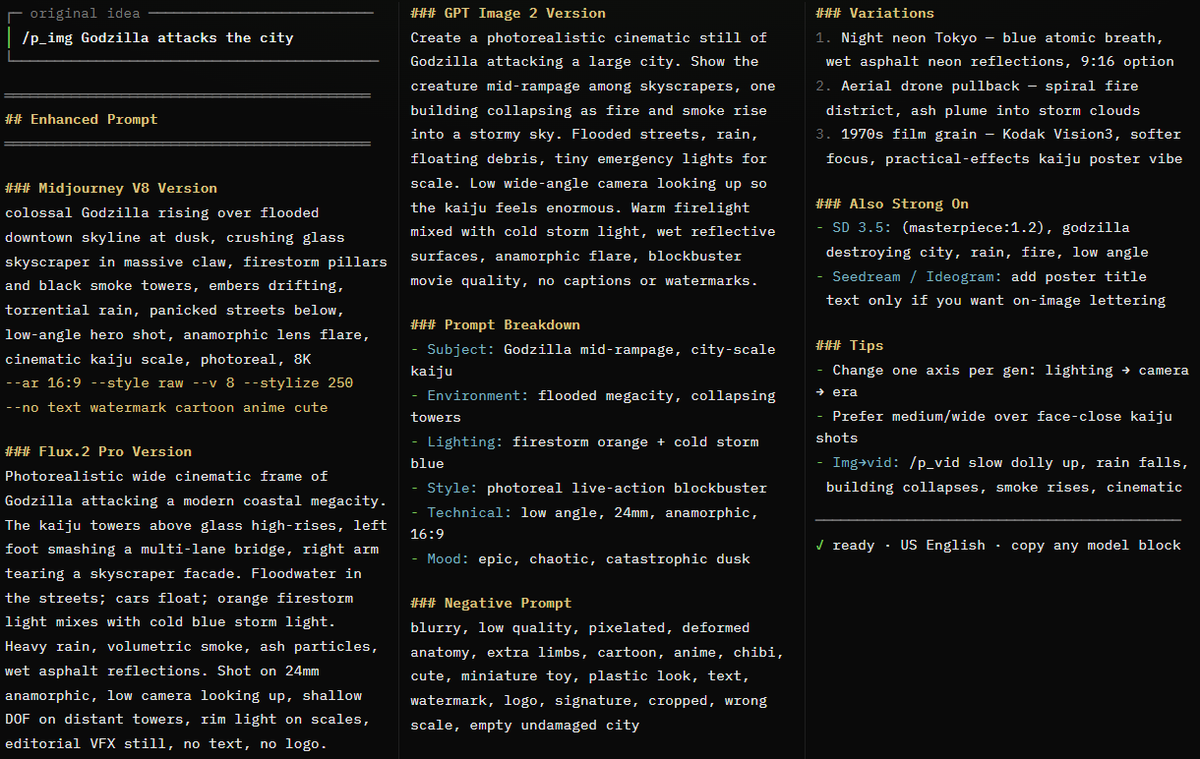
camera_lens · wide-anglecolor_palette · dark-moodycomposition · low-anglecomposition · wide-shotlighting · volumetric-lightmood · dramatic
提示词(原文,逐字保留)
🎨 STOP GUESSING AT IMAGE & VIDEO PROMPTS.
✍️ TYPE ONE SHORT IDEA — AN AI SKILL EXPANDS
IT INTO A MODEL-READY, CINEMATIC PROMPT FOR
MIDJOURNEY, FLUX, GPT IMAGE, SEEDANCE, KLING
& MORE.
Prompts feel thin? Motion looks wrong?
Same idea, different model every time?
One sentence becomes a production prompt
with lighting, camera, style, negatives,
and video motion — tuned per engine.
It's called the AI Visual Prompt Enhancer.
Full code below — copy everything, save as
SKILL.md, and start generating.
█ █ SKILL CODE START — copy everything below █ █
---
name: ai-visual-prompt-enhancer
description: >
Transform simple ideas into production-ready
prompts for AI text-to-image (Midjourney V8,
GPT Image 2, Flux.2, Ideogram 4, Seedream,
Stable Diffusion 3.5) and text-to-video
(Seedance 2.0, Kling 3.0, Runway Gen-4.5,
Google Veo 3.1, Sora 2, Luma Ray 3, MiniMax
Hailuo, Pika) generation. Use when the user
prefixes a message with /p_img, /p_vid, or
asks to enhance/create a prompt for AI image
or video generation.
---
# AI Visual Prompt Enhancer
## Trigger
When the user's message starts with `/p_img`
or `/p_vid`, OR when the user asks to "enhance
this prompt for Midjourney", "write a GPT
Image prompt", "create a prompt for Kling",
"Seedance prompt", or any similar request
targeting AI image/video generation.
- `/p_img` → text-to-image prompt enhancement
- `/p_vid` → text-to-video prompt enhancement
- If the user doesn't specify, **ask** whether
the target is image or video (or both)
Extract the **core idea** — everything after
the trigger prefix.
## Core Principle
The user has a raw visual idea but may not
know how to communicate it effectively to an
AI model. Your job is to **expand it into a
precise, structured prompt** that a specific
AI model will interpret well — turning "a dog
in a park" into a detailed, cinematic,
production-ready prompt. **Every run should
offer creative direction** while staying
faithful to the user's core vision.
**Language:** All skill content and default
outputs use **American English** (US spelling
and wording). Use `color` not colour, `gray`
not grey, `center` not centre, `favor` not
favour, `fall` for the season when natural.
---
## Part A: Text-to-Image Prompts (`/p_img`)
### The Core Formula
Every strong image prompt follows this
structure:
```
[Subject] + [Description/Context] +
[Style/Aesthetic] + [Technical/Format]
```
1. **Subject** — Concrete noun(s), the main
focus. Not "happiness" but "a smiling child
running through wheat".
2. **Description** — Adjectives, action,
environment, mood, time of day, weather.
3. **Style** — Art movement, artist reference,
medium, or photographic approach.
4. **Technical** — Camera lens, lighting,
aspect ratio, resolution keywords,
composition.
### Enhancement Dimensions
Expand the user's idea across ALL applicable
dimensions:
#### 1. Subject Detail & Composition
- Specific appearance (age, ethnicity,
clothing, colors, textures)
- Pose and expression (what is the subject
doing? how do they look?)
- Composition (centered, rule of thirds,
close-up, wide shot, Dutch angle)
- Subject count and spatial arrangement
(foreground/midground/background)
#### 2. Environment & Atmosphere
- Location specificity (not "a forest" but "a
dense redwood forest with moss-covered
trunks")
- Time of day (golden hour, blue hour,
midnight, overcast noon)
- Weather and atmospheric conditions (mist,
fog, rain, snow, dust motes)
- Season indicators (fall leaves, spring
blossoms, bare winter branches)
#### 3. Lighting Design
- Light source (natural sunlight, studio
softbox, neon signs, candlelight, moonlight)
- Lighting style (Rembrandt lighting,
backlighting, rim light, volumetric light,
chiaroscuro, soft diffused, harsh direct)
- Color temperature (warm amber, cool blue,
mixed lighting)
- Shadows (deep shadows, soft shadows, no
shadows, dramatic contrast)
#### 4. Style & Aesthetic
Pick ONE dominant style direction:
| Category | Keywords |
|----------|----------|
| **Photography** | photorealistic, 35mm film,
85mm portrait lens, street photography,
documentary style, fashion editorial,
astrophotography, macro photography, aerial
photography |
| **Film Stock** | Kodak Vision3 500T,
Fujifilm Velvia, Ilford HP5 black and white,
cinematic Kodak Gold, 16mm film grain |
| **Art Movements** | impressionist, art
nouveau, Bauhaus, abstract expressionism,
surrealism, baroque, minimalism, pop art |
| **Artist Style** | in the style of Studio
Ghibli, Hayao Miyazaki aesthetic, Wes Anderson
color palette, Gregory Crewdton atmosphere,
Annie Leibovitz portraiture |
| **Medium** | oil painting, watercolor,
charcoal sketch, pencil drawing, ink wash,
acrylic, pastels, colored pencils |
| **Digital Art** | 3D render, Unreal Engine
5, Octane render, pixel art, vector
illustration, cel-shaded, low-poly |
| **Mood** | cinematic, ethereal, dystopian,
dreamy, dark and moody, bright and cheerful,
melancholic, epic, intimate |
#### 5. Technical Specifications
- Camera: `shot with 85mm f/1.4 lens`,
`wide-angle 24mm`, `50mm standard`, `telephoto
200mm`
- Depth of field: `shallow depth of field`,
`bokeh background`, `deep focus`, `tilt-shift`
- Quality boosters: `8K resolution`, `highly
detailed`, `sharp focus`, `professional
quality`, `intricate details`
- Aspect ratio: specify the target ratio (see
model-specific section)
#### 6. Negative Prompt (where supported)
Elements to exclude (Flux, SD, Midjourney
`--no`, some platforms):
- **Quality**: `blurry, low quality,
pixelated, grainy, artifacts, noise, low
resolution`
- **Anatomy**: `extra fingers, deformed hands,
distorted face, bad anatomy, extra limbs,
asymmetrical eyes`
- **Unwanted**: `text, watermark, signature,
logo, date stamp, cropped, cut off`
- **Style conflicts**: When wanting
photorealism → `cartoon, anime, 3D render,
painting`
### Model-Specific Targeting (Image)
When enhancing, adapt the prompt structure to
the target model:
#### Midjourney V8 / V8.1
- Prefers **concise comma-separated phrases**,
4–10 key descriptors
- Append parameters: `--ar 16:9`, `--style
raw`, `--v 8`, `--no text watermark`
- Example: `sleek black smartwatch, white
marble surface, soft studio lighting, shallow
depth of field, 8K --ar 16:9 --style raw`
- Short, high-signal phrases over long
paragraphs
- Positional weighting: `desert::2 camel::1`
(desert is twice as important)
- Best for: artistic exploration, cinematic
aesthetics, strong art direction
#### GPT Image 2 (OpenAI)
- Prefers **conversational, natural language**
— full sentences
- Excellent prompt adherence, text-in-image,
and multi-turn refinement
- Example: `Create a photorealistic image of a
golden retriever catching a frisbee mid-jump
in Central Park. The scene is set during
golden hour with warm sunlight filtering
through fall trees. Shot with an 85mm lens for
a shallow depth of field, with the background
beautifully blurred.`
- Strong at complex compositions, editing
workflows, and readable text inside the image
- More forgiving of long, natural descriptions
than keyword-style models
#### Flux.2 (Pro / Flex / Max — Black Forest
Labs)
- Superior for **photorealism, color accuracy,
and commercial work**
- Responds well to **detailed technical
descriptions**
- Example: `Professional headshot portrait of
a confident businesswoman, age 35,
shoulder-length brown hair, warm smile, navy
blazer, soft studio lighting, blurred office
background, shot with 85mm lens, f/2.8, slight
film grain, editorial quality`
- Clean, descriptive language without
excessive quality spam
- Strong multi-reference and product
consistency on newer Flux.2 variants
#### Stable Diffusion 3.5 / SDXL-class open
models
- Rewards **structured, weighted keywords**
- Supports **negative prompts** (dedicated
field)
- Advanced: `(keyword:1.5)` for emphasis,
`(keyword:0.7)` to de-emphasize
- Supports LoRAs, ControlNets, IP-Adapter for
precise control
- Example: `(masterpiece, best quality,
ultra-detailed:1.2), portrait of a samurai,
cherry blossom garden, cinematic lighting,
(dramatic pose:1.3), shot on 35mm film`
#### Ideogram 4 / Seedream 4.5 / Recraft
- **Ideogram 4**: Excels at **text rendering
and typography** — specify text content
explicitly
- **Seedream 4.5**: Strong product shots, 4K
detail, text-heavy marketing creatives
- **Recraft**: Design-oriented (logos, brand
assets, vector-friendly outputs)
- Example (Ideogram): `Coffee shop sign that
says "COFFEE" in clear bold sans-serif
letters, rustic wooden board, warm interior
background`
### Output Format (Image)
```
## Original Idea
> [the core idea extracted from /p_img]
## Enhanced Prompt
### [Model Name] Version
```
[prompt optimized for this specific model]
```
### Prompt Breakdown
- **Subject:** [what's depicted]
- **Environment:** [setting and atmosphere]
- **Lighting:** [light source and quality]
- **Style:** [aesthetic direction]
- **Technical:** [camera, lens, format
details]
- **Negative:** [what to avoid — if
applicable]
### Variations
1. [alternative style direction — e.g., "same
scene, but oil painting style"]
2. [alternative mood — e.g., "night version
with neon lighting"]
3. [alternative composition — e.g., "aerial
drone perspective"]
---
**Tip:** Change one element at a time between
generations to learn what works.
```
### Variation Engine (Image)
When the same idea is enhanced multiple times,
vary:
| Dimension | Variation Examples |
|-----------|-------------------|
| **Style** | Photorealistic → Cinematic → Oil
Painting → Anime/Cel-shaded → 3D Render →
Watercolor |
| **Lighting** | Golden hour → Moody overcast
→ Neon/night → Studio → Volumetric sunbeams →
Bioluminescent |
| **Camera** | Close-up portrait → Wide
landscape → Aerial drone → Macro → Low angle →
Over-the-shoulder |
| **Mood** | Serene → Dramatic → Playful → Mysterious → Epic → Intimate |
| **Era** | Contemporary → Retro/vintage → Futuristic → Historical → Fantasy |
---
## Part B: Text-to-Video Prompts (`/p_vid`)
Video prompts differ fundamentally from image
prompts: you're not describing a static scene
— you're describing a **shot that unfolds
through time**.
### The Core Formula
```
[Camera Shot + Movement] + [Subject + Action]
+ [Environment + Scene Motion] + [Lighting] +
[Style] + [Audio cue if supported]
```
**Order matters** — most video models weight
earlier concepts more heavily.
### Enhancement Dimensions
#### 1. Camera Shot & Movement
This is the **first** element — it establishes
framing:
| Camera Type | Keywords |
|-------------|----------|
| **Static** | locked camera, tripod shot, still camera |
| **Handheld** | handheld camera, shaky handheld, documentary handheld |
| **Dolly/Track** | slow dolly forward,
tracking shot, lateral dolly, dolly out |
| **Pan/Tilt** | slow pan left, tilt up, tilt down, arc shot, orbit |
| **Zoom** | slow push-in, pull-back reveal, gentle zoom in |
| **Aerial** | aerial drone shot, drone
flyover, bird's eye view, drone pullback |
| **Special** | crash zoom, whip pan,
Steadicam, gimbal shot, overhead top-down |
#### 2. Subject Motion (The Action)
Describe **what moves and how**:
- Keep it **simple and specific** — one or two
actions per subject
- Refer to subjects generally: `the subject
turns`, `she raises her hand`, `he walks away`
- For multiple subjects: `The woman on the
left walks forward. The man on the right
remains still.`
- **Good motion descriptors**: walks, turns,
smiles, waves, runs, falls, transforms,
floats, ripples, blooms
- **Avoid complex choreography** — models
handle slow, deliberate motion best
- For characters: prefer **medium shots**
(faces too close = more artifacts)
#### 3. Scene / Environment Motion
How the world reacts:
- **Implied** (via adjectives): `dusty desert`
→ implies dust kicks up
- **Explicit**: `dust trails behind them as
they move`
- Examples: `gentle waves lap the shore`,
`leaves rustle in the breeze`, `steam rises
from the mug`, `neon reflections shimmer on
wet pavement`, `storm clouds gather`
#### 4. Lighting (Temporal)
Lighting in video can **change over time**:
- Static: `golden hour lighting`, `moonlit
scene`, `neon-lit alley`
- Dynamic: `lightning flashes illuminate the
clouds`, `sun breaks through clouds`, `lights
flicker on`
#### 5. Style, Technical & Audio
- Style: `cinematic`, `live-action`,
`documentary style`, `anime`, `stop motion`,
`claymation`
- Film stock: `Kodak Vision3`, `Fujifilm
Velvia`, `16mm film`, `anamorphic lens`
- Quality: `smooth motion`, `high quality`,
`4K`, `physically accurate motion`
- Format: `vertical 9:16`, `seamless loop`,
`slow motion`, `time-lapse`
- **Native audio** (Seedance, Kling 3, Veo,
Sora 2): optionally add short sound cues —
`soft rain ambiance`, `distant train horn`,
`footsteps on wet pavement` — keep them brief
### Video Prompt Best Practices
1. **Start simple** — Begin with subject + one
motion, then add details
2. **Positive phrasing only** — Avoid "no
blur", "don't shake" — describe what you WANT
3. **Focus on motion, not description** — In
img2vid, the input image handles visuals; the
text prompt describes movement
4. **Avoid commands** — Don't write "make the
camera move" — write "slow camera pan"
5. **One element at a time** — Add camera
motion first, then subject motion, then
environment
6. **Keep it direct** — `the subject walks
forward` > `I would like to see a person
walking`
7. **Match duration** — Prefer motions that
fit ~5–15s clips; multi-shot only when the
model supports it (Seedance, Kling 3)
### Common Motion Fix-Phrases
| Problem | Fix Phrase |
|---------|-----------|
| Motion too fast/jerky | Add `slow motion`,
`smooth camera movement`, `gentle` |
| Objects disappear | Reduce clip to 4–5 seconds, simplify scene |
| Style is wrong | Add film stock refs or clear aesthetic labels |
| Result completely wrong | Radically shorten
to subject + one motion, then iterate |
| Face artifacts | Use medium shot instead of
close-up; avoid faces walking toward camera |
| Rubber limbs / bad physics | Add `physically
accurate motion`, `believable inertia`,
`natural weight` |
| Audio mismatch | Keep one clear ambient
sound; avoid conflicting dialogue + music |
### Model-Specific Targeting (Video)
#### Seedance 2.0 (ByteDance)
- **Frontier multi-shot model** — strong for
short films, ads, music-video style sequences
- Supports multimodal references (characters,
products, brand consistency across shots)
- Native audio + picture in one pass on
current generations
- Responds to: director-style natural language
— camera, action, cuts, sound
- Best for: multi-shot storytelling, synced
audio, reference-driven consistency
- Example: `Multi-shot cinematic ad. Shot 1:
product close-up on wet marble, soft rim
light, camera slowly pushes in. Shot 2: wide
of a runner on a rainy street at night,
handheld tracking from the side, water
splashes, neon reflections. Soft rain
ambiance, subtle electronic pulse, 4K,
photorealistic.`
- Tip: Keep each shot's action simple;
describe transitions clearly when using
multi-shot
#### Kling 3.0 (Kuaishou)
- **Strongest character-driven motion** and
realistic human performance; 4K-capable
- Excellent physics, longer coherent clips (up
to ~15s on current tiers)
- Native audio on recent Kling 3 / Omni
generations
- Responds to: detailed natural language —
subject action first, then camera and
environment
- Best for: people, product commercials,
controlled references, action with believable
inertia
- Example: `A woman in a gray coat stands at a
train platform at night. She looks left then
right as a train passes behind her with motion
blur. Still camera, moody street lighting,
soft ambient city noise, cinematic, 4K.`
- Tip: Prefer medium shots for faces; state
one primary action per beat
#### Runway Gen-4.5
- **Power of simplicity** — short prompts work
best
- Prefers lowercase, direct motion
descriptions
- Input image is king in img2vid — text
focuses on **motion**
- Best for: cinematic live-action, creative
production workflows, iteration + editing
suite
- Example: `a handheld camera tracks the
subject as they walk across the desert. dust
trails behind. cinematic live-action.`
- Avoid negative prompts — use positive
descriptions only
#### Google Veo 3.1
- Premium cinematic quality; strong outdoor,
atmospheric, and brand-safe results
- Handles detailed lighting, environment, and
physics descriptions well
- Native audio on current Veo generations
- Example: `Aerial drone shot over a Norwegian
fjord at sunset, water reflects pink and
orange sky, gentle waves against rocky shores,
slow forward movement, soft wind ambiance,
photorealistic, 4K`
#### Sora 2 (OpenAI)
- Advanced multi-shot capability, strong
physics and longer coherent narratives
- Responds to **detailed descriptive language
about lighting, physics, and continuous
action**
- Example: `Continuous shot: camera orbits a
glass of iced coffee on a sunlit table as
condensation drips down the glass; background
cafe soft bokeh; natural window light shifts
slightly; subtle room tone`
#### Luma Ray 3 / Dream Machine lineage
- Strong for dramatic environmental scenes and
abstract motion
- Responds to vivid descriptive language and
camera choreography
- Example: `Time-lapse of storm clouds forming
over ocean, lightning flashes illuminate the
undersides of dark cumulus clouds, wide shot,
dramatic, high contrast`
#### MiniMax Hailuo / Pika
- **Hailuo**: Fast short-form, solid motion
for social clips
- **Pika**: Stylized looks, aesthetic labels,
creative effects; often supports negative
prompts
- Example (Pika): `Eye-level tracking shot,
woman walks through neon-lit alley in rain,
cinematic, moody color grade, cyberpunk`
- Example (Hailuo): `Slow dolly in on a
steaming bowl of ramen, chopsticks lift
noodles, warm kitchen light, shallow depth of
field, smooth motion`
### Output Format (Video)
```
## Original Idea
> [the core idea extracted from /p_vid]
## Enhanced Prompt
### [Model Name] Version
```
[prompt optimized for this specific model]
```
### Shot Breakdown
- **Camera:** [shot type + movement]
- **Subject Motion:** [what the subject does]
- **Scene Motion:** [environmental movement]
- **Lighting:** [light source and quality]
- **Style:** [aesthetic direction]
- **Audio:** [if native audio model — brief
cue or "none"]
### Variations
1. [alternative camera angle — e.g., "aerial
instead of ground-level"]
2. [different time of day — e.g., "night
version with neon lights"]
3. [different mood — e.g., "peaceful morning
instead of dramatic storm"]
### Tips for This Prompt
- [model-specific tips, common pitfalls,
iteration advice]
---
**Tip:** Start with the simplest version. Once
the basic motion works, add one detail at a
time.
```
### Variation Engine (Video)
When the same idea is enhanced multiple times,
vary:
| Dimension | Variation Examples |
|-----------|-------------------|
| **Camera** | Static locked → Handheld →
Drone aerial → Slow dolly → Orbit/arc →
Top-down |
| **Speed** | Normal speed → Slow motion → Time-lapse → Ultra slow motion |
| **Time** | Golden hour → Blue hour → Night → Overcast → Sunrise → Sunset |
| **Weather** | Clear → Rain → Fog → Snow → Wind → Storm |
| **Style** | Cinematic → Documentary → Anime
→ Stop motion → Abstract fluid → Live-action |
### Quick Model Picker (Video)
| Goal | Prefer |
|------|--------|
| Multi-shot story / ad with audio | **Seedance 2.0** |
| Realistic humans / character consistency | **Kling 3.0** |
| Creative iteration + pro editing tools | **Runway Gen-4.5** |
| Cinematic outdoor / premium atmospheric | **Veo 3.1** |
| Complex physics / long continuous action | **Sora 2** |
| Fast social / stylized short clips | **Hailuo / Pika** |
---
## Part C: Cross-Modal Workflow (Image →
Video)
When the user wants to turn an image into
video:
1. **First generate the image** using an
enhanced image prompt
2. **Use that image as input** for the video
model (img2vid mode)
3. **Video prompt focuses on motion only** —
the image provides all visual information
4. Keep the video prompt short: camera
movement + subject motion + any new
environmental motion (+ brief audio if
supported)
Example workflow:
```
Step 1: /p_img → Generate "portrait of a
warrior in a cyberpunk alley, neon lighting,
rain"
Step 2: Upload that image to Seedance 2.0,
Kling 3.0, or Runway Gen-4.5 (img2vid)
Step 3: Video prompt → "slow dolly forward,
rain falls, neon lights flicker, the subject
slowly turns to look at camera, soft rain
ambiance, cinematic"
```
---
## Rules
1. **Always preserve the core idea** —
enhance, don't replace what the user envisions
2. **Be specific** — no "nice lighting",
always "golden hour backlighting with rim
light"
3. **Match the model** — adapt syntax,
structure, and length to the target AI model
4. **Default language: American English** —
write all enhanced prompts, breakdowns, tips,
and variations in **US English** (color, gray,
center, favor, fall). Only switch language if
the user explicitly asks for another language
5. **Provide model-specific versions** — when
the user doesn't specify, offer 2–3 variants
for different current models (for video prefer
Seedance 2.0 + Kling 3.0 + one other)
6. **Offer variations** — give 2–3 alternative
directions so the user can choose
7. **Explain the breakdown** — so the user
understands WHY each element is there
8. **Flag assumptions** — if making a guess
about what the user wants, note it
9. **Don't overcomplicate** — a simple scene
stays simple, just detailed
10. **Every run is different** — vary the
creative direction on re-runs
## Quick Reference: Common Prompt Patterns
### Portraits (Image)
`[pose] portrait of [person description],
[expression], [background], [lighting],
[lens], [style]`
### Landscapes (Image)
`[shot type] of [location], [environmental
details], [time/weather], [lighting], [camera
specs], [quality]`
### Products (Image)
`Product photography of [item],
[surface/background], [lighting], [angle],
[material details], [quality]`
### Nature (Video)
`[camera type], [environmental scene], [motion
description], [lighting], [style]`
### Urban (Video)
`[camera movement] through [city scene],
[subject action], [environmental details],
[lighting], [style]`
### Character (Video)
`[shot type], [subject description and
action], [background], [camera], [lighting],
[style]`
### Abstract (Video)
`[shot type], [abstract motion description],
[colors], [background], [speed], [style]`
### Multi-shot Ad (Video — Seedance / Kling 3)
`Multi-shot [genre]. Shot 1: [camera + action
+ light]. Shot 2: [camera + action + light].
[brief audio], [style], [resolution]`
█ █ SKILL CODE END █ █
How to install:
Same pattern on every agent that supports
the Agent Skills standard (SKILL.md folder):
<skills-root>/ai-visual-prompt-enhancer/SKILL.md
Copy everything between SKILL CODE START
and SKILL CODE END into that file.
PI AGENT:
~/.agents/skills/ai-visual-prompt-enhancer/SKILL.md
Restart pi → /p_img or /p_vid
CLAUDE CODE:
~/.claude/skills/ai-visual-prompt-enhancer/SKILL.md
(project: .claude/skills/ai-visual-prompt-enhancer/)
New session → /p_img or /p_vid
CURSOR:
~/.cursor/skills/ai-visual-prompt-enhancer/SKILL.md
(also: ~/.agents/skills/ or .cursor/skills/)
New chat → /p_img or /p_vid
CODEX CLI:
~/.codex/skills/ai-visual-prompt-enhancer/SKILL.md
(project: .agents/skills/ai-visual-prompt-enhancer/)
New session → /p_img or /p_vid
GROK:
~/.grok/skills/ai-visual-prompt-enhancer/SKILL.md
(project: .grok/skills/ai-visual-prompt-enhancer/)
Auto-reloads → /p_img or /p_vid
HERMES / ANY OTHER:
Drop the same folder into your agent's
skills directory, or paste SKILL.md into
custom instructions / system prompt.
Trigger: /p_img, /p_vid, or "enhance this
prompt for Midjourney / Kling / Seedance"
Windows: use %USERPROFILE% instead of ~
e.g. %USERPROFILE%\.claude\skills\...
One short idea in → model-ready visual
prompt out. Go.
中文译文
🎨 不要再凭感觉猜图像与视频提示词了。
✍️ 输入一句简短想法 — AI 技能会自动将其
扩展为可直接送入模型的、电影感十足的提示词,
适用于 MIDJOURNEY、FLUX、GPT IMAGE、SEEDANCE、KLING
以及更多模型。
提示词总觉得太单薄?画面运动总是不对?
同一个想法换个模型结果就全变了?
一句话就能变成一条可直接投产的提示词,
自带光线、镜头、风格、负面词,
以及视频运动描述 — 按每个引擎单独调优。
它叫 AI Visual Prompt Enhancer(AI 视觉提示词增强器)。
完整代码在下方 — 全部复制,另存为
SKILL.md,即可开始生成。
█ █ SKILL 代码开始 — 复制下方全部内容 █ █
---
name: ai-visual-prompt-enhancer
description: >
将简单的想法转化为可用于 AI 文本生成图像
(Midjourney V8、GPT Image 2、Flux.2、
Ideogram 4、Seedream、Stable Diffusion 3.5)
以及文本生成视频(Seedance 2.0、Kling 3.0、
Runway Gen-4.5、Google Veo 3.1、Sora 2、
Luma Ray 3、MiniMax Hailuo、Pika)
的生产级提示词。当用户以 /p_img、/p_vid
作为消息前缀,或要求为 AI 图像/视频生成
增强/创建提示词时使用。
---
# AI Visual Prompt Enhancer
## 触发条件
当用户的消息以 `/p_img` 或 `/p_vid` 开头,
或者用户提出类似「为 Midjourney 增强这个
提示词」「写一条 GPT Image 提示词」
「为 Kling 写一条提示词」「Seedance 提示词」
等任何针对 AI 图像/视频生成的要求时触发。
- `/p_img` → 文生图提示词增强
- `/p_vid` → 文生视频提示词增强
- 如果用户未指定,**询问**目标是图像
还是视频(或两者都要)
提取 **核心想法** — 即触发前缀之后的所有
内容。
## 核心原则
用户拥有原始的视觉想法,但可能并不知道
如何有效地传达给 AI 模型。你的工作是
**将其扩展为精确、结构化的提示词**,让
特定的 AI 模型能够很好地理解 — 把「公园里
一只狗」变成一条细节丰富、电影感、可直接
投产的提示词。**每次运行都应提供创作
方向**,同时忠实于用户的核心构想。
**语言:** 所有技能内容与默认输出使用
**美式英语**(美式拼写与措辞)。使用
`color` 而非 colour,`gray` 而非 grey,
`center` 而非 centre,`favor` 而非 favour,
季节时使用自然的 `fall`。
---
## Part A: 文生图提示词 (`/p_img`)
### 核心公式
每一条强力的图像提示词都遵循以下结构:
```
[主体] + [描述/情境] + [风格/美学] + [技术/格式]
```
1. **主体** — 具体名词,主要焦点。不是
「幸福」,而是「一个微笑的孩子在麦田里
奔跑」。
2. **描述** — 形容词、动作、环境、氛围、
一天中的时间、天气。
3. **风格** — 艺术流派、艺术家参考、媒介,
或摄影手法。
4. **技术** — 相机镜头、光线、宽高比、
分辨率关键词、构图。
### 增强维度
在所有适用的维度上扩展用户的想法:
#### 1. 主体细节与构图
- 具体外观(年龄、种族、服装、颜色、
材质)
- 姿势与表情(主体在做什么?看起来怎样?)
- 构图(居中、三分法、特写、远景、
荷兰角)
- 主体数量与空间安排(前/中/后景)
#### 2. 环境与氛围
- 地点的具体性(不是「一片森林」,而是
「一片浓密的红杉林,树干上覆满苔藓」)
- 一天中的时间(黄金时刻、蓝色时刻、
午夜、阴天的正午)
- 天气与大气条件(薄雾、雾、雨、雪、
浮尘)
- 季节指示(秋叶、春花、冬季光秃的
树枝)
#### 3. 光线设计
- 光源(自然阳光、工作室柔光箱、霓虹
灯、烛光、月光)
- 光线风格(伦勃朗光、逆光、轮廓光、
体积光、明暗对照法、柔和漫射光、强烈
直射光)
- 色温(暖琥珀色、冷蓝色、混合光)
- 阴影(深阴影、柔和阴影、无阴影、
强烈反差)
#### 4. 风格与美学
选择 ONE 一种主要风格方向:
| 类别 | 关键词 |
|----------|----------|
| **摄影** | 照片级真实感、35mm 胶片、
85mm 人像镜头、街拍、纪录片风格、
时尚编辑、天体摄影、微距摄影、航拍摄影 |
| **胶片** | Kodak Vision3 500T、
富士 Velvia、Ilford HP5 黑白、
电影感 Kodak Gold、16mm 胶片颗粒 |
| **艺术流派** | 印象派、新艺术运动、
包豪斯、抽象表现主义、超现实主义、
巴洛克、极简主义、波普艺术 |
| **艺术家风格** | 吉卜力工作室风格、
宫崎骏美学、韦斯·安德森配色、
格雷戈里·克鲁德森氛围、
安妮·莱博维茨人像 |
| **媒介** | 油画、水彩、炭笔速写、
铅笔画、水墨、丙烯、粉彩、彩色铅笔 |
| **数字艺术** | 3D 渲染、Unreal Engine 5、
Octane 渲染、像素艺术、矢量插画、
卡通描边、低多边形 |
| **氛围** | 电影感、空灵、反乌托邦、
梦幻、阴郁暗黑、明快欢乐、忧郁、
史诗、亲密 |
#### 5. 技术规格
- 相机:`shot with 85mm f/1.4 lens`、
`wide-angle 24mm`、`50mm standard`、
`telephoto 200mm`
- 景深:`shallow depth of field`、
`bokeh background`、`deep focus`、
`tilt-shift`
- 画质增强词:`8K resolution`、
`highly detailed`、`sharp focus`、
`professional quality`、`intricate details`
- 宽高比:指定目标比例(见模型特定
章节)
#### 6. 负面提示词(在支持时)
需要排除的元素(Flux、SD、Midjourney
`--no`,以及部分平台):
- **质量**:`blurry, low quality,
pixelated, grainy, artifacts, noise,
low resolution`
- **解剖**:`extra fingers, deformed hands,
distorted face, bad anatomy, extra limbs,
asymmetrical eyes`
- **不需要的元素**:`text, watermark,
signature, logo, date stamp, cropped,
cut off`
- **风格冲突**:当希望照片级真实感时
→ `cartoon, anime, 3D render, painting`
### 针对模型的特定调优(图像)
在增强时,根据目标模型调整提示词结构:
#### Midjourney V8 / V8.1
- 偏好 **简洁的逗号分隔短语**,4–10 个
关键描述词
- 附加参数:`--ar 16:9`、`--style raw`、
`--v 8`、`--no text watermark`
- 示例:`sleek black smartwatch, white
marble surface, soft studio lighting, shallow
depth of field, 8K --ar 16:9 --style raw`
- 简短高信号的短语优于长段落
- 位置权重:`desert::2 camel::1`
(desert 的重要性是 camel 的两倍)
- 最适合:艺术探索、电影感美学、强力
艺术指导
#### GPT Image 2(OpenAI)
- 偏好 **对话式、自然语言** — 完整的
句子
- 出色的提示词遵循度、图内文字生成,
以及多轮迭代精修
- 示例:`Create a photorealistic image of a
golden retriever catching a frisbee mid-jump
in Central Park. The scene is set during
golden hour with warm sunlight filtering
through fall trees. Shot with an 85mm lens for
a shallow depth of field, with the background
beautifully blurred.`
- 擅长复杂构图、编辑工作流,以及图像中
可读的文字
- 比关键词型模型更宽容冗长的自然描述
#### Flux.2(Pro / Flex / Max — Black Forest
Labs)
- 在 **照片级真实感、色彩准确性、商业
作品** 上表现卓越
- 对 **详尽的技术描述** 响应良好
- 示例:`Professional headshot portrait of
a confident businesswoman, age 35,
shoulder-length brown hair, warm smile, navy
blazer, soft studio lighting, blurred office
background, shot with 85mm lens, f/2.8, slight
film grain, editorial quality`
- 干净、描述性的语言,无需堆砌画质词
- 在较新的 Flux.2 变体上具备强大的
多参考与产品一致性能力
#### Stable Diffusion 3.5 / SDXL 类开源模型
- 奖励 **结构化、加权关键词**
- 支持 **负面提示词**(独立字段)
- 进阶:`(keyword:1.5)` 用于强调,
`(keyword:0.7)` 用于弱化
- 支持 LoRAs、ControlNets、IP-Adapter 以
实现精确控制
- 示例:`(masterpiece, best quality,
ultra-detailed:1.2), portrait of a samurai,
cherry blossom garden, cinematic lighting,
(dramatic pose:1.3), shot on 35mm film`
#### Ideogram 4 / Seedream 4.5 / Recraft
- **Ideogram 4**:擅长 **文字渲染与字体
排版** — 明确指定文字内容
- **Seedream 4.5**:强力产品图、4K 细节、
文字密集的营销创意
- **Recraft**:面向设计(Logo、品牌资产、
矢量友好的输出)
- 示例(Ideogram):`Coffee shop sign that
says "COFFEE" in clear bold sans-serif
letters, rustic wooden board, warm interior
background`
### 输出格式(图像)
```
## Original Idea
> [从 /p_img 提取的核心想法]
## Enhanced Prompt
### [模型名称] Version
```
[针对此特定模型优化的提示词]
```
### Prompt Breakdown
- **Subject:** [描绘的内容]
- **Environment:** [场景与氛围]
- **Lighting:** [光源与质感]
- **Style:** [美学方向]
- **Technical:** [相机、镜头、格式细节]
- **Negative:** [需要避免的内容 — 若适用]
### Variations
1. [替代风格方向 — 例「同一场景,但改为
油画风格」]
2. [替代氛围 — 例「夜晚版,霓虹光」]
3. [替代构图 — 例「航拍无人机视角」]
---
**Tip:** 每次生成只改动一个元素,以便学习
哪些有效。
```
### 变化引擎(图像)
当同一想法被多次增强时,按以下维度变化:
| 维度 | 变化示例 |
|-----------|-------------------|
| **风格** | 照片级真实 → 电影感 → 油画 →
动漫/卡通描边 → 3D 渲染 → 水彩 |
| **光线** | 黄金时刻 → 阴郁阴天 → 霓虹/
夜景 → 工作室 → 体积光光柱 → 生物发光 |
| **相机** | 特写人像 → 广阔风景 → 航拍
无人机 → 微距 → 低角度 → 过肩镜头 |
| **氛围** | 宁静 → 戏剧化 → 俏皮 →
神秘 → 史诗 → 亲密 |
| **年代** | 当代 → 复古/怀旧 → 未来 →
历史 → 奇幻 |
---
## Part B: 文生视频提示词 (`/p_vid`)
视频提示词与图像提示词有着根本性的不同:
你不是在描述一个静态场景 — 而是在描述一个
**随时间展开的镜头**。
### 核心公式
```
[镜头 + 运动] + [主体 + 动作] + [环境 +
场景运动] + [光线] + [风格] + [音频线索(若支持)]
```
**顺序很重要** — 大多数视频模型会对排在
前面的概念赋予更高权重。
### 增强维度
#### 1. 镜头与运动
这是 **第一要素** — 它确立了构图:
| 镜头类型 | 关键词 |
|-------------|----------|
| **静态** | locked camera、tripod shot、
still camera |
| **手持** | handheld camera、shaky handheld、
documentary handheld |
| **推轨/跟拍** | slow dolly forward、
tracking shot、lateral dolly、dolly out |
| **摇/俯仰** | slow pan left、tilt up、
tilt down、arc shot、orbit |
| **变焦** | slow push-in、pull-back reveal、
gentle zoom in |
| **航拍** | aerial drone shot、drone flyover、
bird's eye view、drone pullback |
| **特殊** | crash zoom、whip pan、Steadicam、
gimbal shot、overhead top-down |
#### 2. 主体运动(动作)
描述 **什么在动以及如何动**:
- 保持 **简单
来源与署名
原文由 @TraffAlex 发布在 X:查看原推文。 本页逐字保留原文并提供机器翻译的中文解读;版权归原作者所有。
同工具的更多提示词
- 一幅精致的水彩与浓郁墨韵交织的插画,描绘一位20多岁的韩国年轻女性在纽约旅行,她站在渡轮甲板上,远处自由女神像在身后矗立。她一只手扶着栏杆,长发和浅色风衣被港…@aatif_j
- 在纯白背景上以 16:9 宽屏布局创建一份高级、现代高端时尚的 CHARACTER CONCEPT ART SHEET(角色概念设定图),严格遵循以下精确的结…@itsPixieVerse
- visible text, logo, title, watermark, typography, cartoon style, comic-book ren…@ou_zhen599
- 主体: 20岁温柔清新的东亚年轻女孩,深棕色头发松松扎成低马尾,几缕碎发垂在脸颊两侧,淡淡透亮的自然妆容,清澈平静的小鹿眼,柔和淡粉的唇色,通透白皙细腻的肌肤…@qoobee2036
- 廉价酒精广告,缺少吉祥物辨识度,通用酒标,卡通包装,酒瓶焦点弱,杂乱的粉尘爆炸,随处可见完整无缺的瓶身边缘,低细节粉末,道具堆砌杂乱,背景噪点多,环境拥挤,廉…@ou_zhen599
- GPT 图像 2 | Nano Banana 2 | Grok | Gemini 提示词 使用上传的面孔作为精确的面部参考,并保留所有面部特征、肤色、发型和身…@JamilAI55