让物理规律正确,对AI来说也要棘手得多。
分享链接 · https://openimages.ajiang.me/p/2071851102488961418/
composition · multi-panellighting · studio-lightquality_flags · embedded-textquality_flags · multi-panel-layoutsubject_type · diagram-documentsubject_type · still-life
提示词(原文,逐字保留)
Getting the physics right is much trickier even for AI.
That's exactly what caught my attention when I analyzed some images last spring. Today I came across a very interesting article that discusses exactly this issue – the physics of an image and the geometry of a scene. Here's a brief summary.
The history of photo manipulation is as old as photography itself. A famous portrait of Abraham Lincoln actually shows Lincoln's head superimposed onto the body of politician John Calhoun. Stalin famously airbrushed political opponents out of photographs. And two girls from Yorkshire convinced countless people – including Arthur Conan Doyle – that their photographs of fairies were genuine.
But how can we tell whether a digital image is actually real?
Digital forensics expert Hany Farid realized that whenever a computer creates new pixels by extrapolating from existing ones, it leaves behind detectable traces – statistical correlations between pixels. The challenge, therefore, was not to "prove" that an image was authentic, but to identify the traces left by different types of manipulation. Eventually, he concluded that the answer lies in physics.
Today, billions of people have access to AI systems capable of producing photorealistic images from almost any prompt within seconds. Early AI-generated images were often easy to spot because they lacked subtle statistical signatures present in real photographs, such as sensor noise or lens artifacts. However, modern image generators have become remarkably good at learning and reproducing these patterns, even adding realistic imperfections to mimic camera-generated images.
Physics, however, is a different story.
When analyzing an image, it's always worth asking a simple question: Does this scene obey the laws of the real world?
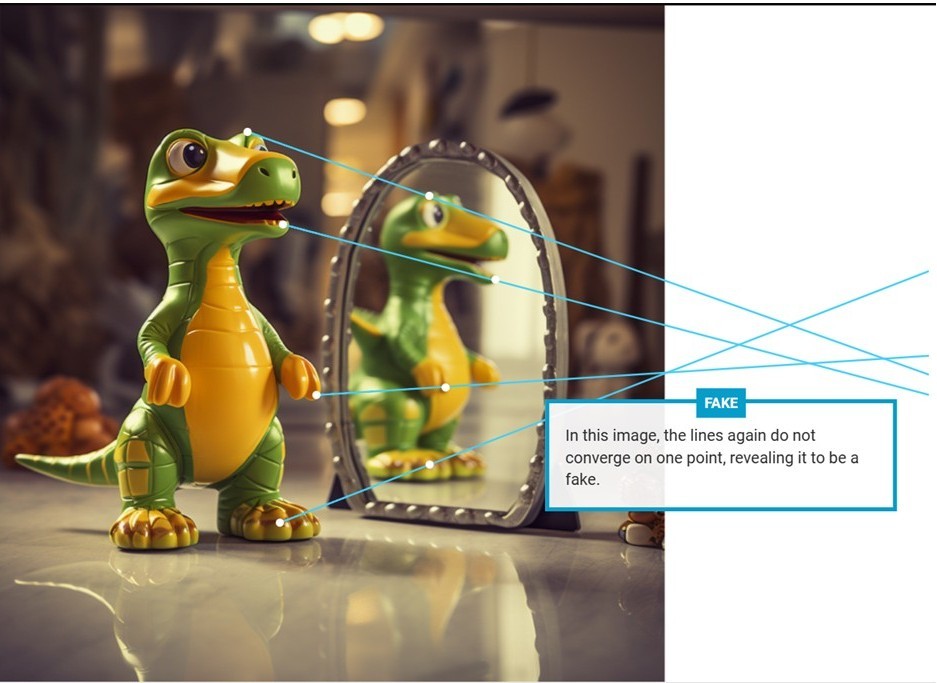
For example, in a genuine photograph, lines that are parallel in reality should converge toward the same vanishing point. Likewise, lines connecting points on an object with the corresponding points in its mirror reflection should also converge consistently according to the rules of perspective.
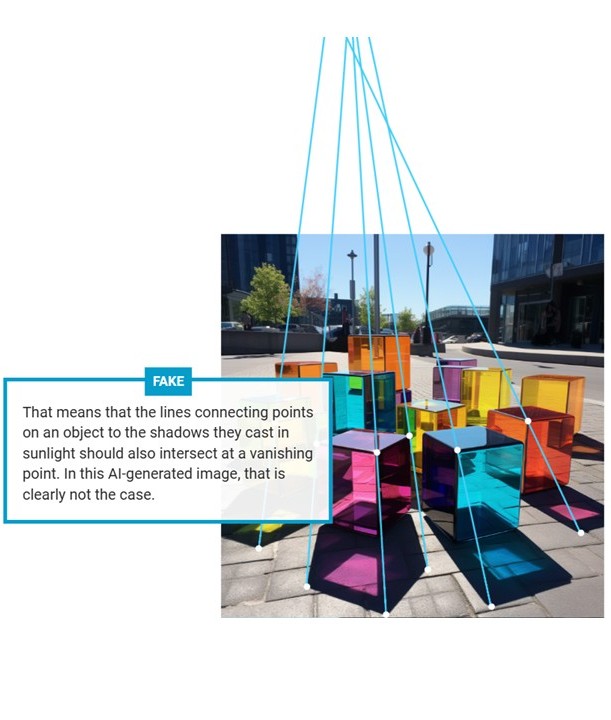
Shadows can also reveal inconsistencies. Because the Sun is so far away, its rays are effectively parallel when they reach the Earth's surface, which places strict constraints on the direction and behavior of shadows.
"Generative AI doesn't know about physics, doesn't know about geometry, and it does all kinds of crazy shit."
Source (Science): https://t.co/Kt5jJcufpm
中文译文
让物理规律正确,对AI来说也要棘手得多。
这正是我去年春天分析一些图像时注意到的事情。今天我偶然读到一篇非常有趣的文章,恰恰讨论了这个问题——图像中的物理与场景的几何。下面是一个简要的总结。
照片篡改的历史与摄影本身一样悠久。一幅著名的亚伯拉罕·林肯肖像,实际上是将林肯的头部叠加在了政客约翰·卡尔霍恩的身体上。斯大林曾以喷绘将政敌从照片中抹去。而约克郡的两个女孩则让无数人——包括阿瑟·柯南·道尔——相信她们拍摄的仙女照片是真的。
但我们如何判断一张数字图像是否真的真实?
数字取证专家哈尼·法里德(Hany Farid)意识到,每当计算机通过从现有像素外推来生成新像素时,都会留下可被检测的痕迹——像素之间的统计相关性。因此,挑战不在于"证明"图像是真实的,而在于识别不同类型的篡改所留下的痕迹。最终,他得出结论:答案在于物理学。
如今,数十亿人可以使用AI系统,在几秒钟内根据几乎任何提示生成照片般逼真的图像。早期的AI生成图像通常容易被发现,因为它们缺乏真实照片中存在的细微统计特征,例如传感器噪点或镜头瑕疵。然而,现代的图像生成器已经变得非常擅长学习和再现这些模式,甚至会添加逼真的瑕疵来模仿相机生成的图像。
然而,物理则是另一回事。
在分析一张图像时,有一个简单的问题值得一问:这个场景是否遵循现实世界的规律?
例如,在一张真实的照片中,现实中平行的线条应当汇聚到同一个消失点。同样地,将物体上的点与其镜像反射中的对应点连接起来的线条,也应根据透视规则一致地汇聚。
阴影也能揭示不一致之处。由于太阳极其遥远,当其光线到达地球表面时实际上是平行的,这严格约束了阴影的方向与表现。
"生成式AI不懂物理,不懂几何,还会做出各种疯狂的事情。"
来源(Science):https://t.co/Kt5jJcufpm
来源与署名
原文由 @mirokany 发布在 X:查看原推文。 本页逐字保留原文并提供机器翻译的中文解读;版权归原作者所有。
同工具的更多提示词
- 黑与蓝 一只威严的黑豹从旋绕的蓝宝石色薄雾中现身,光滑的午夜黑毛皮上微妙地反射着深钴蓝与电光蓝的高光,一双锐利的冰蓝色眼睛散发着沉静而强烈的光芒。这只强壮的猫…@MFH_1984
- 一张专业摄影作品,拍摄于黎明时分一条宽阔的热带河流,低薄的晨雾飘浮在如镜般平静的水面上,河岸是长着棕榈树和突出树木的丛林,柔和的粉色与金色天空完美地倒映在水面…@RockGrokAI
- 周一晚间提示词分享 #promptshare Teazy 在客厅中散发着慵懒的魅惑 Teazy,一位高挑惊艳的年轻女性,拥有白皙光滑的肤色与自然的暖色调,面部…@AIPhotoJourney
- 一个[subject]的戏剧皮影戏场景,以鲜明的剪影形式呈现于发光的羊皮纸幕布之后。可见铰接式风格化木偶造型、戏剧化的镂空轮廓、精致的操纵杆与可活动的肢体,边…@azed_ai
- 清晨咖啡 🌄☕ 在海天相接之处,开启美好的一天。🪄 Google gemini 提示词分享: 一张高质量的专业自拍照片,一位外表粗犷、面带笑容的年轻男子,手臂…@Beingsayedul
- 一位孤身侦探,在午夜时分、雨浸城市小巷中,站在一盏忽明忽暗的路灯下,身穿一件黑色长款风衣,袖口处有一抹不易察觉的血迹。暴雨穿过霓虹倒映在湿漉漉的路面,营造出阴…@myka4AI