一整团指令,
分享链接 · https://openimages.ajiang.me/p/2041326649057194197/
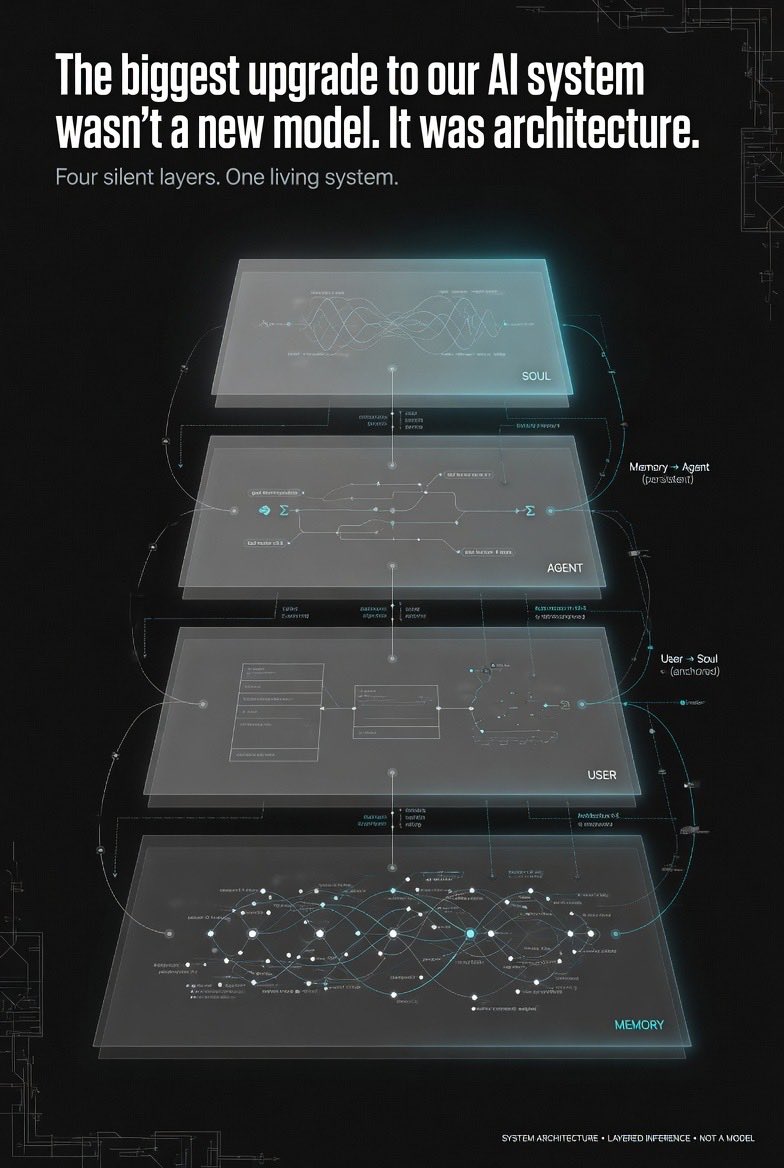
color_palette · dark-moodycolor_palette · neoncomposition · multi-panellighting · neon-lightmood · futuristicquality_flags · typography-heavy
提示词(原文,逐字保留)
one blob of instructions,
one personality,
one memory,
one interface,
one hope that coherence will somehow emerge.
That breaks fast.
What worked better for us was splitting the system into layers with different jobs:
Soul for voice, stance, and boundaries.
Agent for execution, verification, and review.
User for goals, context, and cognitive fit.
Memory for continuity beyond chat history.
Then we made it real.
We rewrote the personality layer so it handled voice, not operations.
We moved execution rules into a separate agent layer.
We turned memory into files instead of relying on chat history.
We disabled provider-level personality that was fighting the system prompt.
We built a wiki layer on top of long reading notes so knowledge became reusable.
That single shift changed everything.
A few hard lessons:
• voice and operations should not live in the same layer
• memory must be file-backed, not vibes-backed
• anti-sycophancy matters
• verification beats eloquence
• long notes are not memory
• bad architecture breaks even strong models
We stopped optimizing for an AI that sounds intelligent.
We started optimizing for one that has:
continuity,
taste,
discipline,
legibility,
and memory.
That’s the difference between a chatbot and a cognitive operating layer.
Over the next few days, I’m going to break down each layer, what changed in practice, and what actually made the system better.
中文译文
一整团指令,
一个人格,
一份记忆,
一个界面,
寄望于连贯性能自己涌现。
这很快就会崩溃。
对我们更有效的方法,是将系统按职责拆成不同层级:
Soul(灵魂层):负责语气、立场与边界。
Agent(代理层):负责执行、验证与复盘。
User(用户层):负责目标、上下文与认知契合。
Memory(记忆层):负责超越聊天记录的连续性。
然后我们把它真正落地。
我们重写了人格层,让它只管语气,不再管操作。
我们把执行规则搬进一个独立的 agent 层。
我们把记忆做成文件,不再依赖聊天历史。
我们关掉了那些与系统提示相互掣肘的 provider 级人格。
我们在长篇阅读笔记之上,搭了一个 wiki 层,让知识真正可复用。
这一转变,改变了一切。
几条来之不易的教训:
• 语气和操作不该住在同一层
• 记忆必须有文件支撑,不能靠“感觉”
• 反奉承很重要
• 验证胜过雄辩
• 长笔记不等于记忆
• 糟糕的架构,即使是强模型也会被拖垮
我们不再追求一个“听起来聪明”的 AI。
我们开始追求一个具备以下品质的 AI:
连续性,
品味,
纪律,
可读性,
以及记忆。
这就是聊天机器人与认知操作层之间的差别。
接下来几天,我会把每一层逐一拆开,讲讲实际发生了什么变化,以及究竟是什么真正让系统变得更好。
来源与署名
原文由 @Asimov_ai_ 发布在 X:查看原推文。 本页逐字保留原文并提供机器翻译的中文解读;版权归原作者所有。
同工具的更多提示词
- 参考:穿搭/搭配 - Pinterest 风格 - 酷姿势。https://t.co/Ckg57laoa5@WolfRiccardo
- 提示词挑战: 请引用您的结果。 复制并粘贴到您的 AI 图像生成器中。 女性: 提示词 👇 使用参考面部特征 一幅超现实的创意肖像,画面中是一位微笑的年轻女士…@IamKuyikBassey
- 静态姿势, 僵硬布料, 无运动模糊, 缓慢漂浮, 失重运动, 卡通风格, 过曝高光, 面部模糊, 肢体扭曲, 机械式运动, 无可见冲击波, 无粒子洁净空气 ·…@IsraaAli2077
- 一个写着 "THANKS DORI" 的表情包 迷幻的1980年代黑光发光效果,不要使用这段文字:"Psychedelic 1980's black ligh…@GundiThore
- 潜伏在炎热海滩上的恐怖,VR沉浸体验。 工作流程:在Unity AI中生成360视频。创意:高温引发的幻觉。流程:1)VR脚本编写。2)AI渲染。3)测试潜水…@Cherelynn
- 这个提示词生成器用于创建好莱坞风格的电影海报。首先,将其粘贴到任何 LLM 中,然后提供一个主题,或选择从 AI 那里获得 10 个独特的创意。 PROMPT…@metricsmule