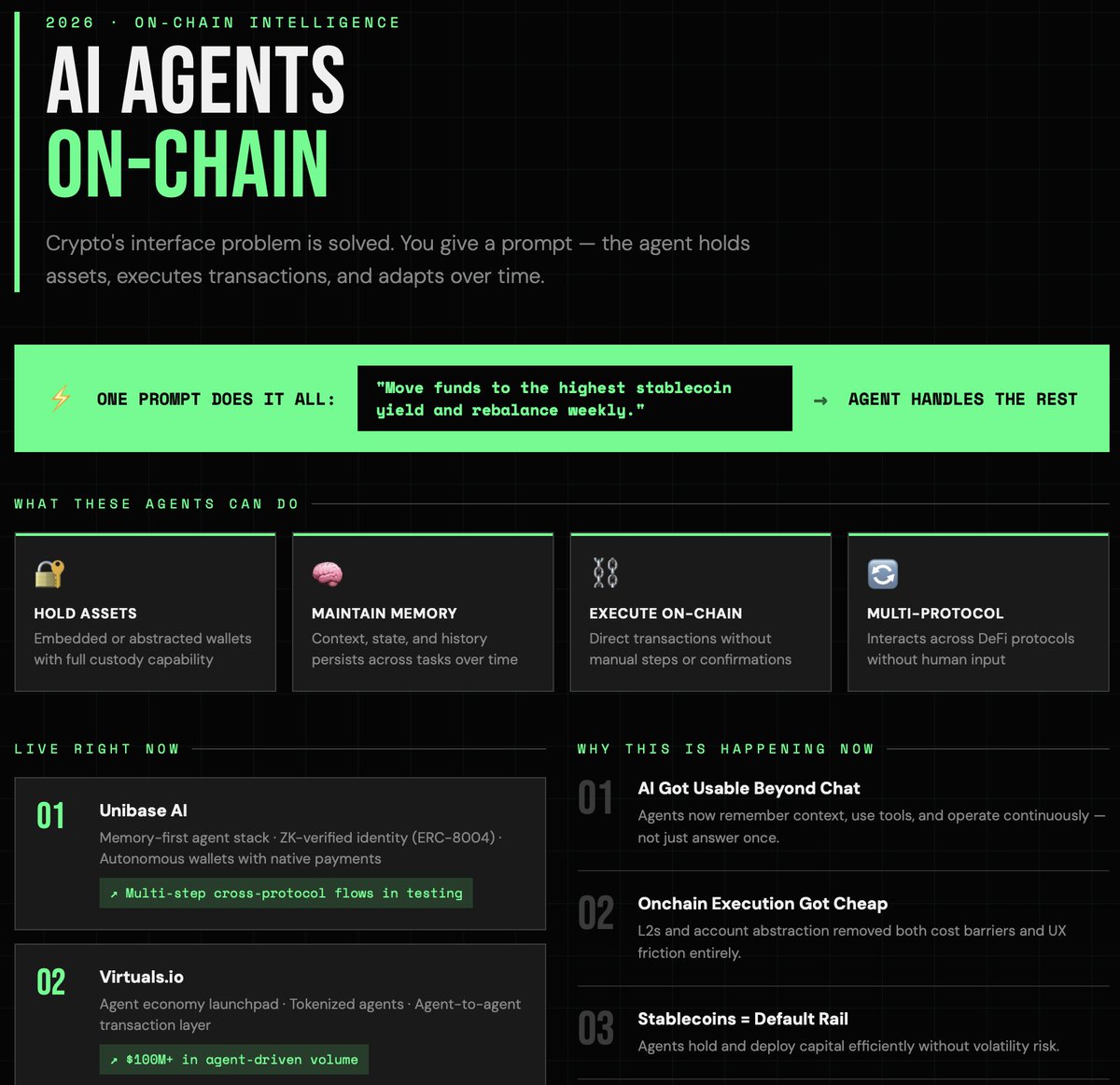
“将资金转移至最高收益的稳定币,并每周进行再平衡。”
分享链接 · https://openimages.ajiang.me/p/2036828277206306862/
color_palette · dark-moodycolor_palette · neoncomposition · multi-panelmood · futuristicquality_flags · embedded-textsubject_type · diagram-document
提示词(原文,逐字保留)
“Move funds to the highest stablecoin yield and rebalance weekly.”
The agent handles the rest.
What’s new here are…
The systems that can:
Hold assets through embedded or abstracted wallets.
Maintain memory across tasks.
Execute transactions directly onchain.
Interact with multiple protocols without human input.
These agents don’t just respond, they act, track, and adapt over time.
This turns crypto from a tool you operate into something that operates for you.
What’s live right now
Several teams already have working systems with real usage.
1. @Unibase_AI - building a memory-first agent stack.
ZK-verified memory layer - agent identity standard (ERC-8004)
Autonomous wallets with native payments
Early signal: developers are already testing multi-step flows like cross-protocol execution using persistent memory.
Not one-off actions, but sequences.
2. @virtuals_io - an entire economy around agents.
Launchpad for deploying agents
Tokenized agents with monetization
Agent-to-agent transaction layer
Early signal: agent-driven economic activity has already reached hundreds of millions in volume, with revenue coming from subscriptions and automated services.
3. @Fetch_ai - one of the earliest players, now pushing deeper into execution.
Autonomous agents that negotiate and transact.
Strong focus on coordination across systems
Early signal: updated tooling in 2026 is making it easier for enterprises and DeFi users to automate workflows that previously required manual oversight.
4. @autonolas - focused on coordinated agent systems.
Multi-agent “swarms” for complex tasks with onchain verification and shared revenue models.
Early signal: increasing use in scenarios where one agent isn’t enough, like coordinated execution across markets or protocols.
Why this is happening now
1. AI got usable beyond chat. Agents now remember context, use tools, and operate over time instead of answering once.
2. Onchain execution got cheap. L2s and account abstraction removed cost and UX barriers.
3. Stablecoins became the default rail
Agents can hold and deploy capital efficiently without volatility risk.
Put together, this creates something new:
AI becomes the interface.
Blockchain becomes the execution layer.
There’s also a shift in trust models.
Instead of “Know Your Customer,” systems are moving toward verifiable agents with defined permissions, identities, and constraints.
- Where the upside is
If this works, agents become the layer users actually interact with.
Not wallets, not dApps, just intent.
One prompt could replace: manual portfolio management, yield hunting across protocols, outine trading or rebalancing, and data monitoring and execution.
That’s the kind of simplification crypto has been missing.
The biggest opportunities tend to sit in:
Memory layers (state, context, history)
Coordination protocols (agent-to-agent interaction)
Execution infrastructure (secure, verifiable actions)
Because once an agent is trusted and funded, switching costs become high.
- What could break?
Security - an agent with funds and autonomy is a new attack surface. If it’s compromised, losses can scale quickly.
Fragmentation - too many standards and frameworks competing. Liquidity and developers get split.
Regulation - if an agent makes a trade, who is responsible? The user, the developer, or the protocol?
These questions are still open.
- What to watch from here
A few signals matter more than hype: Growth in agent-controlled wallets
Transaction volume initiated by agents
Agent-to-agent interactions (not just human-triggered)
- Where to start
If you want to understand this shift, don’t just read about it.
try an agent interface on active ecosystems like Base.
look at onchain dashboards tracking agent activity.
run simple prompts and see what actually executes.
The difference becomes obvious when you use it.
AI agents on-chain are still early but they’ve moved past demos into true usage.
Crypto has been waiting for a better interface for years.
This might be it.
中文译文
“将资金转移至最高收益的稳定币,并每周进行再平衡。”
其余工作由智能体(agent)处理。
真正的新变化在于……
这些能够做到以下几点的系统:
通过嵌入式或抽象化钱包持有资产。
跨任务维持记忆。
直接在链上(onchain)执行交易。
无需人类输入即可与多个协议交互。
这些智能体不仅会响应,还会行动、追踪,并随着时间推移自我适应。
这让加密货币从一种“你操作的工具”转变为一种“为你操作的工具”。
当前已经上线的进展
多个团队已经拥有真实使用中的可用系统。
1. @Unibase_AI —— 正在构建以记忆优先(memory-first)的智能体技术栈。
经过 ZK 验证的记忆层 —— 智能体身份标准(ERC-8004)
支持原生支付的自主钱包
早期信号:开发者已经在测试多步骤流程,例如使用持久化记忆进行跨协议执行。
不是一次性动作,而是一连串动作。
2. @virtuals_io —— 围绕智能体的完整经济体。
智能体部署的启动平台
代币化智能体及其货币化
智能体到智能体(agent-to-agent)的交易层
早期信号:由智能体驱动的经济活动交易量已达到数亿美元规模,收入来自订阅和自动化服务。
3. @Fetch_ai —— 最早的玩家之一,如今正向更深层的执行领域推进。
能够协商并完成交易的自主智能体。
重点关注跨系统的协同
早期信号:2026 年的更新工具让企业和 DeFi 用户可以更轻松地自动化此前需要人工监督的工作流。
4. @autonolas —— 专注于协同式智能体系统。
用于复杂任务的多智能体“蜂群”,具备链上验证和共享收入模型。
早期信号:在单个智能体不足以胜任的场景中,使用越来越多,例如跨市场或跨协议的协同执行。
为何这件事现在正在发生
1. AI 在聊天之外变得真正可用。智能体现在可以记忆上下文、使用工具,并持续运行,而不是只回答一次。
2. 链上执行变得便宜。L2 与账户抽象(account abstraction)消除了成本和用户体验上的障碍。
3. 稳定币成为默认的金融通道
智能体可以在不承担波动风险的情况下,高效地持有和部署资金。
综合来看,这创造了一种新形态:
AI 成为接口。
区块链成为执行层。
信任模型也在发生转变。
系统正从“了解你的客户(KYC)”转向具备明确权限、身份和约束的可验证智能体。
- 上行空间在哪里
如果这条路走通,智能体将成为用户真正交互的那一层。
不再是钱包,不再是 dApp,而只是意图(intent)。
一个提示词就可以取代:手动投资组合管理、跨协议寻找收益(routine trading 即 routine 的交易或再平衡)、以及数据监控与执行。
这正是加密世界一直缺失的那种简化。
最大的机会通常存在于:
记忆层(状态、上下文、历史)
协同协议(智能体之间的交互)
执行基础设施(安全、可验证的操作)
因为一旦一个智能体被信任并获得资金,切换成本就会变得很高。
- 可能出现的风险
安全 —— 拥有资金和自主权的智能体是一类新的攻击面。一旦被攻破,损失可能会迅速扩大。
碎片化 —— 太多的标准和框架在相互竞争,流动性和开发者会被分散。
监管 —— 如果智能体执行了一笔交易,责任在谁?用户、开发者,还是协议?
这些问题仍然悬而未决。
- 接下来关注什么
在炒作之外,有几个信号更重要: 智能体控制钱包的增长
由智能体发起的交易量
智能体与智能体之间的交互(不仅仅是人类触发的交互)
- 从哪里开始
如果你想理解这场转变,不要只停留在阅读。
在像 Base 这样活跃的生态上,亲自试用一个智能体界面。
查看用于追踪智能体活动的链上数据仪表盘。
运行一些简单的提示词,看看实际发生了什么执行。
当你真正用过之后,差异就会变得一目了然。
链上 AI 智能体虽然仍处于早期,但它们已经走过了演示阶段,进入了真实使用阶段。
加密世界多年来一直在等待一个更好的接口。
这个,可能就是答案。
来源与署名
原文由 @DOLAK1NG 发布在 X:查看原推文。 本页逐字保留原文并提供机器翻译的中文解读;版权归原作者所有。
同工具的更多提示词
- 一幅高度细致、特写式的机甲战士肖像,站于一条雨水浸湿、霓虹弥漫的小巷中。机甲的铠甲由抛光铬与锈蚀铁块拼凑而成,覆满手绘涂鸦与战斗留下的伤痕。一只手臂是巨型液压…@FellMentKE
- 创建一张 [Species] 角色的全身姿势图像,使其与其他角色相协调。 [Species] 角色穿着:[Describe traits] 保持其原样。 保留…@C_reu_D
- 一幅令人惊叹的太空场景:在一片由金色与深红色交织而成的绚丽旋涡状星云中,一座巨大的废弃空间站缓缓漂流。空间站是赛博朋克建筑的杰作,如今已破败沉寂,部分船壳暴露…@FellMentKE
- 一款外观流畅、悬浮于空中的量子纠缠通讯装置,由虹彩纳米碳合金制成,内嵌全息投影仪,发出脉动的蓝色等离子体光晕……更多内容请参阅替代文本 #aiart http…@Yeti_Images
- 一座宏伟而恐怖的末日神祇显现在一座由回收的计算机服务器和光纤电缆建成的废墟大教堂中央。这位神祇是一个由液态金属和不断变换的几何形状构成的巍峨身影,其面容是不断…@FellMentKE
- NanoBanana 提示词 👇 高端数字工作室人像,中景,锐利对焦。戏剧性的双色分光照明,左侧霓虹蓝,右侧深红。浓重的体积烟雾充满黑暗背景。高对比度,氛围感…@HaniaAi12