关于 @idolly_AI ,我觉得有一点很有趣:它并不把 AI 图像生成仅仅当作一个提示词输入框来对待。
分享链接 · https://openimages.ajiang.me/p/2033146708046061649/
color_palette · dark-moodycolor_palette · neoncomposition · multi-panelquality_flags · embedded-textquality_flags · screenshot-uisubject_type · diagram-document
提示词(原文,逐字保留)
One thing I find interesting about @idolly_AI is that it doesn’t treat AI image generation as just a prompt box.
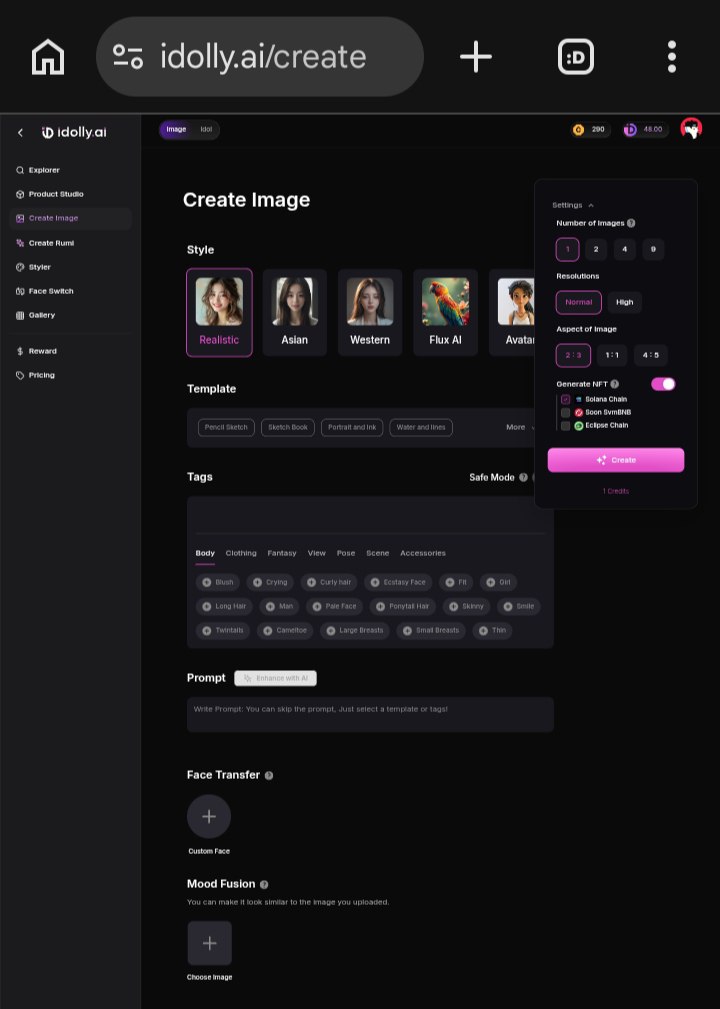
From the interface alone, you can see that the platform is trying to build a structured creative pipeline, where users move from idea → generation → customization → ownership in a much more guided way.
A few parts of the system stand out.
First is the multi-style generation layer. Instead of relying on a single general-purpose model, the platform separates generation styles such as Realistic, Asian, Western, Flux AI, and Avatar.
This might seem like a simple UI feature, but it actually reflects a deeper technical idea: style-specialized model behavior.
In generative AI, one of the biggest problems is inconsistency. A generic model often struggles to maintain a coherent aesthetic. By guiding the generation through specific style domains, the system can push the model toward more predictable visual outputs.
Second is the template-based prompt system.
Templates like Pencil Sketch, Portrait and Ink, or Water and Ink act as pre-built creative frameworks. Instead of forcing users to understand complex prompt engineering, the platform embeds style instructions directly into the generation pipeline.
Technically, this means the model already receives structured information about things like:
• drawing style
• lighting characteristics
• texture behavior
• composition patterns
This makes AI creation more accessible without sacrificing control, which is something many AI tools still struggle to balance.
Another interesting component is the tag-based attribute system.
Rather than writing long prompts, users can define visual attributes such as body type, hairstyle, pose, or accessories through selectable tags. Behind the scenes, these tags likely correspond to semantic tokens or weighted prompts within the model.
The benefit is that it reduces prompt complexity while improving consistency in character generation, which is extremely useful for creators who want to maintain a recognizable visual identity.
Then there’s the Face Transfer feature, which hints at identity preservation technology.
This likely combines facial embedding models with image-to-image generation so that a specific face can be recreated across different scenes and styles.
For creators building AI personas, virtual influencers, or recurring characters, this kind of system makes it possible to maintain character continuity without manual editing.
Another layer is the Mood Fusion feature, which allows users to upload reference images.
Reference-based generation is powerful because prompts alone often struggle to capture subtle elements like color atmosphere, emotional tone, or lighting dynamics. By feeding a reference image into the model, the AI can extract visual cues and apply them to the generated result.
In practice, this means creators can control not just what the image shows, but also how it feels visually.
Finally, one detail that shouldn’t be overlooked is the multi-chain NFT integration.
The interface suggests support for networks like Solana, BNB Chain, and Eclipse. That indicates the platform isn’t only designed for image generation, but also for direct digital asset ownership workflows.
Instead of generating an image and then moving to another platform to mint it, creators can potentially go from creation to on-chain asset in a single pipeline.
When you step back and look at the whole system, the interesting part isn’t just the AI models themselves.
It’s the attempt to build a complete creative infrastructure around them.
AI idea → structured generation → identity control → style control → digital ownership.
And if generative AI keeps expanding into creator economies, tools that simplify this entire pipeline may end up becoming far more important than the models alone.
中文译文
关于 @idolly_AI ,我觉得有一点很有趣:它并不把 AI 图像生成仅仅当作一个提示词输入框来对待。
仅从界面就能看出,该平台正在尝试构建一个结构化的创作流水线,让用户以更引导式的方式从创意 → 生成 → 定制 → 所有权逐步推进。
系统中有几个部分尤为突出。
首先是多风格生成层。平台并没有依赖单一的通用模型,而是将生成风格划分为写实(Realistic)、亚洲风格(Asian)、西方风格(Western)、Flux AI 和 Avatar 等。
这看起来可能只是一个简单的 UI 特性,但它实际上反映了一个更深层的技术理念:风格专门化的模型行为。
在生成式 AI 中,最大的问题之一就是不一致性。通用模型往往难以保持统一的美学风格。通过在特定风格领域内引导生成,系统可以推动模型输出更具可预测性的视觉结果。
第二个是基于模板的提示词系统。
像 Pencil Sketch(铅笔素描)、Portrait and Ink(肖像与墨)、或 Water and Ink(水墨)这样的模板充当预构建的创作框架。平台无需强迫用户理解复杂的提示工程,而是将风格指令直接嵌入到生成流水线中。
从技术层面来说,这意味着模型已经接收了关于以下方面的结构化信息:
• 绘画风格
• 光照特征
• 纹理表现
• 构图模式
这使得 AI 创作更加易于上手,同时不牺牲可控性——而这正是许多 AI 工具仍然难以平衡的地方。
另一个有趣的组件是基于标签的属性系统。
用户无需撰写冗长的提示词,可以通过可选择的标签来定义身体类型、发型、姿势、配饰等视觉属性。在后台,这些标签很可能对应模型内部的语义 token 或加权提示词。
这样做的好处是降低了提示词的复杂度,同时提升角色生成的一致性——这对希望保持可识别视觉形象的内容创作者来说极其有用。
接下来是 Face Transfer(面部迁移)功能,它暗示了身份保持技术。
该功能很可能将面部嵌入模型与图生图(image-to-image)生成相结合,从而让特定的面孔能够在不同的场景和风格中被复刻。
对于打造 AI 虚拟形象、虚拟影响者或反复出现的角色形象的创作者来说,这类系统使他们无需手动编辑即可保持角色的连贯性。
另一层是 Mood Fusion(情绪融合)功能,允许用户上传参考图像。
基于参考图像的生成之所以强大,是因为仅靠提示词往往难以捕捉色彩氛围、情绪基调或光影动态等细微元素。通过将参考图像输入模型,AI 可以提取视觉线索并将其应用于生成结果。
在实践中,这意味着创作者不仅能控制图像所呈现的内容,还能控制其在视觉上的"感觉"。
最后,一个不容忽视的细节是多链 NFT 集成。
界面显示支持 Solana、BNB Chain 和 Eclipse 等网络。这表明该平台不仅用于图像生成,还面向直接的数字资产所有权工作流。
创作者不再需要先在一处生成图像,再到另一个平台去铸造(mint),而是有望在一个流水线内完成从创作到链上资产的完整过程。
当你退后一步,纵观整个系统,有意思的地方并不仅仅在于 AI 模型本身。
而在于围绕它们构建一套完整创作基础设施的尝试。
AI 创意 → 结构化生成 → 身份控制 → 风格控制 → 数字所有权。
如果生成式 AI 持续向创作者经济领域拓展,那么能够简化整条流水线的工具,最终可能会比单纯的模型本身变得更加重要。
来源与署名
原文由 @0xBoysz 发布在 X:查看原推文。 本页逐字保留原文并提供机器翻译的中文解读;版权归原作者所有。
同工具的更多提示词
- 电影感人像肖像:一位英俊的年轻男子,眼神锐利呈蓝色,深棕色蓬松头发向后梳拢,额前垂下一缕散落的发丝,胡须修剪齐整。氛围阴郁的低调照明,戏剧性的明暗对比,冷蓝色…@iamsofiaijaz
- 漂浮的糖果岛、风中的丝绸,以及一场穿越超现实巧克力世界的超高速FPV飞行。 https://t.co/2SpThMiw4L > 转发 @ElevenLabs…@sulegulmenX
- 提示:将 LTXLogo 替换为你的元素,并确保使用 Flux.2. Pro 模型。 提示 2 空灵的 T 台模特身穿金属银色拉梅高级定制连衣裙,搭配夸张的裙…@carolletta
- 一只可爱的腊肠犬以侧面视角站立着,一只小小的黄色小鸟停在它的鼻子上,以手绘钢笔和墨水风格插画,搭配富有表现力的马克笔上色,通过柔和的明暗过渡暗示柔和的自然光…@heathergreen
- “宇航员骑马穿过巴黎” 硬件配置:Lenovo Legion 5 | 第 13 代 Intel® Core™ i7-13650HX x 20 | 24GB 内…@Palagov_dot_TV
- 宇航员骑着马在特拉维夫,导弹如雨般从天空落下 写实风格@Palagov_dot_TV