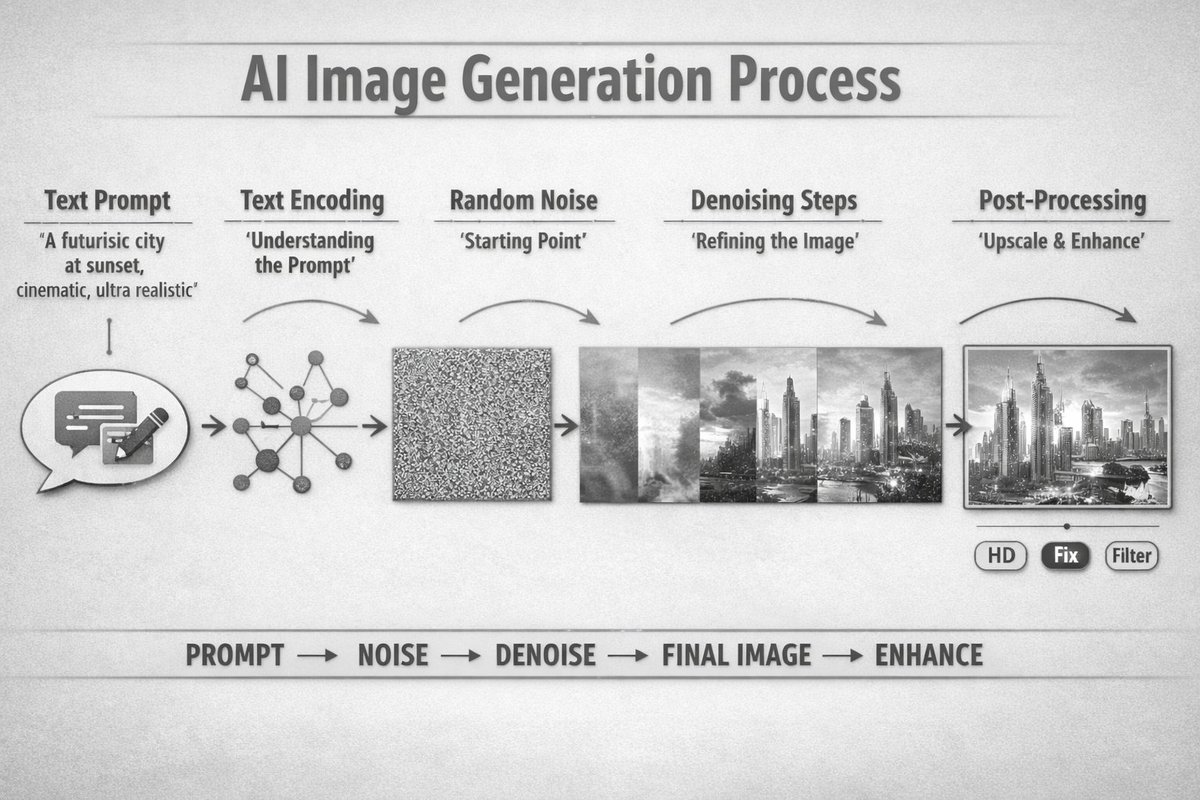
AI 图像生成的循环通常是这样工作的:
分享链接 · https://openimages.ajiang.me/p/2030469542124626041/
color_palette · monochromecolor_palette · white-minimalcomposition · multi-panelquality_flags · typography-heavysubject_type · diagram-documentusage · presentation
提示词(原文,逐字保留)
The AI image generation cycle usually works like this:
1. You give it a prompt
Example:
a futuristic city at sunset, cinematic, ultra realistic
The AI receives your text and tries to understand:
the objects
the style
the mood
the composition
the visual details
2. The text is turned into a numerical representation
The prompt is not read like a human reads it.
It is converted into numerical vectors that capture the meaning of the words and the relationships between them.
For example:
city suggests buildings, streets, skyline
sunset adds warm colors and low light
cinematic influences the visual style
3. The model often starts from random noise
In many modern systems, especially diffusion models, the image does not begin as a clean picture.
It starts as something like random visual noise.
4. The AI gradually removes the noise
This is the core of the process.
At each step, the model asks:
If this image is supposed to match the prompt, what should a slightly less noisy version look like?
Then it repeats this process many times:
full noise
blurry shapes
rough forms
clearer objects
fine details
final image
5. The model guides the image toward the prompt
During the denoising process, the AI keeps aligning the image with the meaning of the text.
So it keeps adjusting:
shape
color
lighting
texture
overall coherence
That is why the prompt strongly affects the final result.
6. The latent image becomes a visible image
In many systems, the model first works in a compressed space called latent space.
Then a decoder turns that compressed version into a visible pixel image.
7. Extra steps can be added
Depending on the system, there may also be:
upscaling to increase resolution
inpainting to modify a specific area
face enhancement to improve faces
color correction to refine the look
safety filtering to block certain content
Ultra simple version
The cycle is:
prompt
→ text understanding
→ random noise
→ gradual denoising
→ alignment with the prompt
→ final image
One sentence summary
An AI image generator takes a text prompt, converts it into mathematical meaning, often starts from random noise, and then transforms that noise step by step into an image that matches the prompt.
中文译文
AI 图像生成的循环通常是这样工作的:
1. 你给它一个提示(prompt)
示例:
a futuristic city at sunset, cinematic, ultra realistic
AI 接收到你的文本,并试图理解:
objects(物体)
style(风格)
mood(氛围)
composition(构图)
visual details(视觉细节)
2. 文本被转化为数值表示
提示(prompt)不会被像人类阅读那样被读取。
它会被转换为数值向量(numerical vectors),这些向量捕捉了词语的含义以及它们之间的关系。
例如:
city(城市)暗示 buildings(建筑)、streets(街道)、skyline(天际线)
sunset(日落)增加暖色调和低光照
cinematic(电影感)影响视觉风格
3. 模型通常从随机噪声开始
在许多现代系统中,尤其是扩散模型(diffusion models),图像并不是从一张干净的图片开始的。
它从类似随机视觉噪声的东西开始。
4. AI 逐步去除噪声
这是整个过程的核心。
在每一步,模型都会问:
如果这张图像应该匹配这个提示(prompt),那么一个稍微少一些噪声的版本应该是什么样的?
然后它会多次重复这个过程:
full noise(完全噪声)
blurry shapes(模糊的形状)
rough forms(粗糙的轮廓)
clearer objects(更清晰的物体)
fine details(精细的细节)
final image(最终图像)
5. 模型将图像引导向提示(prompt)
在去噪过程中,AI 持续让图像与文本的含义保持一致。
因此它不断调整:
shape(形状)
color(颜色)
lighting(光照)
texture(纹理)
overall coherence(整体一致性)
这就是为什么提示(prompt)会对最终结果产生强烈影响。
6. 潜在图像(latent image)变为可见图像
在许多系统中,模型首先在一个被称为潜在空间(latent space)的压缩空间中工作。
然后解码器(decoder)将该压缩版本转换为可见的像素图像。
7. 可以添加额外的步骤
根据系统的不同,可能还会有:
upscaling(放大)以提高分辨率
inpainting(局部重绘)以修改特定区域
face enhancement(面部增强)以改善人脸
color correction(色彩校正)以精修外观
safety filtering(安全过滤)以屏蔽某些内容
超简单版本
整个循环是:
prompt(提示)
→ text understanding(文本理解)
→ random noise(随机噪声)
→ gradual denoising(逐步去噪)
→ alignment with the prompt(与提示对齐)
→ final image(最终图像)
一句话总结
AI 图像生成器接收一个文本提示(prompt),将其转化为数学化的含义,通常从随机噪声开始,然后逐步将这种噪声转变为与提示(prompt)匹配的图像。
来源与署名
原文由 @techniahq 发布在 X:查看原推文。 本页逐字保留原文并提供机器翻译的中文解读;版权归原作者所有。
同工具的更多提示词
- 🧠 Kaplex 中的图像生成工作原理 大多数 AI 图像工具只给你一个空白提示框。 而 Kaplex 使用结构化工作流。 流程如下 👇 1️⃣ 创建项目 奠…@usekaplex
- { "image_generation_prompt": { "scene_overview": "大规模核爆炸后片刻的超写实电影级现代城市废墟场景。", "…@Fujimoto_hina
- { "图像生成提示词": { "主体": { "实体": "巨大无比的巨人", "特征": { "面部": "参考用户上传照片,100%还原面部细节", "表…@Fujimoto_hina
- 一幅时装秀场插画,灵感源自[subject]的造型,展示了[color1]和[color2]的高级时装面料色卡,伴有戏剧性的灯光、夸张的姿态,以及两侧带有铅笔…@azed_ai
- { "image_generation": { "subject": { "description": "一位美丽的年轻女子站在繁华的好莱坞街头,面对人生的冒…@WallPapers360
- { "image_generation_prompt": { "style": "电影感时尚编辑摄影", "aspect_ratio": "4:5", "re…@AFantagirl85190